Digital marketing feels like a big, complex world. You hear terms like SEO, PPC, and SMM. It can seem overwhelming. Where do you even begin? Yet, learning digital marketing has never been more important. In 2025, global digital ad spending is projected to surpass $1.08 trillion, accounting for about 73% of all advertising revenue. Over 5.4 billion people now use social media, that’s nearly two-thirds of the world’s population. Organic search drives more than half of all website traffic, while email marketing continues to deliver one of the highest returns — around $36 for every $1 spent. These numbers show how powerful and essential digital marketing has become for businesses of all sizes.
This post will walk you through the core pillars of digital marketing. You will learn about finding your audience online. We will cover making your website easy to find on Google. You will discover how to use social media for your business. We will explore paid ads and how they work. You will also see why email marketing is still so powerful. Let’s start this journey together.
What is Digital Marketing?
First, let’s define digital marketing. It is any marketing effort that uses an electronic device or the internet. Businesses use digital channels such as search engines, social media, email, and websites to connect with customers. The goal is to reach people where they spend most of their time — online.
As of 2025, there are about 5.56 billion internet users worldwide, representing nearly 68% of the global population. On average, people now spend around 6 hours 38 minutes per day online, making the digital space one of the most effective places to reach audiences.
Think about traditional marketing. Billboards, magazine ads, and TV commercials are examples. Digital marketing takes a similar idea to the online space. Instead of a billboard, you have a banner ad on a website. Instead of a TV commercial, you have a YouTube or TikTok video ad.
The difference is huge. Digital marketing helps you target specific audiences. More than 70% of companies track their campaigns in real time to improve results. This makes digital marketing a powerful tool for businesses of all sizes. It can deliver up to 5 times more return on investment than untargeted ads.
Why Digital Marketing Matters
You might wonder why this shift to online is so important. People’s habits have changed. We use our phones and computers for everything. We search for information, shop for products, and connect with friends online. In fact, as of 2025, the average person spends more than 6 hours a day online. Businesses need to be where their customers are. That place is the digital world.
Digital marketing also offers a better return on investment for many companies. Over 90% of marketers say data-driven marketing is crucial for success. You can start with a small budget. You can test different ideas. You can see what works and what does not. This data helps you make smarter decisions. It helps you spend your money more effectively. For a beginner, this is great news. You don’t need a massive budget to get started.
Understanding the Core Marketing Channels
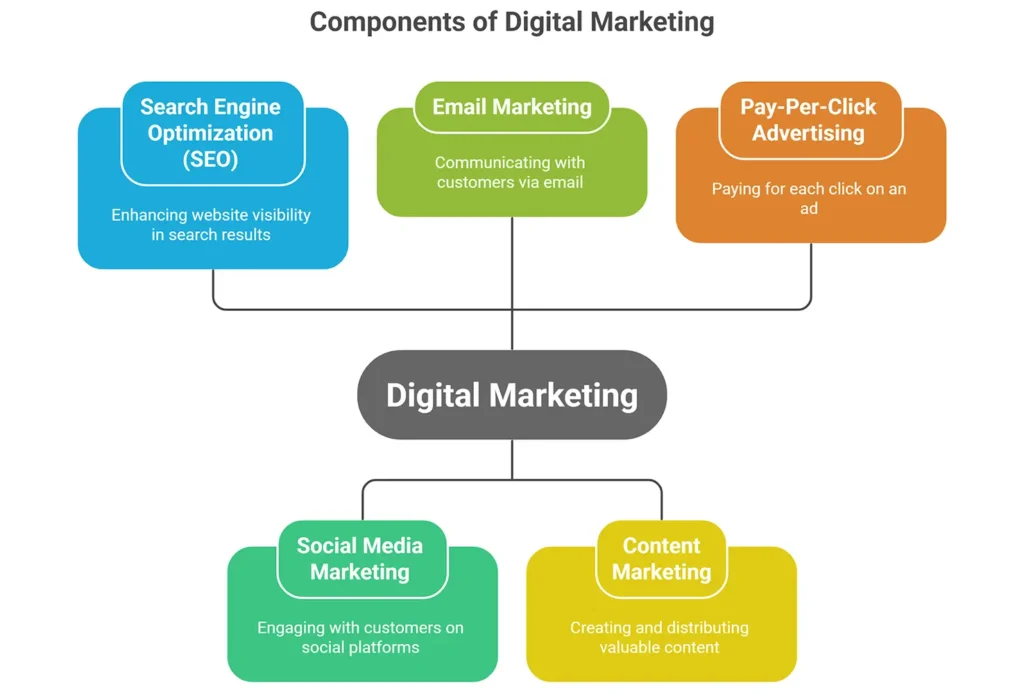
Digital marketing is not just one thing. It is a collection of different strategies and tactics. We call these “marketing channels.” Each channel is a different way to reach your audience. Some digital marketing channels work better for certain goals than others. A strong digital marketing strategy often uses a mix of channels. Around 72% of marketers say a balanced multi-channel approach improves customer engagement.
Let’s explore the most important channels for beginners.
1. Search Engine Optimisation (SEO)
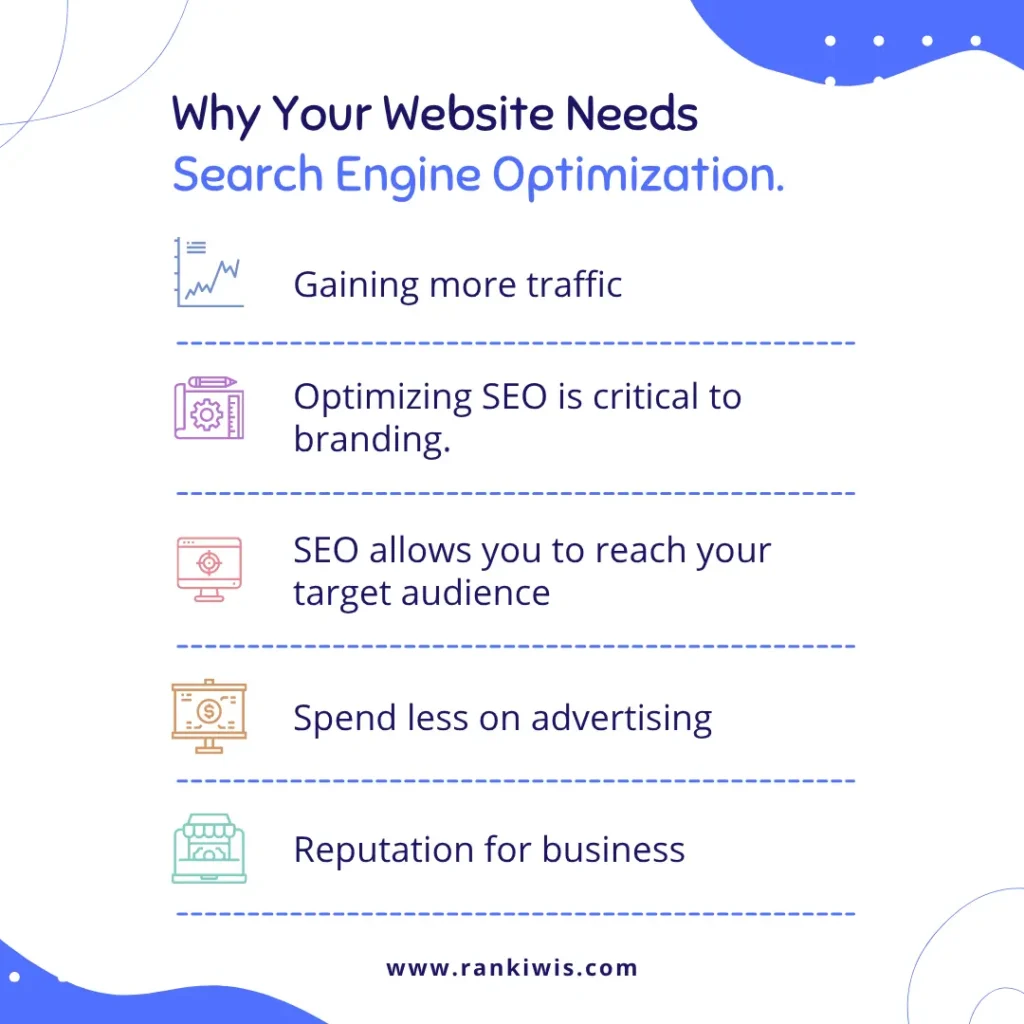
Search Engine Optimisation, or SEO, is the process of improving your website to rank higher in search engine results. When people search for words related to your business on Google, you want your site to appear on the first page. SEO makes that happen. It’s all about making your website more visible. For free.
How SEO Works
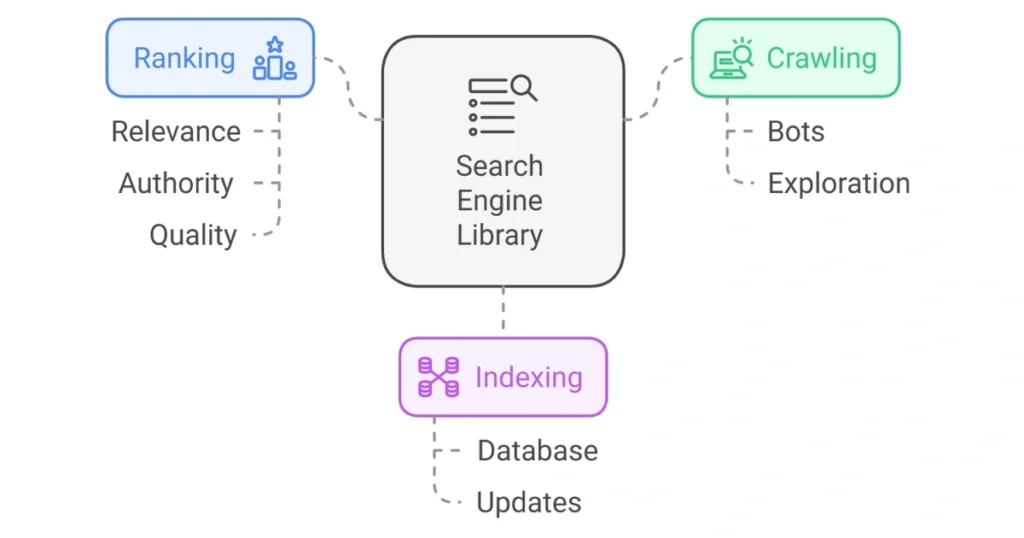
Search engines like Google use bots to “crawl” the web. These bots go from site to site, collecting information. They index this information to build a massive library of the internet. When someone searches, the search engine pulls the most relevant results from its library.
SEO helps search engines understand that your page is the best answer for a particular search. Around 68% of online experiences start with a search engine, so showing up in those results matters.
There are two main parts to SEO:
- On-Page SEO: This involves optimising elements on your website. You focus on things like keywords, page titles, headers, and the quality of your content. You make sure your website loads quickly and is easy to use on mobile devices. Good on-page SEO helps search engines understand what your content is about.
- Off-Page SEO: This involves activities outside of your website. The most important part is building backlinks. A backlink is a link from another website to yours. When a reputable website links to you, it tells search engines that your site is trustworthy and valuable. Think of it as a vote of confidence.
Getting Started with SEO
As a beginner, you can start with the basics. First, think about what your potential customers are searching for. These search terms are your keywords. Use free tools like Google Keyword Planner to find ideas.
Next, create high-quality content around these keywords. Write blog posts, create guides, or make videos that answer people’s questions. Place your main keyword in your page title, in your headings, and a few times in your text. Make sure your content is genuinely helpful. That is the most important rule.High-quality content is still one of the top Google ranking factors.
Finally, make sure your website is technically sound. It should be fast and mobile-friendly. You can use Google’s PageSpeed Insights tool to check your website’s performance for free. A one-second delay in load time can reduce conversions by up to 7%. These first steps build a strong foundation for your digital marketing efforts.
2. Content Marketing
Content marketing works hand-in-hand with SEO. It is the strategy of creating and sharing valuable content to attract and retain an audience. Recent studies show that content marketing generates 3x more leads than traditional marketing, while costing 62% less. This content can be blog posts, videos, podcasts, infographics, and more. The goal is not to directly sell your product or services. The goal is to provide value. To build trust.
When you consistently provide helpful information, people start to see you as an expert. They trust your brand. Brands that publish consistent content see up to 6x higher conversion rates. When they are ready to buy, you will be the first one they think of. That is the power of content marketing.
Types of Content to Create
The type of content you create depends on your audience and your business. Here are a few popular formats:
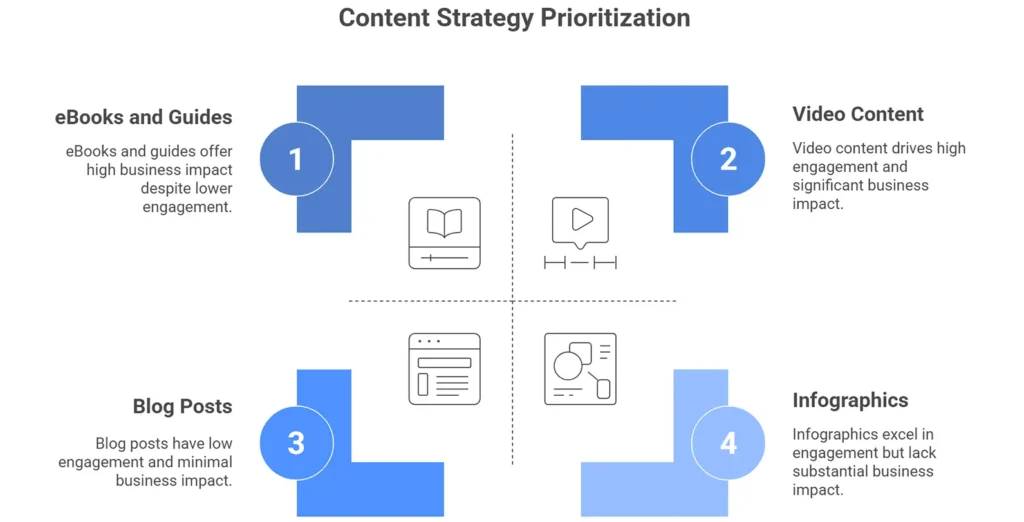
- Blog Posts: Blogs are a fantastic way to share your knowledge. You can answer common questions, provide tutorials, and share industry news. They are also great for SEO. Blogs get 55% more website visitors on average.
- Videos: People love video content. You can create how-to videos, product demos, or behind-the-scenes looks at your business. Platforms like YouTube and TikTok are huge. Video content is expected to make up over 82% of all internet traffic.
- eBooks and Guides: For more in-depth topics, you can create a longer piece of content like an eBook. People can download it in exchange for their email address. This is a great way to generate leads.Long-form content like guides can boost engagement by up to 40%.
- Infographics: These are visual representations of information. They are easy to share on social media and can make complex data simple to understand. Infographics are shared 3x more than any other type of content on social media.
A Simple Content Marketing Strategy
You do not need to create every type of content. Start small. Pick one or two formats that feel right for you and your audience. A blog is often the best place to start.
Your strategy should be simple. First, identify your audience’s pain points. What problems are they trying to solve? What questions do they have? Second, brainstorm content ideas that address those problems. Third, create a content calendar. Plan what you will publish and when. Consistency is key.
Businesses posting weekly experience 2x more website traffic compared to those who post less often. Try to publish new content regularly, even if it’s just once a week. This focus on content is a core part of a good digital marketing plan.
3. Social Media Marketing (SMM)
Around 71% of consumers are more likely to recommend a brand they follow on social media. Social Media Marketing is the use of social media platforms to connect with your audience. You can build your brand, increase sales, and drive traffic to your website. Popular platforms include Facebook, Instagram, X (formerly Twitter), LinkedIn, and TikTok.
Each platform has its own unique audience and style. You do not need to be on every single one. The key is to find out where your target audience spends their time. Then, you can focus your efforts there.
- Current User Count: As of early to mid-2025, the number of global social media users is approximately 4.9 billion.
- Growth Trend: The number of social media users has seen significant growth, expanding by 79.1% since 2017.
- Future Projections: The user base is expected to continue growing, with forecasts projecting 5.85 billion users by 2027.
Choosing the Right Platforms
- Facebook: Facebook remains the largest platform with over 3 billion monthly active users. It’s good for building a community and sharing different types of content, from text updates to videos.
- Instagram: This is a highly visual platform. Instagram drives over 70% of consumer shopping decisions, and 90% of users follow at least one business.
- LinkedIn: Most industry reports suggest LinkedIn generates between 40-80% of B2B social media leads.This is the professional network. It is the best platform for B2B (business-to-business) companies. You can connect with other professionals and share industry insights.
- TikTok: This platform is all about short, entertaining videos. TikTok has grown very quickly and now has over 1.5 billion monthly users worldwide. It attracts a younger audience, with around 36% aged 18-24 and about 34% aged 25-34, meaning roughly two-thirds of users are under 35. This makes TikTok a powerful platform.
- YouTube: YouTube’s audience is fairly balanced, with 54.4% male and 45.6% female users. The largest age group is 25‑34, making up 21.5% of viewers. As of mid‑2025, YouTube has over 2.7 billion monthly active users worldwide. It’s a key platform for brand awareness, share tutorials, reviews, and educational content creation, and drive traffic to their websites.
Your First SMM Steps
Once you have chosen one or two platforms, create your business profiles. Fill them out completely with accurate information and good-quality images.
Then, start sharing content. You can share your blog posts, interesting articles from others, or create content specifically for that platform. Engage with your followers. Respond to comments and messages. Ask questions. Run polls. The goal is to build a relationship with your audience. Social media is a two-way conversation. It is one of the most direct marketing channels you can use.
4. Pay-Per-Click (PPC) Advertising
Pay-Per-Click, or PPC, is a form of online advertising where you pay a fee each time someone clicks on one of your ads. It is a way of buying visits to your site, rather than “earning” those visits organically through SEO.
One of the most common types of PPC is search engine advertising. You can place ads at the top of Google’s search results. When someone searches for a keyword you have bid on, your ad might appear. This is a fast way to get in front of potential customers who are actively looking for what you offer.
How PPC Works
You use platforms like Google Ads or Microsoft Advertising. You choose the keywords you want to target. You create ads that will show up for those keywords. You also set a budget for how much you are willing to spend.
The platform runs an auction every time a search happens. It considers your bid and the quality of your ad to decide which ads to show. You only pay when someone actually clicks on your ad. This makes it a very controlled and measurable way to advertise.
Is PPC Right for a Beginner?
PPC can deliver quick results. Unlike SEO, which takes time, you can start getting traffic almost immediately. That is its biggest advantage.
However, there is a learning curve. It is easy to waste money if you don’t know what you’re doing. As a beginner, it is wise to start with a very small budget. Focus on a small number of highly relevant keywords. Test different ad copy to see what works best. Carefully track your results. See how many clicks turn into actual customers. PPC is a powerful marketing channel, but it requires careful management.
Statistical benchmarks you should know:
- Average click-through rate (CTR) for search ads across industries: ~6.42%
- Average cost-per-click (CPC) for search ads: $4.66 USD
- Average conversion rate (CVR) for search ads across industries: ~6.96%
- Average conversion rate for search ads in 2025: ~7.52%
- Average conversion rate for e‑commerce search ads: ~2.81%

5. Email Marketing
Email marketing is one of the oldest forms of digital marketing. It is also one of the most effective. It involves sending emails to a list of subscribers to promote your business, share news, or build relationships.On average, email marketing has a return on investment (ROI) of $36 for every $1 spent.
The people on your email list have given you permission to contact them. They are already interested in what you have to say. This makes them a highly engaged audience. You own this list. Unlike your social media followers, no algorithm change can take your audience away from you.
Building Your Email List
You cannot just email random people. That is called spam. You need to build a list of people who want to hear from you. How do you do that?
You offer something valuable in exchange for their email address. This is often called a “lead magnet.” It could be:
- A discount coupon
- A free eBook or guide
- A helpful checklist
- Access to an exclusive webinar
Place a sign-up form on your website. Make it easy for people to subscribe. Promote your lead magnet on your blog and social media. Emails with personalized subject lines have 26% higher open rates.
What to Send in Your Emails
Once you have a list, you need to nurture it. Do not just send sales pitches. Your emails should provide value.
- Welcome Series: Send a series of automated emails to new subscribers. Introduce your brand and set expectations.
- Newsletters: Send regular updates with your latest blog posts, company news, or helpful tips.
- Promotional Emails: You can send emails about sales, new products, or special offers. Just make sure you balance them with valuable, non-promotional content.
Email marketing open rates average 21.5%, and click-through rates (CTR) are around 2.9% across industries. It helps to build a long-term relationship. Treat your subscribers’ inboxes with respect. Send them content they will find useful. This marketing channel can become your most valuable asset.
Frequently Asked Questions
Is it hard to become a digital marketer?
No, it is not hard if you take it step by step. The basics are easy to learn, and there are many free resources online. Start small, practice what you learn, and improve over time.
How long does it take to learn digital marketing?
Most people can learn the basics in a few months. Deeper skills, like building campaigns or using advanced tools, can take longer. You get better with practice, so keep learning and testing new ideas.
How do beginners start digital marketing?
Start by learning one marketing channel at a time, like SEO or social media marketing. Create your own website or blog and use it to practice. Follow free online guides and join forums to ask questions.
How much does a digital marketer earn?
Salaries vary. Beginners might start at $35,000 to $50,000 a year in the US. With experience, digital marketers can earn $70,000 or more. Freelancers charge by project or by the hour, so income can be higher or lower.
How to start a career with digital marketing?
Learn the basics first, then build a simple website or help a local business with online marketing. Update your resume and LinkedIn profile with your new skills. Apply for internships or entry-level positions to gain real experience.
Putting It All Together: Your First Digital Marketing Plan
You have learned about the five core marketing channels: SEO, content marketing, SMM, PPC, and email marketing. Now, how do you combine them into a plan? You do not need to do everything at once.
Here is a simple plan for a beginner with no experience:
- Start with a Website and a Blog: Your website is your online home base. A blog is the engine for your content marketing and SEO. Focus on creating a simple, clean website.
- Focus on Content and SEO: Begin by researching keywords for your industry. Write 2-4 high-quality blog posts based on those keywords. This is your foundation.
- Choose One Social Media Platform: Pick the platform where your audience is most active. Share your blog posts there. Engage with people. Build a small community.
- Build Your Email List: Create a simple lead magnet, like a checklist. Add a sign-up form to your website. Start collecting emails from day one.
- Test with a Small PPC Budget (Optional): Once you have some content and a clear offer, you can experiment with PPC. Set a very small daily budget, like $5 or $10. Drive traffic to your best blog post or a specific product landing page. See what happens.
- Measure and Learn: Use free tools like Google Analytics. See where your website traffic is coming from. See which blog posts are most popular. Learn from the data and adjust your plan.
This step-by-step approach prevents you from feeling overwhelmed and helps you build momentum gradually. Each piece supports the others:
- Your blog content fuels your SEO and provides material to share on social media.
- Your social media presence drives traffic and helps grow your email list.
- Your email list gives you a direct line to your most loyal fans.
Digital marketing is a marathon, not a sprint. It takes time and consistent effort. The great thing is that you can learn by doing. Start with these basics, stay curious, and keep learning. You have the power to build an online presence from scratch, even with no experience. You just need to take that first step. Do you have questions or need guidance? Book a free consultation with the Rankiwis team and start your digital marketing journey today!