Digital marketing feels like a maze the first time you look at it. SEO, PPC, SMM, GEO, the acronyms pile up fast, and it’s easy to freeze before you’ve picked a starting point. That hesitation is normal. The timing, though, works in your favor. Global advertising spend crossed one trillion US dollars for the first time in 2026, and digital channels now account for close to 69 percent of that investment. Right now, figuring out how to start digital marketing isn’t a gamble. It’s catching up to where the money, and the customers, already are.
This guide breaks digital marketing into five channels you can genuinely learn: SEO, content marketing, social media, paid ads, and email. You’ll also see how AI search tools like ChatGPT and Google’s AI Overviews are reshaping the rules, a shift most beginner guides skip entirely. By the end, you’ll have a simple first plan for putting these pieces together, even with zero experience.
Table of Contents
What Is Digital Marketing?
Digital marketing is any marketing effort delivered through an electronic device or the internet. It covers search engines, social platforms, email, and websites, all aimed at reaching people where they already spend their time. For a business, that means meeting customers on their phones and laptops instead of waiting for them to walk past a billboard.
As of April 2026, roughly 6.12 billion people use the internet worldwide, close to 74 percent of the global population, according to DataReportal’s Digital 2026 research. That’s not a niche audience anymore. It’s most of the planet.
Think about traditional marketing for a second. Billboards, magazine spreads, TV spots. Digital marketing takes that same instinct online. A billboard becomes a banner ad. A TV commercial becomes a YouTube pre-roll or a TikTok clip. The underlying job, earn attention, build trust, hasn’t changed. Only the medium has.
The real advantage is precision. A billboard reaches everyone who drives past it and hopes for the best. A digital campaign can target a specific age group, city, or interest, and you’ll see whether it’s working within days, not months.
Why Digital Marketing Matters Right Now
Digital marketing matters now because customer attention has already moved online, and AI tools are starting to answer questions before shoppers ever land on a website. Businesses that build visibility across search, social, and AI-generated answers reach customers earlier in the decision process than those relying on a single channel.
Here’s the part most beginner guides miss entirely. Search itself is changing. When Google shows an AI Overview above the regular results, fewer people click through to any website, though the picture is more nuanced than the “SEO is dying” headlines suggest. Seer Interactive’s ongoing tracking of over 5 million queries found organic click-through rates on AI Overview searches compressed hard through 2025, then partly recovered in early 2026, climbing from roughly 1.3 percent in December to 2.4 percent by February.
A citation inside that AI Overview still delivers about 120 percent more clicks than showing up uncited on the same results page, though even a citation still underperforms a plain, no-AI-Overview result by around 38 percent. That’s not a reason to skip SEO. It’s a reason to understand, from day one, that ranking well and getting cited by AI engines are becoming two related but separate skills. More on that shortly.
The good news for beginners: you don’t need a big budget to start. Pick one channel, run a small test, watch what happens, then adjust. Digital marketing rewards people who learn by doing far more than people who wait until they feel ready.
The Core Digital Marketing Channels for Beginners
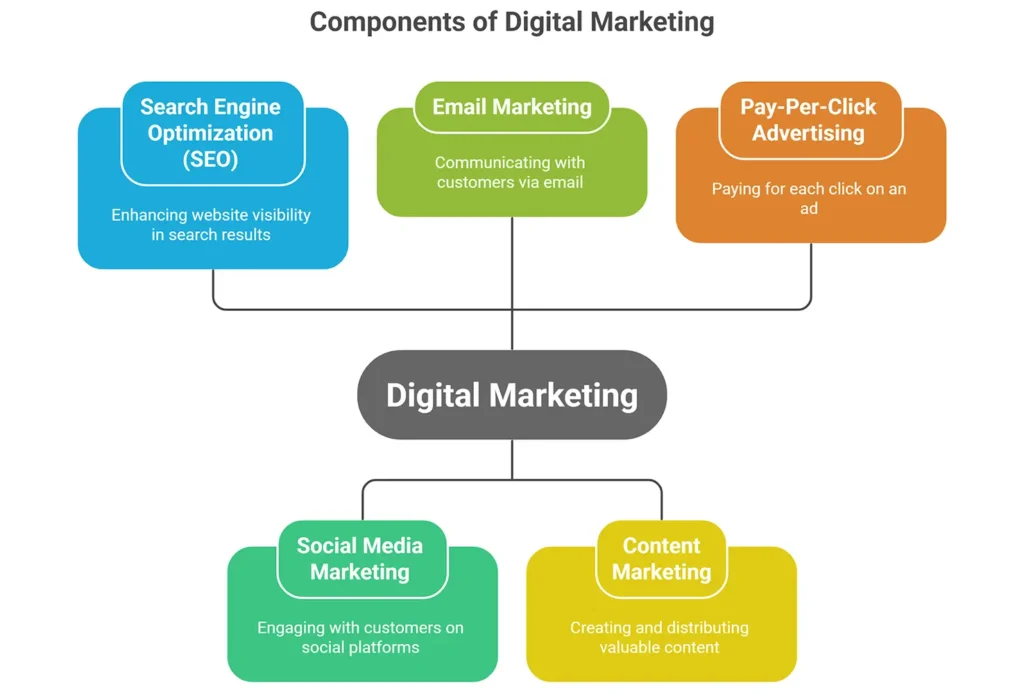
Digital marketing isn’t one skill. It’s a set of channels, and each one earns attention in a different way. Most businesses eventually use a mix, but a beginner shouldn’t try to learn all of them at once. Here are the five worth learning first, followed by a few others worth knowing about.
1. Search Engine Optimization (SEO)
Search engine optimization, or SEO, is the process of improving a website so it ranks higher in unpaid search results. When someone searches a term related to your business, SEO increases the odds your page appears on page one, without paying for the click.
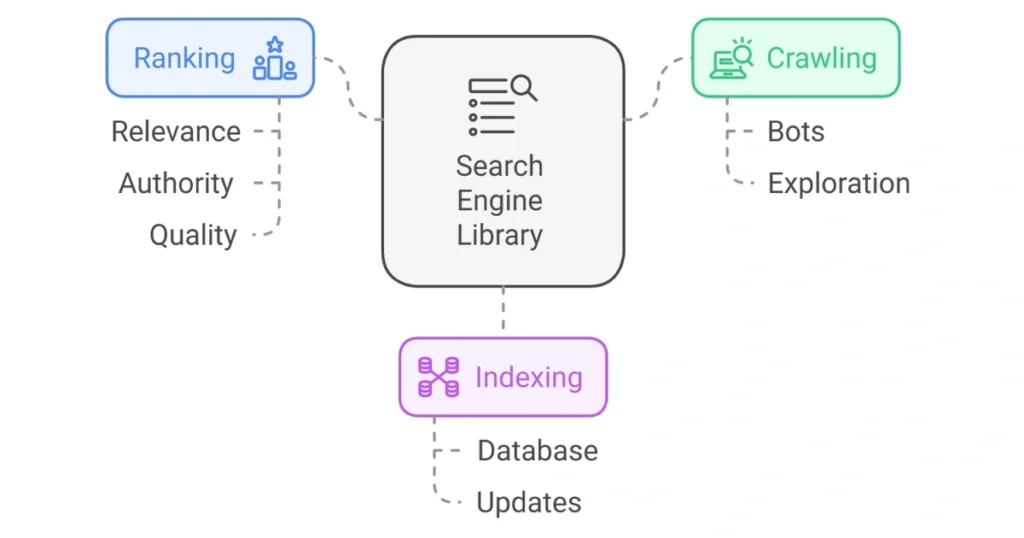
How SEO works. Search engines send out bots that crawl the web, following links from page to page and building an index of what’s out there. When someone searches, the engine pulls what it judges to be the most relevant, trustworthy pages from that index. SEO is how you help a search engine recognize your page as one of those answers.
SEO splits into two main pieces:
- On-page SEO covers everything you control directly on your own pages: titles, headings, content quality, page speed, and mobile usability. It’s about making a page’s topic and value unmistakable to both readers and search engines.
- Off-page SEO covers activity outside your website, mainly backlinks. When another reputable site links to yours, it works like a vote of confidence that tells search engines your content is worth trusting.
How to start with SEO
Begin with what your potential customers are actually typing into Google. That’s the start of keyword research, and free tools like Google Keyword Planner give you a starting list of terms to target. From there, write content that genuinely answers the question behind each keyword rather than just repeating it. Helpful, specific content still beats keyword density every time, and it’s what turns page-one visibility into real organic traffic over time.
One more thing worth knowing from the start: SEO and GEO (Generative Engine Optimization) share the same foundation, clear structure, real expertise, credible sources, but they aim at different targets. SEO earns a ranking. GEO earns a citation inside an AI-generated answer. Build both into your content from the start, and you won’t need to retrofit it later. See GEO vs SEO for the full breakdown.
2. Content Marketing
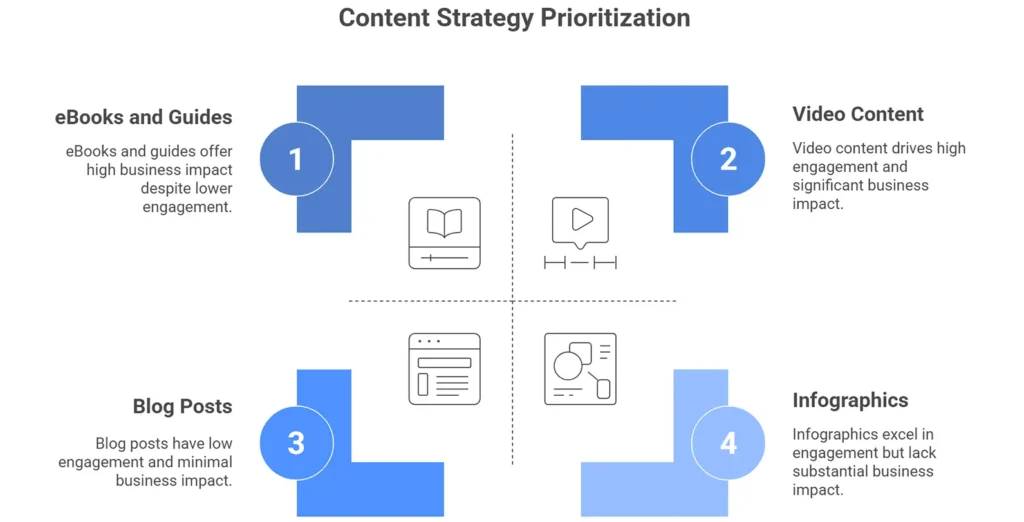
Content marketing means creating and sharing useful content, blog posts, guides, videos, that attracts and holds an audience without selling to them directly. The goal is to earn trust first. When that audience is ready to buy, they think of the business that already helped them for free.
Content marketing and SEO work as a pair. SEO gets the content found. Content marketing gives people a reason to stay, come back, and eventually convert.
A few formats worth trying as a beginner:
- Blog posts for answering common customer questions in depth. They’re also the easiest format to optimize for SEO.
- Short videos for tutorials, product demos, or behind-the-scenes content. Video consumption keeps growing across YouTube, TikTok, and Instagram Reels.
- Guides or checklists for topics that need more depth than a blog post allows, often exchanged for an email address to build your list.
Start with one format, not four. A blog is usually the easiest place to build momentum, because it feeds your SEO and gives you material to repurpose across every other channel. For the full framework, including pillar content and a content calendar template, see the content marketing strategy playbook.
3. Social Media Marketing (SMM)
Social media marketing uses platforms like Facebook, Instagram, LinkedIn, and TikTok to build a brand, reach new customers, and drive traffic back to a website. As of April 2026, social platforms reach roughly 5.79 billion user identities worldwide, close to 70 percent of the global population, according to DataReportal.
You don’t need to be on every platform. You need to be where your specific audience already spends time, and nowhere else.
- Facebook and Instagram work well for community building and visual products, from text updates to short-form video.
- LinkedIn is the strongest platform for B2B companies and professional networking.
- TikTok favors short, entertaining video and skews toward a younger audience.
- YouTube remains the default home for tutorials, reviews, and longer-form brand content.
Once you’ve picked a platform, build out your profile completely, post consistently, and treat every comment and message as a real conversation rather than a broadcast. Social media only works as a two-way channel.
4. Pay-Per-Click (PPC) Advertising
Pay-per-click, or PPC, is online advertising where you pay only when someone clicks your ad, most often through Google Ads or Microsoft Advertising. Unlike SEO, PPC can put your business in front of ready-to-buy searchers within hours of launching a campaign, not months.
How it works. You choose keywords to bid on, write ads to match, and set a budget. Every time someone searches a term you’re bidding on, the platform runs an auction that weighs your bid against your ad’s relevance and quality. You pay only when someone clicks.
Current search ad benchmarks (WordStream, 2026, US average across all industries):
- Average click-through rate: 6.64%
- Average cost per click: $5.42
- Average conversion rate: 8.18%
- Average cost per lead: $66.69
These vary enormously by industry, legal and home improvement run far above average CPC, while arts and entertainment run well below, so treat them as a rough compass, not a target.
Is PPC right for a beginner? It’s the fastest way to get traffic, which is its biggest advantage over SEO. The tradeoff is that it’s easy to waste money without a clear strategy. Start with a small budget, a tight list of highly relevant keywords, and close tracking of which clicks actually turn into customers before scaling anything up.
5. Email Marketing
Email marketing means sending messages to a list of people who’ve already agreed to hear from a business. It remains one of the highest-return channels available, delivering roughly $36 back for every $1 spent, according to Litmus research, because the audience is already interested and no algorithm decides whether your message gets delivered.
Every conversation about email marketing ROI starts with the list itself. You can’t earn a return from an audience you haven’t built yet.
How to build your list. You can’t email random people, that’s spam. You earn permission by offering something worth trading an email address for: a discount, a free guide, a checklist, or access to a webinar. Put a sign-up form somewhere visible on your website and promote it through your blog and social channels.
What to send. Once you have a list, nurture it rather than pitching constantly:
- A welcome series that introduces your brand to new subscribers automatically.
- Regular newsletters with your latest content, updates, or tips.
- Promotional emails, balanced carefully against non-promotional content so your list doesn’t start tuning you out.
Treat every subscriber’s inbox with respect and this channel becomes one of the few marketing assets you fully own, no algorithm can take it away from you overnight.
Where AI Search Fits Into Your Plan
This is the part almost no beginner guide covers, and it’s the part that will matter most over the next few years.
AI tools like ChatGPT, Perplexity, and Google’s AI Overviews don’t just list links. They read multiple sources, synthesize an answer, and sometimes cite one or two of them directly. That’s a different game than ranking in a list of ten blue links. Generative Engine Optimization (GEO) is the practice of structuring content so those AI systems choose to cite it.
The reassuring part: GEO builds directly on top of good SEO. Clear structure, real expertise, and credible sourcing help you in both places at once. As a beginner, you don’t need a separate GEO strategy on day one. You need to know it exists, so the content habits you build from the start (clear answers, honest sourcing, a real point of view) serve you in both search and AI-generated results as the landscape keeps shifting.
Frequently Asked Questions
Is it hard to become a digital marketer?
No, not if you take it one channel at a time. The basics are genuinely learnable through free resources, and the field rewards steady practice over natural talent. Start small, apply what you learn on a real website or a friend’s small business, and improve from there.
How long does it take to learn digital marketing?
Most people pick up the basics of one channel within a few months of consistent practice. Deeper skills, like managing a full PPC account or building a content strategy from scratch, take longer and mostly come from hands-on experience rather than reading.
How do beginners start digital marketing?
Pick one channel, SEO or social media are the easiest entry points, and start a website or blog you can practice on. Free guides and communities cover almost everything you need before you spend a dollar on tools or courses.
How much does a digital marketer earn?
Pay varies a lot by country, industry, and specialization, so treat any specific number online with caution. What tends to hold true everywhere: pay rises quickly once you can show real campaign results, since a portfolio of actual outcomes carries more weight in this field than a certificate does.
Do beginners need to worry about AI search or GEO?
Not as a separate project, but it’s worth understanding early. AI Overviews and tools like ChatGPT are already changing how people find information, and content built with clear structure and honest sourcing performs better in both traditional search and AI-generated answers. Build good habits now and you won’t need to relearn them later.
How do I start a career in digital marketing?
Learn the basics of one channel, then build a simple website or offer to help a local business with their online marketing for free or at a discount. Update your resume and LinkedIn with the specific results you produced, then apply for entry-level roles or internships to build real experience on top of what you’ve taught yourself.
Putting It All Together: How to Start Digital Marketing This Week
You’ve now got a working picture of the five core channels: SEO, content marketing, social media, PPC, and email, plus where AI search fits in. Here’s how to combine them into an actual first plan, without trying to do everything at once.
- Start with a website and a blog. This is your home base and the engine behind both your content marketing and your SEO. Keep it simple and clean.
- Focus on content and SEO first. Research a handful of keywords for your industry and write two to four genuinely useful blog posts around them. This is your foundation.
- Choose one social media platform. Pick wherever your audience already spends time, share your content there, and engage with real people rather than just posting.
- Build your email list from day one. Create one simple lead magnet, add a sign-up form to your site, and start collecting emails immediately.
- Test a small PPC budget once you have something to send traffic to. Five or ten dollars a day is enough to learn the mechanics before you scale anything.
- Measure what’s actually working. Google Analytics will show you where traffic comes from and which content performs. Let the data, not your assumptions, guide your next move.
Each piece reinforces the others. Blog content fuels your SEO and gives you something to share on social media. Social media drives traffic and grows your email list. Your email list gives you a direct line to the people most likely to buy, one no algorithm change can take away.
Digital marketing rewards patience more than perfection. Start with these basics, stay curious about how the channels connect, and keep adjusting as you learn what actually moves the needle for your specific audience.
Have questions about where to start, or want a second pair of eyes on your plan? Book a free consultation with the Rankiwis team and we’ll help you map it out.