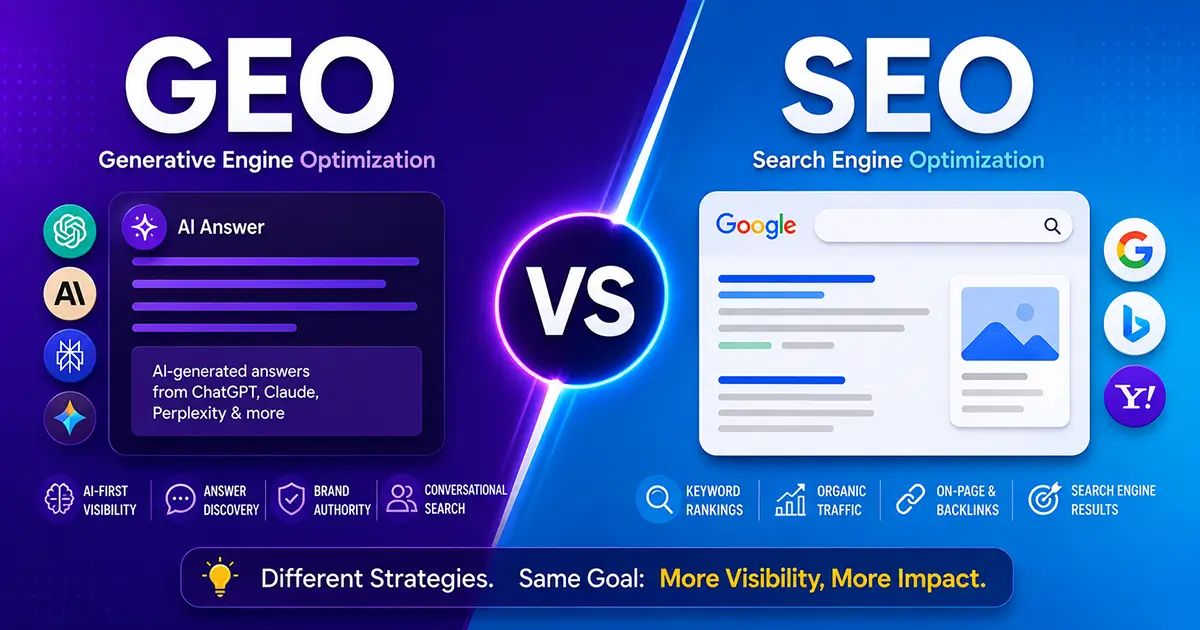
A few years ago, the question of where your content showed up had one answer: Google. Rank on page one, get traffic. Simple.
That’s not the full picture anymore.
AI-powered tools like ChatGPT, Perplexity, Google Gemini, and Microsoft Copilot now answer questions directly, pulling from across the web and citing sources — without sending people to a search results page at all.
That’s why marketers are talking about something called GEO. And that’s why the GEO vs SEO question matters for any business that relies on organic visibility.
Table of Contents
What Is SEO?
Search Engine Optimization is the practice of improving a website’s visibility in search engine results pages, primarily Google. It works through three main levers: on-page signals like keyword targeting, content quality, and heading structure; technical signals like site speed, crawlability, and structured data; and off-page signals like backlinks and domain authority.
The goal of SEO is to rank your pages higher so more people click through to your site when they search for relevant terms.
SEO is the process of optimizing a website to rank higher in search engine results like Google. It combines on-page content, technical performance, and backlinks to improve organic visibility. The primary metrics are rankings and the traffic they generate, typically measured through tools like Google Search Console and GA4.
SEO has been around since the mid-1990s. It’s mature, well-researched, and still drives a significant share of web traffic globally. For most businesses, it remains the biggest lever for sustainable organic growth.
What Is GEO?
Generative Engine Optimization (GEO) is newer. It refers to the practice of making your content more likely to be cited or referenced by AI-powered search tools, including ChatGPT, Perplexity, Google Gemini, Microsoft Copilot, Claude, Grok, and DeepSeek.
These tools don’t return a ranked list of links the way Google does. They generate a written answer and, in many cases, cite the sources they pulled from. GEO is about positioning your content to be one of those sources. Rankiwis has a full beginner’s guide to GEO if you want to go deeper on the fundamentals before reading on.
GEO is the process of optimizing content so that AI-powered search engines are more likely to cite it in their generated answers. Unlike traditional SEO, which targets search rankings, GEO targets AI citation. The key signals include factual accuracy, clear structure, inline source attribution, and a neutral, authoritative tone.
The concept is still developing. There’s no official GEO playbook the way there are decades of SEO documentation. But the underlying principle is clear: as more people get information from AI tools rather than traditional search, visibility in those tools becomes commercially important.
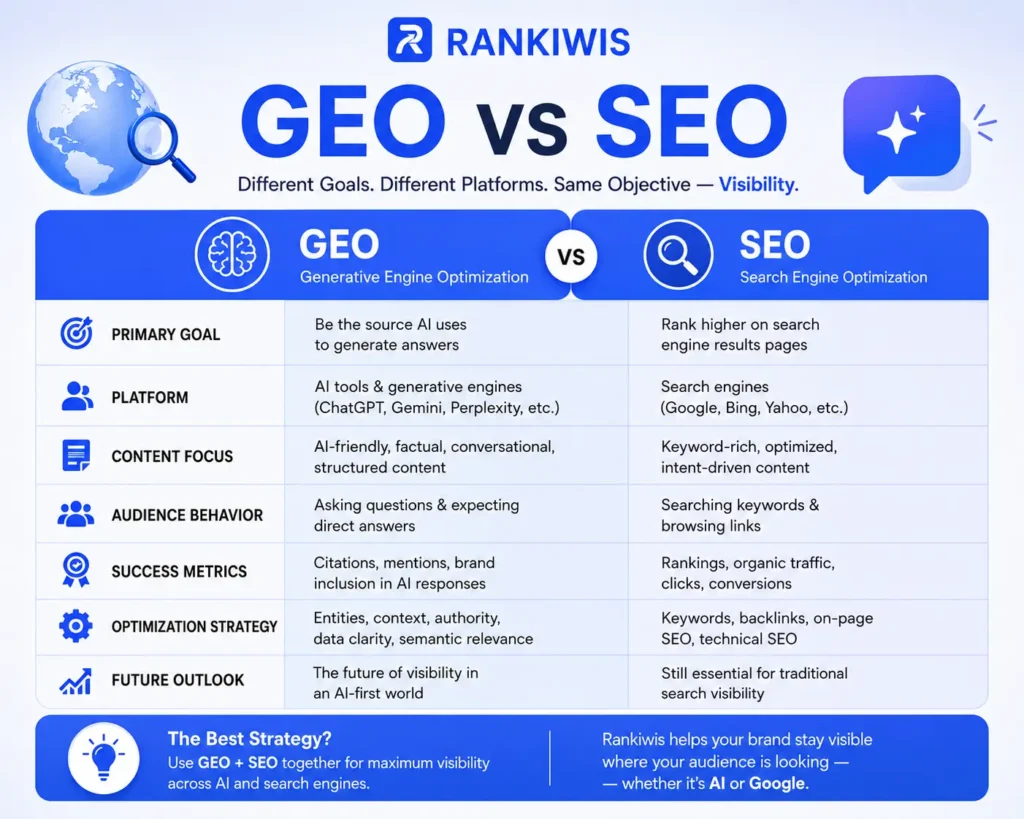
GEO vs SEO: The Key Differences
Both strategies aim to increase organic visibility. But they work in different ways, target different systems, and respond to different signals.
| Dimension | SEO | GEO |
|---|---|---|
| Target platform | Google, Bing, other search engines | ChatGPT, Perplexity, Gemini, Copilot, Claude |
| Primary goal | Rank higher in search results | Get cited in AI-generated answers |
| Success metric | Rankings, organic traffic, CTR | AI citations, brand mentions, referral behavior |
| Key signals | Keywords, backlinks, page authority, technical performance | Factual accuracy, source attribution, structure, neutral tone |
| Timeline | Weeks to months | Faster in some cases — AI engines update frequently |
| Content format | Optimized for humans and search crawlers | Optimized for human readability and machine extraction |
| Measurement tools | Google Search Console, GA4, Ahrefs, Semrush | Mostly manual citation monitoring — dedicated tools still emerging |
The biggest practical difference is the intent behind the optimization. SEO is about making Google’s algorithm prefer your page over a competitor’s. GEO is about making AI engines trust your content enough to quote it.
Where GEO and SEO Overlap
More than you’d expect. The two strategies share a significant foundation.
Strong SEO requires high-quality, well-structured, factually accurate content from a credible source. Strong GEO requires exactly the same thing. The principles behind Google’s E.E.A.T. guidelines — Experience, Expertise, Authoritativeness, and Trustworthiness — apply directly to what AI engines prioritize when deciding which sources to cite.
Pages that rank well on Google tend to get cited more often by AI engines. This isn’t a coincidence. Both systems try to surface the most credible, relevant answer to a user’s question. The inputs they use are different, but the underlying quality bar is similar.
GEO and SEO overlap significantly because both reward the same core content qualities: factual accuracy, clear structure, named authorship, cited sources, and topical depth. A page that ranks well on Google is more likely to be cited by AI engines. Investing in one strategy tends to strengthen the other.
Specific tactics that benefit both strategies:
- Clear heading structure keeps both Google and AI engines oriented within the page. A clean H1, H2, H3 hierarchy signals topical organization and makes content easier to parse and extract.
- Short, readable paragraphs reduce friction for human readers and make it simpler for AI engines to lift self-contained answers from your content.
- Named authorship with visible credentials strengthens E.E.A.T. signals and increases the likelihood that AI engines treat the content as a credible source worth citing.
- Cited statistics and external sources give both Google and AI engines something concrete to anchor trust in your content.
- FAQ sections targeting specific questions pick up featured snippet opportunities on Google and serve as clean, quotable blocks for AI citation.
- Authoritative backlinks from credible domains remain one of the strongest ranking signals in traditional SEO and contribute to the domain-level authority AI engines use when assessing source credibility.
- Regular content updates with visible dates signal freshness to Google and carry significant weight with AI engines like Perplexity, which prioritizes recently updated material.
Where the two strategies diverge is in the extra layer GEO requires. AI engines respond strongly to direct-answer paragraphs — 40 to 60 words, self-contained, written to be quoted. They also favor inline attribution like “according to Semrush’s 2024 State of Search report” over vague references like “studies show.” And they consistently deprioritize promotional language, preferring a neutral, informational tone in key passages.
Do You Need Both?
For most businesses: yes. Here’s the practical reason why.
Traditional search isn’t going anywhere. Google still handles billions of searches every day. For transactional queries — “best SEO agency in Austin,” “accountant near me,” “buy project management software” — people still click through to websites. SEO is still the right tool for capturing that traffic.
But information-seeking behavior is shifting fast. A growing number of people now start with an AI tool for research, comparison, or learning. Content that doesn’t surface in those AI-generated answers stays invisible to that part of the audience — even if it ranks on page one of Google.
Most businesses need both SEO and GEO. SEO drives traffic from traditional search, which remains the dominant source of organic web visits. GEO builds visibility in AI-powered tools, where information-seeking behavior is shifting. Running both in parallel is more efficient than the sum of the parts, since the core content requirements overlap significantly.
The good news is that you don’t need two separate content strategies. The same content investment that strengthens SEO — thorough, well-structured, accurate, credible — is exactly what GEO requires. You’re adding a layer, not building a second system. Rankiwis covers this in detail in the guide on how to optimize content for ChatGPT, Perplexity, and Google AI Overviews.
How to Approach Both Without Spreading Your Budget Thin
The most efficient approach is to build content with both in mind from the start.
Start with SEO fundamentals. Keyword research, on-page optimization, technical health, and link building form the base. These still drive the majority of measurable organic traffic and they take time to compound. Don’t pull budget away from this to chase GEO before the foundation is solid.
Add GEO signals during the writing process. Once you have a content brief built around SEO, write the piece so it also performs for AI citation. That means including at least one direct-answer paragraph per major section, attributing data sources inline, keeping a neutral tone in factual passages, and building in a clean FAQ section at the end.
Prioritize topical depth over volume. AI engines favor pages that cover a topic thoroughly. A single comprehensive guide outperforms five thin articles targeting similar terms. This aligns with SEO best practice too. Google’s helpful content guidance has pushed in the same direction for years.
Monitor where you’re being cited. Tools for tracking AI citations are still early-stage, but manually searching your brand name, key topics, and primary questions in tools like Perplexity and ChatGPT gives you a working picture of your GEO visibility. Make it a monthly check alongside your regular on-page SEO review.
Keep content fresh. AI engines — especially Perplexity — weight recency strongly. Adding a visible last-updated date and refreshing key pages every six to twelve months improves both SEO and GEO performance at once.
Where This Leaves You
SEO and GEO are not competing strategies. They’re complementary systems targeting different surfaces of the same goal: getting your brand in front of the right people at the right moment.
The businesses pulling ahead in organic visibility right now are the ones treating both as part of the same content investment. They’re not writing twice. They’re writing once, but writing it well enough to perform in both environments.
Content strategies built purely around Google rankings already have a gap. Closing it now, before your competitors do, is the smarter move.
FAQ
What does GEO stand for?
GEO stands for Generative Engine Optimization. It refers to the practice of optimizing content to improve its chances of being cited or referenced by AI-powered search tools like ChatGPT, Perplexity, and Google Gemini.
Is GEO replacing SEO?
No. GEO is an addition to SEO, not a replacement. Traditional search still drives the majority of organic web traffic. GEO addresses the growing share of information-seeking that happens inside AI tools. Most businesses benefit from running both in parallel.
How is GEO different from SEO?
SEO focuses on ranking in search engine results pages, primarily Google. GEO focuses on getting content cited in AI-generated answers. Both reward high-quality, well-structured, credible content, but GEO adds specific signals: direct-answer paragraphs, inline source attribution, and a neutral, authoritative tone throughout key passages.
How do I measure GEO performance?
Dedicated GEO measurement tools are still developing. The most practical approach right now is manually checking how your content appears in tools like Perplexity, ChatGPT, and Google Gemini when you search for your key topics. Track brand citations and watch for shifts in branded search volume over time.
Can I optimize existing content for GEO?
Yes. A content refresh focused on GEO typically involves adding direct-answer paragraphs, attributing data sources inline, removing promotional language from factual sections, expanding thin areas with more depth, and adding a visible last-updated date.