Every SEO conversation eventually lands on the same word: backlinks. Ignore them and your best content sits buried on page four. Chase the wrong ones and you can tank a site that used to rank just fine.
A backlink is one of the oldest ranking signals in SEO, and one of the most misunderstood. It’s also changing shape. Answer engines like ChatGPT and Perplexity, along with Google’s own AI Overviews, don’t reward links the same way Google’s classic algorithm does. This guide covers what a backlink actually is, how it works under the hood, and why it plays a different role in SEO, AEO, and GEO.
Table of Contents
What Is a Backlink?
A backlink is a hyperlink on one website that points to a page on a different website. Search engines read backlinks as a vote of confidence: the more relevant, authoritative sites that link to a page, the more trustworthy that page looks to Google’s ranking algorithm.
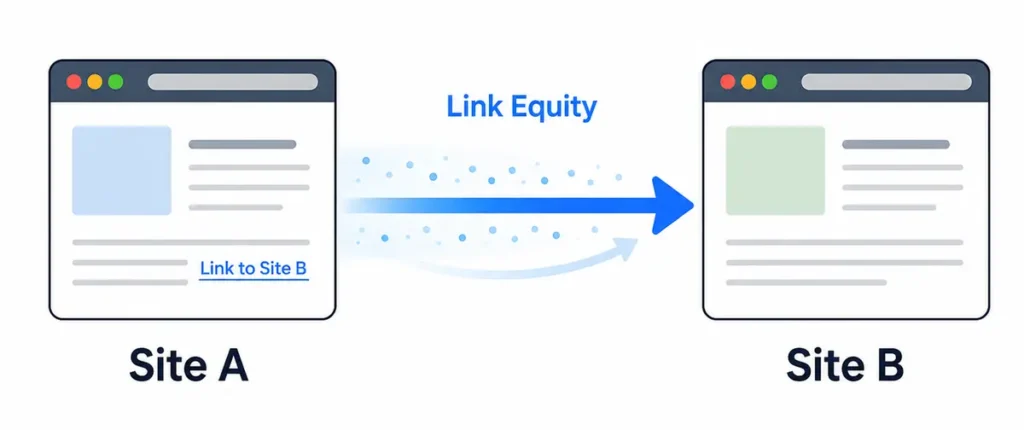
Site A links to Site B. From Site B’s point of view, that’s a backlink, also called an inbound link or an incoming link. From Site A’s point of view, the same link is an outbound link. The site doing the linking is the referring domain. The page receiving the link is the target page.
That distinction matters more than it sounds. A lot of SEO reporting confuses “backlinks” with “referring domains,” and the two aren’t the same thing. One website can link to you fifty times across fifty blog posts, and that’s fifty backlinks from a single referring domain. Google’s own research treats the number of unique referring domains as a stronger ranking signal than raw backlink count. Ten links from ten different websites usually outperform fifty links from one.
How Backlinks Work: Link Equity, PageRank, and Referring Domains
Google’s original ranking algorithm, PageRank, was built entirely around this idea. A page earns authority based on how many other pages link to it, and how much authority those linking pages carry themselves. That authority passes from page to page through links, a concept SEOs call link equity, or “link juice.”
A link from a well-established news website carries far more weight than a link from a brand-new blog with no traffic and no backlinks of its own. That’s why domain authority tools exist. Ahrefs’ Domain Rating, Moz’s Domain Authority, and Semrush’s Authority Score all estimate how much link equity a domain has accumulated, on a rough 0-100 scale, based on the quantity and quality of its backlink profile.
Link equity doesn’t just depend on the linking website’s authority. It also depends on:
- Relevance: a link from a marketing blog carries more topical weight for an SEO article than a link from a recipe website.
- Placement: a link inside the body content of an article passes more value than a link buried in a footer or sidebar.
- Page-level link dilution: a page linking out to 200 other sites spreads its equity thinner across every one of them.
- Link attribute: dofollow links pass equity by default. Nofollow, sponsored, and ugc links generally don’t.
Dofollow, Nofollow, Sponsored, and UGC: The Four Link Types You’ll See
Not every backlink behaves the same way, and the difference comes down to a small piece of HTML called the rel attribute.
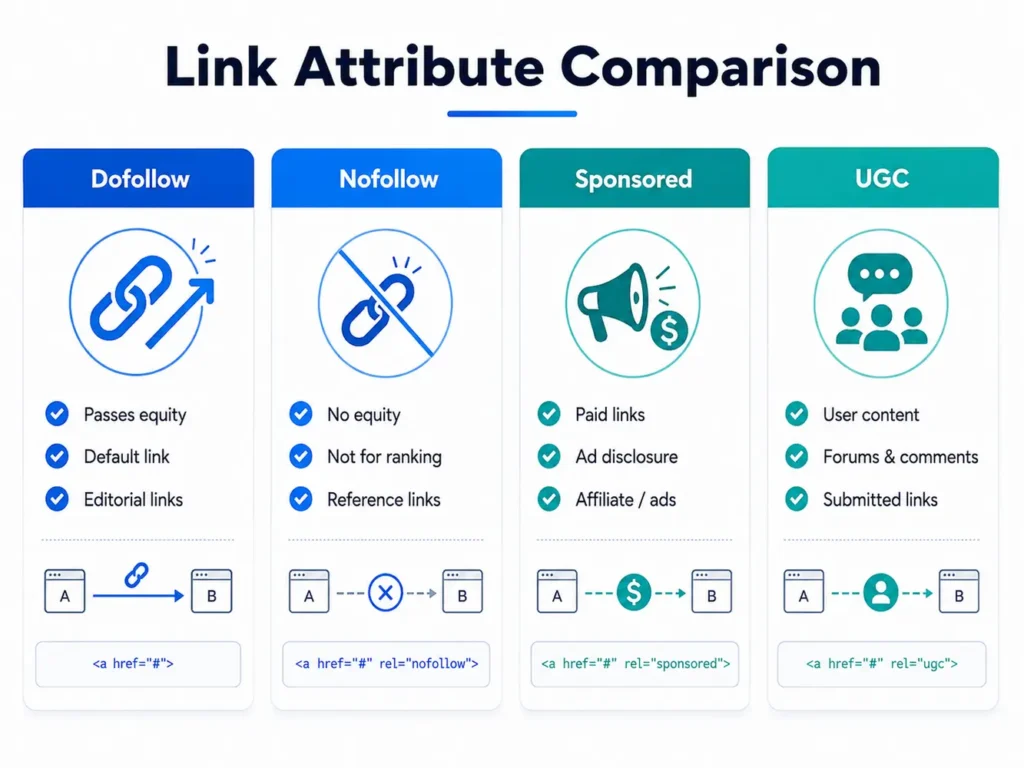
Dofollow is the default. Any plain link with no rel attribute passes link equity and counts as an editorial endorsement in Google’s eyes.
Nofollow tells Google not to associate your website with the linked page and, in most cases, not to pass ranking value to it. Google introduced the attribute in 2005 to fight comment spam.
Sponsored marks links created through paid placements, advertising, or affiliate deals. Google added this attribute in 2019 so websites could flag paid links honestly instead of dressing them up as organic mentions.
UGC stands for user-generated content. It marks links inside comments, forum posts, or reviews, places where the website owner didn’t personally vouch for the link.
Google’s own documentation lays out the three attributes plainly: use sponsored for anything paid, ugc for content your visitors post rather than you, and nofollow for any link you don’t want to vouch for or have Google crawl. All three can be combined on a single link, and Google treats them as hints rather than hard rules, which means a nofollow link can still occasionally get crawled or factored in, just not with the weight of a clean dofollow link.
Dofollow links pass ranking value and count as editorial endorsements. Nofollow, sponsored, and ugc links carry a rel attribute that tells Google not to pass that value. Google treats all three as hints rather than absolute rules, so a healthy backlink profile still includes a natural mix of every type.
A profile that’s 100% dofollow with exact-match anchor text often looks manufactured rather than earned. That hierarchy holds for classic SEO. AI engines don’t follow the same script, covered in the GEO section below.
What Makes One Backlink Better Than a Hundred Others
Quality beats quantity, and it isn’t close. A single link from a respected, topically relevant website with real traffic can do more for a page’s rankings than a hundred links from directories nobody visits. Weigh a backlink against these criteria:
- Domain and page authority: how much accumulated link equity the referring site carries.
- Topical relevance: whether the linking site covers a related subject.
- Traffic: a website with real visitors sends real referral clicks, not just link equity.
- Editorial context: a link placed naturally inside relevant content beats a link stuffed into a random resource list.
- Anchor text: descriptive, varied anchor text reads as natural. The same exact-match phrase repeated across dozens of links reads as manipulation.
Do Backlinks Still Matter for SEO in 2026?
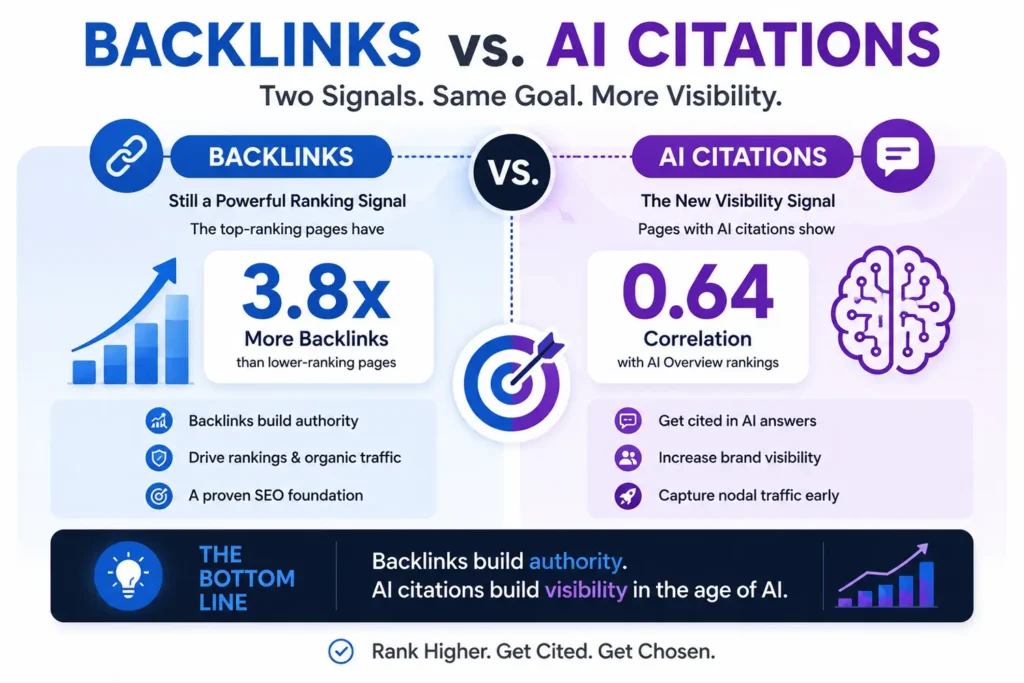
Yes, and the data backs it up. Backlinko’s analysis of 11.8 million Google search results found that a site’s link authority, measured through Ahrefs’ Domain Rating, correlates strongly with higher rankings, and pages carrying more backlinks tend to outrank pages with fewer. The number one result in Google averages close to four times more backlinks than pages sitting in positions two through ten.
That same research turned up a less comfortable fact: roughly 95% of all pages on the web have zero backlinks at all. A handful of quality links puts a page ahead of the vast majority of its competition, before a single other ranking factor gets considered.
Backlinks remain one of Google’s strongest off-page ranking signals in 2026. Pages ranking in position one average nearly four times more backlinks than pages ranked two through ten, and the number of unique referring domains matters more than total link count.
None of this means backlinks work alone. A page stuffed with thin content won’t hold a top ranking no matter how many sites link to it. Backlinks amplify a page that already deserves to rank. They rarely rescue one that doesn’t.
Backlinks and AEO: Does Answer Engine Optimization Care About Links?
Answer Engine Optimization is the practice of getting content pulled into direct answers: featured snippets, voice assistants, and AI-generated overviews. Backlinks still play a supporting role here, just a different one than in classic SEO.
Answer engines lean heavily on pages that already rank well in Google, and a strong backlink profile helps a page earn that ranking in the first place. AEO adds its own layer on top of that foundation: clean formatting, direct-answer paragraphs, and structured data like FAQPage schema often matter as much as, or more than, the backlink profile of the page being pulled.
Backlinks still help content rank well enough to get considered for AI-generated answers and featured snippets, but Answer Engine Optimization adds its own layer on top. Clean formatting, direct-answer paragraphs, and schema markup often decide which well-ranking page actually gets picked.
A page with a modest backlink profile but a tightly written, self-contained answer can still land in a featured snippet ahead of a page with more links but a messier structure. Backlinks get a page into consideration. Clear formatting decides whether it actually gets picked.
Backlinks and GEO: Why AI Citations Play by Different Rules
Generative Engine Optimization covers how content gets cited inside AI-generated answers from tools like ChatGPT, Perplexity, Claude, and Gemini. This is where the classic SEO rulebook stops applying cleanly, and the shift catches a lot of experienced SEOs off guard.
Semrush ran the actual numbers. Its study tracked 1,000 domains across ChatGPT, ChatGPT with Search, Gemini, Google’s AI Overviews, and Perplexity, then correlated backlink signals against how often each domain got mentioned in AI-generated answers. Two findings stand out.
First, authority matters more than volume, but the payoff only shows up once a domain crosses into higher authority tiers; small, incremental link wins barely move the number. Second, and more surprising: nofollow links carry almost the same weight as dofollow links for AI visibility. Follow links scored a Spearman correlation of 0.504 against AI mentions. Nofollow links scored 0.509, statistically indistinguishable.
A domain’s link authority correlates with how often AI engines mention it, but nofollow links carry nearly the same weight as dofollow links for that purpose. Classic SEO treats nofollow as a weaker signal. GEO treats it as close to equal, provided the linking website itself carries real authority.
That’s a genuinely different rulebook than classic SEO, where the dofollow/nofollow split still shapes how link equity flows, back in the “Dofollow, Nofollow, Sponsored, and UGC” section above. It means a Reddit thread, a Wikipedia citation, or a quoted comment on an industry site, links that carry little to no classic SEO weight, can still move the needle for AI visibility, provided the site hosting them has real authority.
Backlinks still function as an upstream input into GEO rather than the deciding factor. Strong backlinks help a page rank well in Google, and AI engines draw heavily from pages that already sit in the top ten. The GEO vs SEO comparison covers this relationship in more depth if you want the full picture of how the two disciplines overlap.
What else moves the needle beyond authority: quotable answer blocks that answer a question in 40 to 60 self-contained words, inline source attribution, and getting cited on sites AI engines already trust, whether that citation carries a link or not.
How to Check Your Own Backlink Profile
Three tools cover most of what a marketer needs to audit backlinks:
- Google Search Console: Free, and tied directly to Google’s own index. The Links report shows top linking websites, top linked pages, and top anchor text. Our Google Search Console guide walks through exactly where to find this data.
- Ahrefs or Semrush: Paid tools that crawl the web independently and estimate Domain Rating or Authority Score, along with a full list of referring domains and links gained or lost over time.
- Moz Link Explorer: A lighter option for a quick Domain Authority check and a snapshot of a site’s top backlinks.
Run this check quarterly at minimum. New backlinks show up, old ones disappear when websites get redesigned or shut down, and a periodic review catches both trends before they affect rankings.
Building Backlinks Without Getting Burned
It takes longer to earn a backlink than to buy one, and earning is the only approach that holds up over time. The short version: create something worth linking to, then get in front of the people who’d genuinely want to reference it, whether that’s a data study, an original tool, or a guide that actually answers the question.
Digital PR, resource page outreach, and broken link building are the three safest, most repeatable tactics available right now. Our off-page SEO guide breaks each one down step by step, along with a full checklist for building links without tripping Google’s spam filters.
When to Worry About Toxic Backlinks
Not every backlink helps. Links from link farms, private blog networks, or sites in unrelated, low-quality niches can drag a site’s reputation down, particularly if they arrive in an unnatural spike.
Before reaching for Google’s Disavow Tool, run an actual link quality review first. Most websites never need to disavow anything. Google’s own algorithms discount obviously spammy links automatically in the vast majority of cases. Save the disavow tool for links tied to a manual action or a clear, deliberate negative SEO attack, not for every low-authority link that shows up in a crawl report.
Where This Leaves You
A backlink is still one vote of confidence, but three different judges are now counting the votes. Google’s classic algorithm cares about link equity, authority, and follow status. Answer engines weigh formatting as heavily as the links themselves. Generative engines care more about brand authority than about any single link, followed or not. The foundation for all three is the same: earn links and mentions from sites that already carry real authority in your niche.
Want a second opinion on where your own backlink profile actually stands? Get in touch with Rankiwis for a straightforward, no-pressure review of what’s helping your website and what’s holding it back.
FAQ
What is a backlink in simple terms?
A backlink is a link from another website that points to your site. Search engines treat backlinks as a signal that other sites find your content valuable, credible, or worth referencing.
Are backlinks still important in 2026?
Yes. Backlinks remain one of the strongest off-page ranking signals for traditional SEO, and pages ranking in Google’s top position still average close to four times more backlinks than pages ranked two through ten.
What’s the difference between a dofollow and a nofollow backlink?
A dofollow link passes link equity and counts as an editorial endorsement. A nofollow link tells Google not to associate the linking site with the target page or pass ranking value to it, though Google treats nofollow as a hint rather than an absolute rule.
Do backlinks help with AI search visibility?
Yes, but differently than in classic SEO. Semrush’s study of 1,000 domains found that domain authority correlates with AI mentions, though gains only appear once a site clears a certain authority threshold. It also found nofollow links carry almost the same weight as dofollow links for AI visibility, which isn’t true for traditional Google rankings.
How many backlinks does a page need to rank?
There’s no fixed number. Quality and relevance matter more than volume. A single link from a highly relevant, authoritative website can outperform dozens of low-quality links.