Plenty of SEO advice tells you to “improve your E-E-A-T” without explaining what it is or what you’d actually change on Monday morning. Worse, most of it repeats a claim Google has corrected more than once.
This guide sets the record straight. What E-E-A-T means, what it does and doesn’t do, and the specific things you can put on your website to show it.
Quick answer: E-E-A-T (Experience, Expertise, Authoritativeness, Trustworthiness) is Google’s framework for human quality raters, not a direct ranking factor. It was introduced in 2014 and got its second E, Experience, in December 2022. You build it by naming real authors, showing first-hand detail, displaying trust signals, and earning outside citations, the same signals AI engines check before quoting a source.
What Does E-E-A-T Stand For?
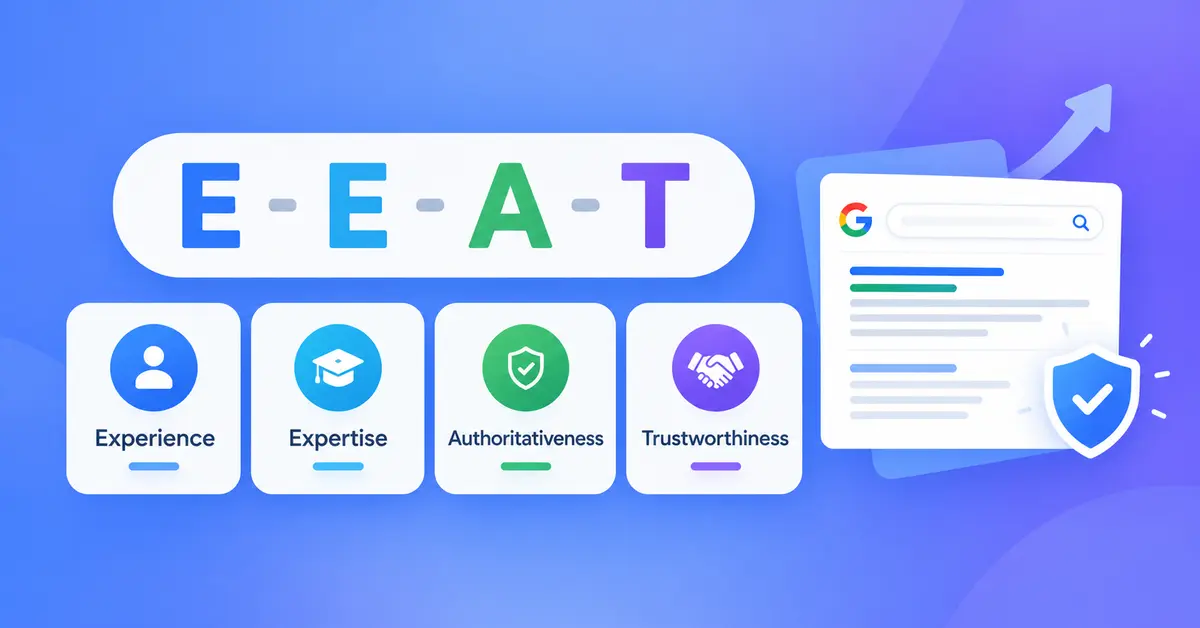
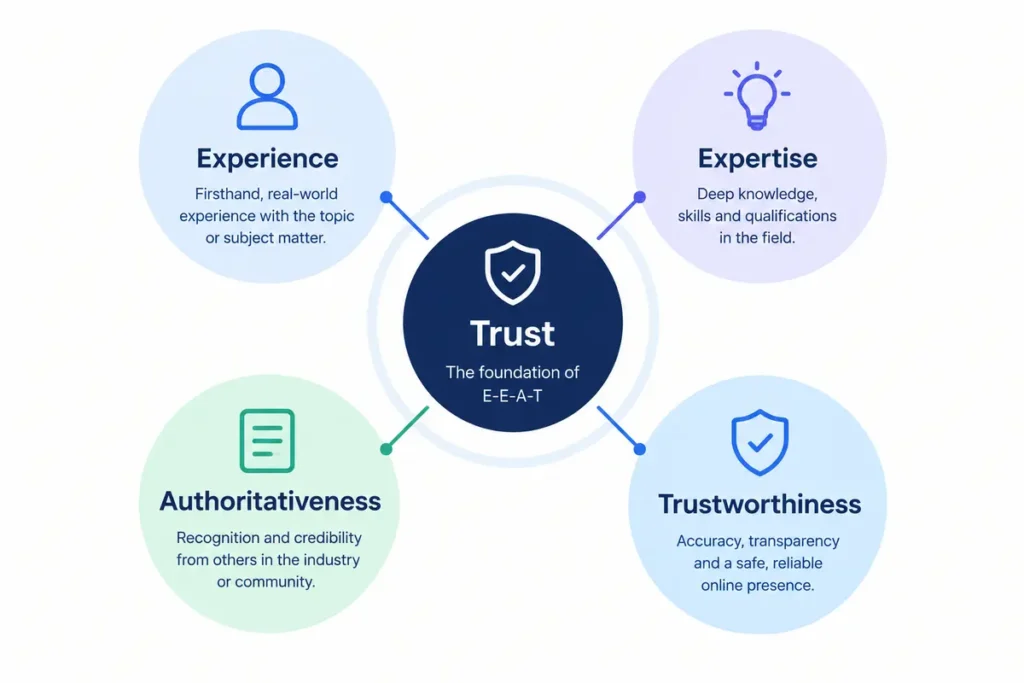
E-E-A-T stands for Experience, Expertise, Authoritativeness and Trustworthiness. It’s a framework in Google’s Search Quality Rater Guidelines used by human reviewers to judge content quality. Google added the first E, Experience, in December 2022, expanding the original E-A-T framework introduced in 2014.
Google employs thousands of people, called quality raters, to review search results by hand. E-E-A-T is the yardstick they use. The four parts break down like this.
| Part | What it asks | What proves it |
|---|---|---|
| Experience | Has the author actually done this thing? | First-hand accounts, original photos, real project examples, “we tested this” detail |
| Expertise | Do they know the subject properly? | Qualifications, years in the field, depth and accuracy of the content itself |
| Authoritativeness | Do others treat them as a go-to source? | Citations, mentions, links and reviews from credible third parties |
| Trustworthiness | Can this site and page be relied on? | Accurate information, clear contact details, secure site, transparent ownership |
Trust sits at the center. In Google’s December 2022 announcement introducing the extra E, the company called trust the most important of the four, because a page can show experience and expertise and still be untrustworthy.
Is E-E-A-T a Ranking Factor?
No, and this is where most articles get it wrong.
E-E-A-T is not a direct ranking factor. It’s a framework human quality raters use to assess whether Google’s results are useful. Their ratings don’t move individual pages, but they tell Google’s engineers which kinds of content to reward or demote, so the algorithm shifts in the direction E-E-A-T describes.
The practical upshot is the same either way. You can’t “set” an E-E-A-T score, and no tool can measure one credibly. What you can do is build the signals the framework describes, because Google keeps tuning its systems to favor exactly those signals. Treat E-E-A-T as a description of what good looks like, not a dial you turn.
What Is YMYL Content, and Why Does It Matter Here?
YMYL stands for Your Money or Your Life. It covers topics that could affect someone’s health, finances, safety or legal standing.
Google holds YMYL pages to a much higher standard. Medical advice, financial guidance, legal information, insurance, and anything touching serious life decisions all qualify. Accountants, mortgage brokers, lawyers, healthcare providers, allied health clinics and financial advisers get judged more strictly than, say, a landscaping blog.
Operate in a YMYL field, and the steps below stop being nice-to-have.
Google broadened this category on September 11, 2025, renaming it “YMYL Government, Civics and Society” and folding in election information, voting details, and topics that affect trust in public institutions. This doesn’t affect existing YMYL businesses. The list of what counts just got longer, and Google has said the change didn’t alter its rating approach.
How Do You Demonstrate E-E-A-T on Your Website?
Here’s the practical list. Work through it in order, because the early items carry the most weight for the least effort. This is also the same checklist Rankiwis runs on every on-page SEO audit we do for clients.
Put real names on your content
Anonymous content doesn’t get trusted or cited. Give every article a named author, a photo, and a bio that says why this person is worth reading. Link the byline to a proper author page listing their background and other articles. Add Author schema so machines can read it too.
This is the most common gap in small-business website audits. Most publish everything under “Admin.”
Show first-hand experience
Experience is the newest part of the framework, and the easiest to fake badly. Generic advice reads as generic. Specific detail reads as real.
Use your own photos rather than stock, and optimize them properly once you do. Describe actual projects, with the numbers and the things that went wrong. Say “across the sites we audited last year, we found…” rather than “many businesses struggle with…”. That difference is the whole point of the extra E.
Make trust signals obvious
Most sites bury the trust signals they already have. Display your business registration number. Show a real street address and a phone number that reaches a human. Publish your business hours. Add clear refund, privacy and terms pages. Keep the website on HTTPS. Show real reviews from Google Business Profile rather than unattributed testimonials.
Get cited by other credible sources
Authoritativeness comes from outside your website. Industry publications, trade associations, local media, established directories and review platforms all count. A mention in a source Google already trusts does more for authority than a dozen low-quality links.
Keep content accurate and current
Trust erodes fast when content is wrong or stale. Show a visible “last updated” date, correct errors openly, and review anything covering regulation or pricing at least once a year. A visible check-in date is a trust signal on its own.
Want a second pair of eyes on your site’s signals? Abu Musa has spent 12+ years in SEO, GEO, and content strategy. Book a free 30-minute audit call at rankiwis.com and get a plain-English rundown of where your E-E-A-T stands.
Does E-E-A-T Affect AI Search Results?
This is the reason E-E-A-T matters more now than it did two years ago.
AI engines have to pick which sources to quote, and they favor the same things quality raters do: named authors with real credentials, accurate and clearly sourced information, transparent site ownership, and recognition from other trusted sources. A page with no author, no date and no sources rarely gets cited by ChatGPT, Perplexity or Google’s AI Overviews, even when the writing is good.
The overlap is close enough to treat as one job. Build E-E-A-T properly, and you improve your odds in traditional rankings and AI citation at the same time. Google made the link explicit in its September 2025 guidelines update, which added dedicated examples for rating AI Overview content using the same E-E-A-T lens as everything else.
One honest caveat: nobody outside Google and the AI labs can see exactly how these systems weight trust, and the details shift. What’s clear is that the signals described here have held up across several years and several major updates.
This post is part of Rankiwis’s on-page SEO series. If your header tags and title tag still need work, start there. Both feed the same trust signals E-E-A-T rewards.
Frequently Asked Questions
What’s the difference between E-A-T and E-E-A-T?
One letter, added in December 2022. E-A-T covered Expertise, Authoritativeness and Trustworthiness. Google added Experience to recognize that first-hand involvement with a topic carries value even without formal credentials.
What is YMYL content?
Your Money or Your Life content covers topics affecting health, finances, safety or legal standing. Google applies stricter quality standards to these pages, which matters for accountants, health providers, legal firms and financial advisers.
How do I improve E-E-A-T on my website?
Start with named authors and author bio pages. Add first-hand detail and original photos. Display your registration details, address and contact details. Earn mentions from credible third parties. Keep content accurate with visible update dates.
Does E-E-A-T affect AI search results?
Indirectly, yes. AI engines favor sources with clear authorship, accurate sourcing and third-party recognition, the same signals E-E-A-T describes. Pages with no author or date rarely get cited in AI answers.
Want an honest read on your site’s credibility signals?
Rankiwis runs an E-E-A-T review as part of every SEO audit. Get in touch for a free chat about where your site stands.