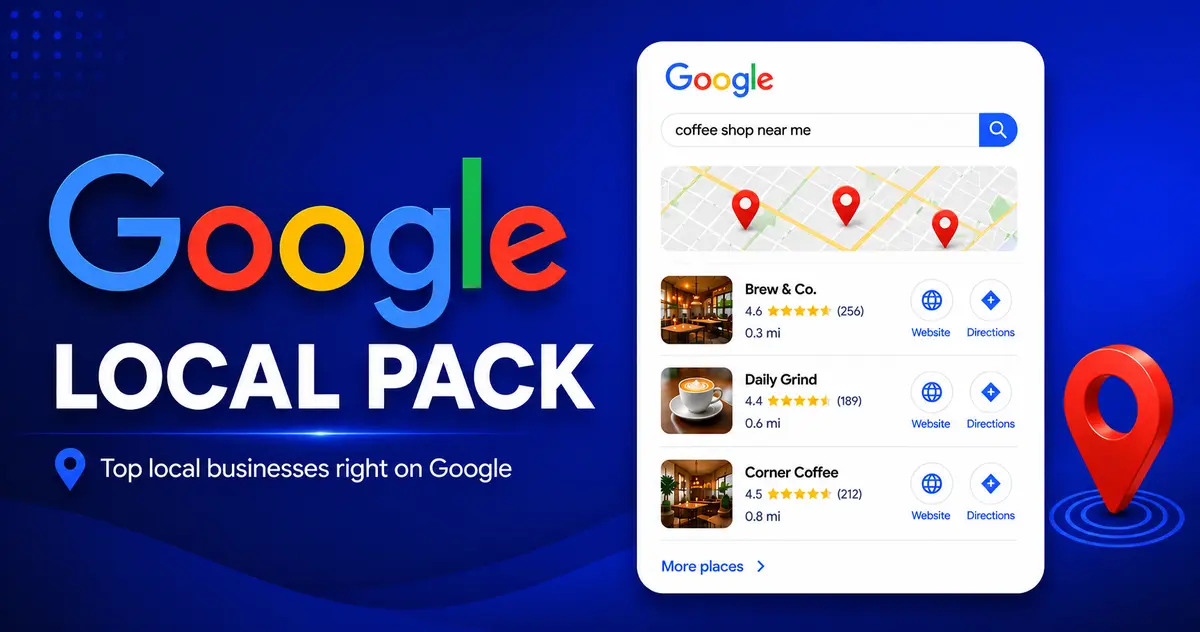
Type “plumber near me” into Google and you won’t scroll far before you see it: three business listings, a small map, and a scatter of star ratings sitting above every other result. That block is the Google Local Pack, and for local businesses, it’s some of the most valuable real estate on the entire results page.
Land a spot in it and your business earns clicks, calls, and driving-direction requests before a single organic listing even loads. Miss it, and you’re competing for attention several scrolls down, if searchers make it that far at all.
This guide covers what the Local Pack actually is, how Google decides who gets in, and the concrete steps that move a business from invisible to fully visible in local search.
Table of Contents
What Is the Google Local Pack?
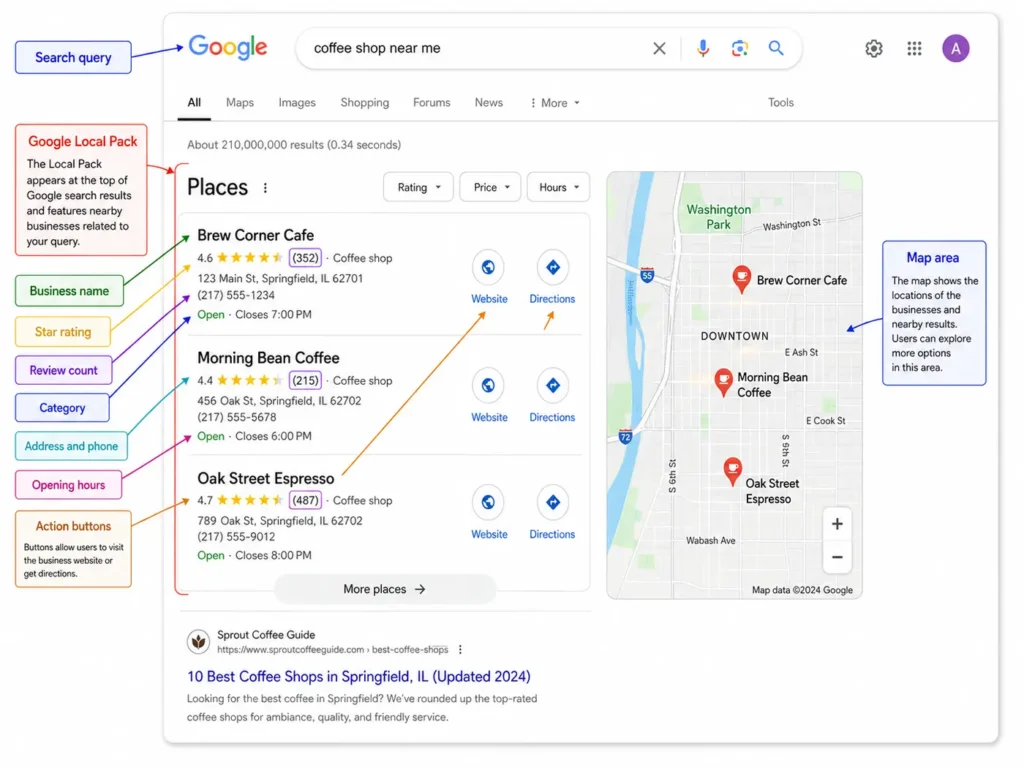
The Google Local Pack is the block of three business listings, complete with a map, star ratings, and contact details, that Google shows above organic results for location-based searches. Also called the Map Pack, Local 3-Pack, or Snack Pack, it draws most of its information directly from each business’s Google Business Profile.
You’ll see it for searches that carry local intent: “coffee shop near me,” “dentist in Austin,” or simply “hair salon” typed from a phone that Google already knows the location of. Each listing typically shows the business name, star rating and review count, address, hours, and a link into Google Maps.
The format hasn’t always looked this way. Google began weaving local business data into search results back in 2004, and the beta launch of Google Maps in 2005 turned that experiment into a core part of how people find nearby businesses. For years, Google showed a list of seven results with no map attached. That changed in 2015, when Google trimmed the list down to three listings and added the map view that still defines the feature today, a shift local SEOs still refer to as the “Snack Pack” update.
The pack sometimes shows fewer than three listings, and it occasionally includes paid Local Service Ads results labeled “Google Verified,” which run on a separate advertising program rather than the standard local algorithm.
Local Pack vs. Local Finder vs. Google Maps vs. Organic Results
These four surfaces get confused constantly, even though they behave differently and reward different signals. Here’s how they actually compare:
| Surface | Where it appears | What triggers it | Where a click takes you |
|---|---|---|---|
| Local Pack | Above organic results on the search page | A search with clear local intent | A Google-hosted business panel with more details |
| Local Finder | A “More places” link under the Local Pack | Clicking through from the pack | An expanded list of nearby businesses |
| Google Maps | The standalone Maps app or maps.google.com | A direct navigation or exploration search | Turn-by-turn directions and business details |
| Organic results | Standard blue links below the pack | Any search, local or not | The business’s own website |
The practical takeaway: your Google Business Profile feeds all three Google-owned surfaces, but your website’s authority and content still matter for organic rankings underneath the pack. A business that only optimizes its profile and ignores its site leaves visibility on the table in the results below the map.
Why the Local Pack Is Worth Fighting For
Industry researchers, BrightLocal among them, consistently put the figure at around 46% of all Google searches carrying local intent. That’s close to half of everything typed into the search bar pointing at a business somewhere nearby.
People act fast once they search. Google’s own Think with Google research has repeatedly found that 76% of consumers who run a “near me” search visit a business within 24 hours. This isn’t casual browsing. It’s a buyer standing at the door.
The businesses that win the Local Pack capture a disproportionate share of that traffic. A study conducted by SOCi, reported by Search Engine Land in late 2025, found that businesses ranked in the top three local positions earn 126% more traffic and 93% more user actions, calls, clicks, and direction requests, than businesses ranked four through ten.
The Local Pack sits at the intersection of high search volume and high buying intent. Businesses that appear in it capture measurably more calls, clicks, and visits than those stuck in position four or lower.
Inside a broader local SEO strategy, the Local Pack is usually the single highest-value target, precisely because it sits above everything else on the page.
How Google Decides Who Gets Into the Local Pack
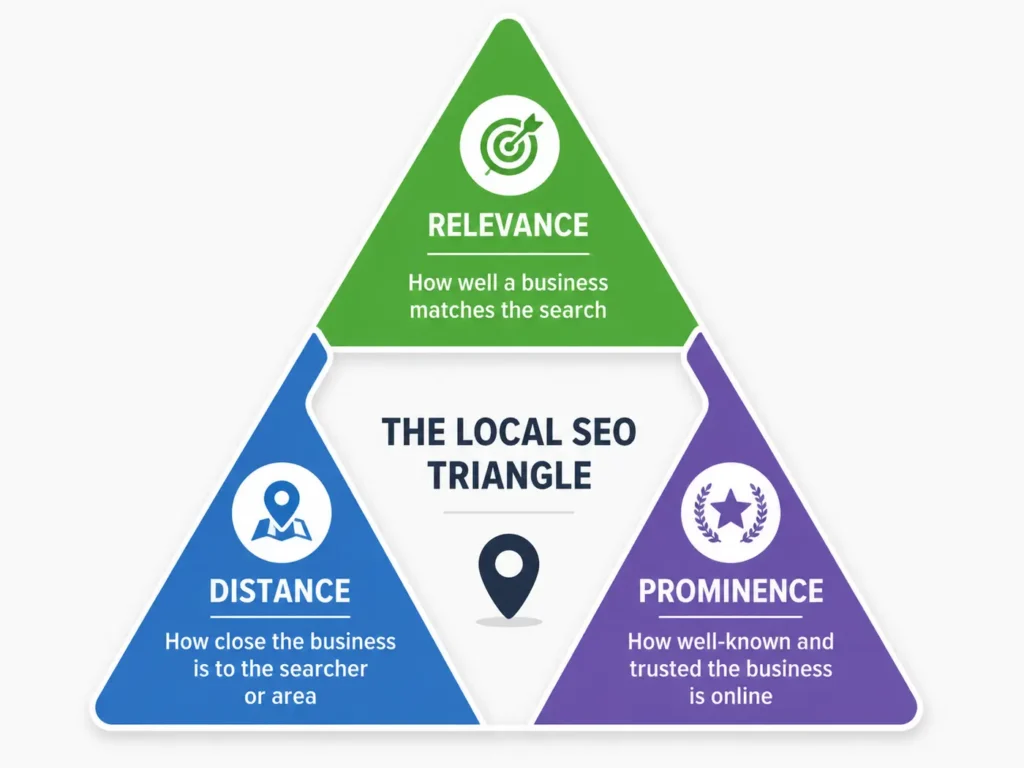
Google is direct about this one. In its own support documentation, Google states that three factors mainly determine local results: relevance, distance, and prominence.
Relevance measures how well your Google Business Profile matches what someone searched for. A complete, accurate, and well-categorized profile helps Google make that match correctly.
Distance is exactly what it sounds like: how close your business sits to the person searching, or to the location named in their query.
Prominence reflects how well-known your business is, both offline and across the web. Google weighs review count and rating, the number and quality of links pointing to your site, and how well-maintained your profile appears.
No business holds a permanent #1 spot in the Local Pack. Because Google bakes distance directly into the ranking, two people searching the same term from different sides of the same city can see two completely different sets of results.
The Ranking Factors That Actually Move the Needle in 2026
Google’s three official factors explain the framework, but local SEOs track which specific actions carry the most weight inside it. Whitespark’s 2026 Local Search Ranking Factors survey, published November 6, 2025 and scored by 47 local search experts, ranks the individual factors that most influence Local Pack and Maps rankings today:
| Rank | Ranking factor |
|---|---|
| 1 | Primary Google Business Profile category |
| 2 | Proximity of address to the point of search |
| 3 | Keywords in the GBP business title |
| 4 | Physical address in the city of search |
| 5 | Business is open at the time of search |
| 6 | High numerical Google ratings |
| 7 | Address showing on GBP (not hidden as a service-area business) |
| 8 | Additional GBP categories |
| 9 | Quantity of native Google reviews with text |
| 10 | Proper placement of the map pin |
The pattern holds across the full list: Google Business Profile fields dominate the top of the table, and three separate review-related factors (ratings, review volume, and review recency) all sit inside the top eleven. That combination is exactly why the optimization steps below start with the profile and the review engine, not the website.
Can Your Business Even Show Up in the Local Pack?
Before optimizing anything, confirm your business is actually eligible. A surprising number of businesses spend months chasing Local Pack rankings they were never going to get.
- You need a Google Business Profile. No profile means no eligibility, full stop. It’s free to create at business.google.com.
- You need a physical location or a defined service area. Purely online businesses with no local service component generally don’t qualify for local results.
- Address visibility affects your odds, though experts still debate why. Google requires service-area businesses without a staffed public office to hide their street address. Search Engine Land’s local search reporting and the Whitespark survey above both rank visible-address businesses ahead of hidden-address ones. Worth noting: Whitespark founder Darren Shaw has publicly questioned whether this is a true ranking factor or a side effect of how Google recalculates a listing’s map position once the address disappears. Either way, the practical outcome for now is the same: expect a visible-address competitor to have an edge.
- Proximity has a real ceiling. A business fifty miles from a searcher won’t compete for a hyperlocal “near me” query, no matter how well-optimized its profile is.
To show up in the Google Local Pack, a business needs a claimed Google Business Profile and either a real, verifiable street address or a clearly defined service area. Service-area businesses that must hide their address under Google’s own guidelines tend to rank behind competitors with a visible location, even when every other signal is equal.
How to Get Into the Google Local Pack: A 6-Step Playbook
Ranking factors explain the “why.” Here’s the “how.”
1. Claim and Fully Optimize Your Google Business Profile
Profile signals carry the heaviest weight in the algorithm, which makes this the highest-impact action available. Claim your listing if you haven’t, choose the most specific primary category available, and fill in every field Google offers: hours, attributes, services, photos, and a clear business description.
Rankiwis has a complete walkthrough of Google Business Profile optimization that covers verification, categories, and the posting cadence that keeps a profile looking active rather than abandoned.
2. Lock Down NAP Consistency Across Every Citation
Your business name, address, and phone number need to match exactly across your website, your GBP, and every directory that lists you. Inconsistent formatting, a missing suite number here, a different phone format there, quietly erodes the trust signal Google uses to confirm your business is legitimate.
Clean, consistent NAP citations across the directories Google actually checks are one of the most overlooked local SEO tasks, and one of the easiest to fix once you know where to look.
3. Build a Review Engine, Not a One-Time Push
Review volume and recency feed directly into the prominence factor, and Google has confirmed that review count and rating influence local ranking. A single push for reviews after launch won’t hold up. Businesses that keep a steady flow of recent, genuine reviews consistently outrank competitors with a large but aging review base.
A repeatable system for generating reviews, asking at the right moment, making the request frictionless, and responding to what comes back, does more for your ranking than any one-time campaign ever will.
4. Match Your Content and Categories to Real Local Intent
Localized keyword research adds a geographic layer that standard keyword research misses. Look at how people in your actual market phrase their searches: service-plus-location terms, “near me” queries, and neighborhood-level phrasing all show up in Google’s autocomplete and “People also ask” results if you look.
Use that language in your GBP description, your website’s title tags and headings, and any location-specific pages you maintain. Never force it. A profile description that reads like a keyword list looks worse to both Google and the customer reading it.
5. Earn Genuine Local Links and Mentions
Links remain one of the strongest prominence signals Google tracks, and local links carry outsized weight for local rankings specifically. A mention from a local news outlet, a chamber of commerce, or a community organization tells Google your business has real standing in its area, something a generic national directory link can’t replicate.
You don’t need volume here. A handful of genuinely relevant local mentions moves the needle more than dozens of low-quality directory listings ever will.
6. Track Performance and Adjust
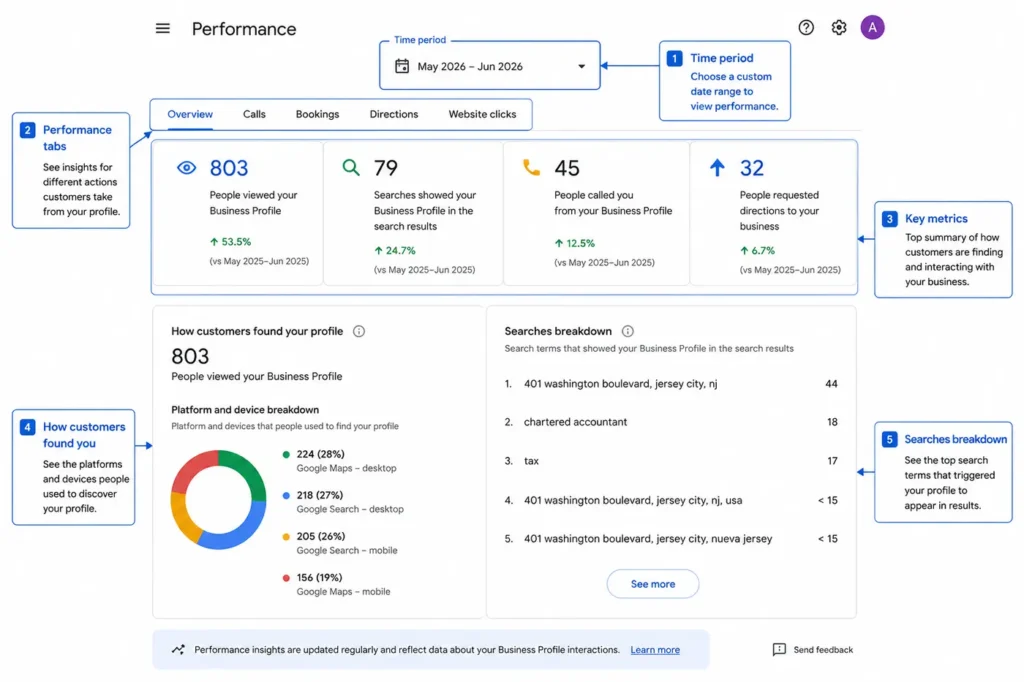
Your Google Business Profile dashboard reports on calls, website clicks, and direction requests generated directly from your listing. Pair that with Google Search Console for organic performance, and a rank-tracking tool such as BrightLocal or Semrush for visibility into where you actually sit across different parts of your service area.
Local rankings shift by location, so a single rank check from your office tells you very little about how you’re performing across your whole market.
Common Reasons Businesses Get Filtered Out of the Local Pack
Even solid businesses lose visibility to avoidable mistakes:
- An unverified or unclaimed profile. Google gives verified, actively managed profiles priority over unclaimed or unverified ones.
- Inconsistent NAP data. Conflicting business information across the web makes Google less confident in which version is accurate, and less confident businesses rank lower.
- A vague or incorrect primary category. Choosing “General Contractor” when you’re a plumber costs you relevance for the exact searches you want to win.
- Thin or duplicate location pages. Copying the same page template across multiple cities and swapping the city name is a well-documented pattern Google’s systems are built to spot and discount.
- Silence on reviews. Ignoring incoming reviews, or never asking for them at all, quietly suppresses the prominence signal your competitors are actively building.
FAQs About the Google Local Pack
How long does it take to rank in the Local Pack? There’s no fixed timeline. A new business in a low-competition market can rank quickly once it verifies its profile. In competitive markets, expect it to take longer, since review volume and link authority both accumulate over time rather than overnight.
Can a service-area business without a storefront show up in the Local Pack? Yes. Google Business Profile supports service-area businesses that hide their street address and list their coverage area instead. The same relevance, distance, and prominence factors still apply, though visible-address competitors often have an edge.
Does the Local Pack look the same for everyone who searches? No. Distance is one of Google’s three core ranking factors, so results shift based on the searcher’s location. Two people in different neighborhoods of the same city can see entirely different businesses for an identical search.
Is it realistic to rank #1 in the Local Pack for every search? Not really, and chasing that goal wastes effort. Because results vary by searcher location, the more useful goal is maximizing visibility across your entire service area rather than owning a single, location-dependent #1 spot.
Final Thought
The Local Pack rewards the businesses that treat their Google Business Profile as a living asset rather than a form filled out once and forgotten. Get the profile right, keep your citations clean, build reviews steadily, and the rest of local search tends to follow.
Want a second pair of eyes on your local search setup? Book a free consultation and the Rankiwis team will walk through what’s holding your Local Pack visibility back.