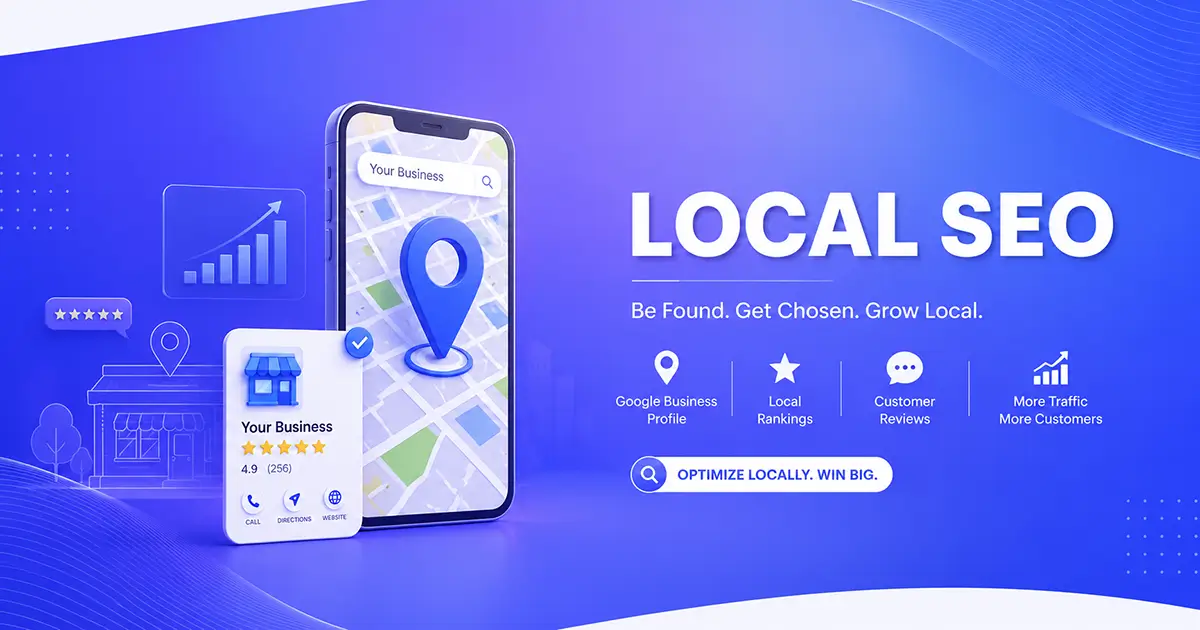
Every day, millions of people open Google and search for a business near them. A dentist, a plumber, a coffee shop, a law firm. They type a few words and Google hands them a shortlist. The businesses that appear at the top of that list get the call. The ones buried below it don’t.
That shortlist is the product of local SEO. And if your business serves customers in a specific area, whether you run a physical store or offer services in someone’s home, local SEO is one of the most valuable things you can invest in.
This guide covers what local SEO is, why it works, and the concrete steps you can take to build a local SEO strategy that drives real business results.
Table of Contents
What Is Local SEO?
Local SEO is the process of improving your business’s visibility in location-based search results on Google and other search engines. The goal is to appear when someone nearby searches for the products or services you offer.
Local SEO is the practice of optimizing a business's online presence to rank higher in location-based searches on Google. It helps businesses with physical locations or local service areas attract nearby customers through Google Search, Google Maps, and the local pack, which is the group of three business listings that appears at the top of many local search results.
”Unlike standard SEO, which targets broad audiences across multiple regions, local SEO focuses on a specific geographic area. The signals Google uses to rank local results are different too. Things like your Google Business Profile, the consistency of your business name address and phone number across the web, and the reviews customers leave about you.
Why Local SEO Matters for Your Business
The numbers make a compelling case on their own. Google processes billions of local searches every month. Research shows that around 46% of all Google searches have local intent, meaning people looking for something near them, right now.
More importantly, local searches convert. Studies consistently show that most people who perform a local search on their phone visit a business within 24 hours. A significant portion of those visits result in a purchase.
Local SEO matters because it connects businesses with high-intent customers at the moment they're ready to act. Someone searching “emergency plumber near me” or “best sushi restaurant downtown” is not browsing casually. They want a solution quickly. Appearing in local results at that moment puts you directly in front of buyers, not just browsers.
”For a local business owner, this is the most targeted form of marketing available. You’re not paying to reach a national audience when your customers are all within 15 miles. Local SEO puts your budget and your visibility exactly where they belong.
How Local SEO Works
To understand how local SEO works, you need to understand what Google is trying to do. When someone performs a local search, Google pulls results from two places: the local pack (also called the map pack) and the standard organic results below it.
The Local Pack
The local pack is the block of three business listings that appears near the top of Google search results for location-based queries. Each listing shows the business name, rating, address, phone number, hours, and a link to Google Maps.
Getting into the local pack is one of the most valuable outcomes of a local SEO strategy. It sits above the organic results, it’s highly visible on mobile, and it shows the information customers need to take action. They don’t even need to visit your website.
The local pack is a group of three business listings that Google surfaces at the top of local search results. It displays business information such as name, address, rating, and hours, and links directly to Google Maps. Ranking in the local pack requires a well-optimized Google Business Profile, consistent citations across business directories, strong reviews, and clear proximity signals.
”How Google Decides Who Ranks
Google evaluates three main factors when ranking local results:
Relevance: Does your business match what the person is searching for? Your Google Business Profile, website content, and the categories you list under all signal relevance.
Distance: How close is your business to the person searching? Google uses the physical location of the searcher (or the location mentioned in their query) to assess distance. This is why businesses closer to a city center often rank more easily for competitive terms.
Prominence: How well-known and trusted is your business? Google looks at your reviews, the number and quality of links to your site, mentions across the web, and your overall online presence to determine prominence.
A strong local SEO strategy works on all three of these factors simultaneously.
The Core Elements of a Local SEO Strategy
1. Optimize Your Google Business Profile
Your Google Business Profile (GBP) is the single most important asset in local SEO. It’s the listing that appears in the local pack, in Google Maps, and in the knowledge panel when someone searches your business name directly.
A Google Business Profile is a free tool that controls how your business appears across Google Search and Google Maps. Optimizing it with accurate business information, the right categories, photos, services, and regular posts is the most direct action a business owner can take to improve local rankings and attract nearby customers.
”To optimize your GBP:
- Claim and verify your listing if you haven’t already
- Choose the most accurate primary category for your business. This is a major ranking signal.
- Add secondary categories that reflect all your products or services
- Write a clear, keyword-relevant business description (use your primary keywords naturally, not forcefully)
- Upload real photos of your location, team, and work. Businesses with photos receive significantly more clicks and calls.
- Add your hours, phone number, website, and service areas
- Enable messaging and keep your Q&A section accurate
- Post updates, offers, and events regularly to signal an active, well-managed listing
Treat your GBP like a second website. The more complete and active it is, the better it performs.
2. Build Consistent Business Citations
A citation is any online mention of your business name, address, and phone number, often abbreviated as NAP. Citations appear on business directories, review platforms, social media profiles, and local websites.
Consistency matters enormously here. If your business name address and phone number appear differently across different directories, a wrong suite number here or a different phone format there, Google treats those inconsistencies as trust signals working against you.
Business citations are online references to a company’s name, address, and phone number across websites and business directories. Consistent, accurate citations tell Google that a business is legitimate and well-established. Inconsistencies in NAP data across listings can hurt local rankings because they create conflicting signals about the business’s identity and location.
”Start by auditing your existing citations. Tools like BrightLocal or Whitespark can find where you’re listed and flag any inconsistencies. Then build out your presence on the most authoritative directories:
- Google Business Profile
- Yelp
- Apple Maps
- Bing Places
- Facebook Business
- Industry-specific directories relevant to your niche (TripAdvisor for hospitality, Houzz for home services, Avvo for legal, etc.)
The goal is breadth and accuracy, not just quantity.
3. Target Localized Keywords
Standard keyword research focuses on search volume and competition. Local keyword research adds a geographic layer. You’re looking for the terms people in your target area actually use when they search for what you offer.
Localized keywords typically follow a few common patterns:
- Service + location (“accountant in Manchester”, “roofing company Denver”)
- “Near me” searches (“electrician near me”, “nail salon near me”)
- Neighborhood or district-level terms (“coffee shop Brooklyn Heights”)
- Problem-first queries (“broken pipe emergency plumber [city]”)
Localized keywords are search terms that combine a service or product with a specific geographic location. They reflect the language and intent of people searching for local businesses. Targeting these keywords in your website content, page titles, and Google Business Profile helps Google connect your business with the relevant local searches happening in your area.
”Use Google’s autocomplete and “People also ask” sections as free research tools. Type your core service into Google and see what location-based variations appear. These are real searches real people are making.
Then use those keywords strategically in your page titles, H1 headings, meta descriptions, body content, and across your GBP. Don’t stuff them. Use them the way you’d naturally mention your location in conversation.
4. Create Location-Specific Pages on Your Website
If your business serves multiple locations, each one deserves its own dedicated page. A single “Service Areas” page listing 15 cities gives Google almost nothing to work with. Individual location pages with unique, relevant content give Google something to rank.
Each location page should include:
- The location name in the title tag, H1, and URL
- Specific information about that area, including local landmarks, neighborhoods served, and local team members
- A map embed
- Location-specific testimonials or case studies if possible
- Your full NAP for that location
- Schema markup using LocalBusiness structured data
Avoid copying the same template content across multiple pages and just swapping the city name. Google identifies and ignores thin, duplicate location pages. Write genuinely useful content for each location.
5. Get and Manage Customer Reviews
Reviews are a major ranking factor for local SEO, and they’re also one of the most powerful conversion tools available. A business with 200 positive reviews will consistently outperform a competitor with 12, all else being equal.
Customer reviews influence both local rankings and consumer decisions. Google uses review volume, recency, and sentiment as signals of a business’s prominence and trustworthiness. A local business owner who actively encourages customers to leave reviews and responds to all feedback, positive and negative, builds a stronger reputation signal than one who ignores this area entirely.
”The simplest way to get more reviews is to ask. After completing a job or sale, send the customer a direct link to your Google review page. Most satisfied customers are happy to leave a review. They just need a nudge and a simple path to do it.
When reviews come in, respond to all of them. Thank customers for positive reviews with a personal touch. Address negative reviews calmly and professionally. Both behaviors signal to Google (and to prospective customers) that you’re an active, accountable business owner.
6. Build Local Links
Links remain one of Google’s strongest ranking signals, and local SEO is no different. A link from a well-respected local source such as a local news outlet, a community organization, or a regional trade association carries real weight for local rankings.
Local link building opportunities include:
- Local business associations and chambers of commerce
- Sponsoring local events, charities, or sports teams
- Getting featured in local press or regional publications
- Partnering with complementary local businesses for cross-promotion
- Being listed on local government or community resource pages
You don’t need hundreds of links. A handful of genuinely relevant local links can move the needle significantly, especially in markets that aren’t hyper-competitive.
7. Optimize Your Website for Local Search
Your Google Business Profile gets a lot of attention in local SEO, but your website still matters. It backs up your GBP, helps you rank in organic results below the local pack, and gives Google more content to assess relevance with.
Key on-page optimizations for local SEO:
- Title tags and meta descriptions: Include your primary service and location in the title tag of your homepage and key service pages
- H1 headings: Use your primary localized keyword naturally in the main heading
- NAP on every page: Include your business name address and phone number in the footer or contact section of every page, in consistent format
- Embedded Google Map: Add a Google Maps embed to your contact page
- LocalBusiness schema: Implement structured data that tells Google your business name, address, phone, hours, and service area in machine-readable format
- Content that mentions local context: References to local neighborhoods, landmarks, and community involvement build topical relevance
The goal is a website that reinforces everything your GBP says about you. Consistency between the two is a trust signal.
Local SEO and Google Maps
Ranking on Google Maps is effectively the same objective as ranking in the local pack. Both pull from the same data. When someone opens Google Maps and searches for a service in a given area, the results come from Google Business Profile data, combined with the same relevance, distance, and prominence signals that drive local pack rankings.
Google Maps rankings are driven by the same signals as the local pack: a complete and verified Google Business Profile, accurate business information, strong reviews, and consistent citations. Businesses that invest in local SEO automatically improve their visibility on Google Maps because the two systems share the same underlying ranking logic.
”A few things specific to Google Maps performance:
- Enable all relevant attributes in your GBP (wheelchair accessible, free Wi-Fi, outdoor seating, etc.). These help you appear in filtered searches.
- Add photos consistently. Listings with regular photo uploads perform better.
- Keep hours accurate, especially during holidays or unusual closures. Outdated hours lead to negative reviews and signal poor maintenance.
Common Local SEO Mistakes to Avoid
Even experienced marketers make avoidable mistakes with local SEO. The most common ones:
Inconsistent NAP data: Different versions of your business name, address, or phone number across listings. This is more common than it sounds and can quietly suppress rankings.
Ignoring your GBP after setup: A one-time setup isn’t enough. GBP is a live, dynamic platform. Businesses that post regularly, respond to reviews, and keep their information updated consistently outperform those that treat it as set-and-forget.
Using the wrong business category: The primary category on your GBP is one of the strongest local ranking signals available. Choosing a broad or slightly inaccurate category costs you relevance for the searches that matter most.
Building citations without checking existing ones: Adding new listings without auditing old ones often means multiplying your inconsistency problem rather than fixing it.
No reviews strategy: Waiting passively for reviews means you’ll always lag behind competitors who actively encourage customers to leave reviews. Build review requests into your post-sale process.
Thin or duplicate location pages: Copy-paste location pages are worse than no location pages. Google either ignores them or flags them as low-quality content.
How Long Does Local SEO Take to Work?
Local SEO is not a one-week fix. In competitive markets, meaningful movement in local rankings typically takes three to six months of consistent effort. In less competitive local areas, some businesses see results faster.
The variables that affect timeline include how competitive your market is, the current state of your GBP and citations, how actively you build reviews, and whether your website has any underlying technical issues.
The businesses that see the strongest long-term results treat local SEO as an ongoing process, not a one-time project. The work compounds. A GBP you’ve been actively managing for two years will consistently outperform a listing set up last month.
Local SEO in 2026 and Beyond: What’s Changing
Local SEO works the same way it always has at its core. But a few developments are worth paying attention to.
AI-powered search results: Google’s AI Overviews (formerly SGE) are starting to appear for some local queries. These pull information directly from business listings, reviews, and website content. The more complete and accurate your information, the more likely your business gets cited in AI-generated summaries.
Voice search: More local searches happen via voice than ever before. Voice queries tend to be conversational and question-based: “Who is the best electrician near me?” Optimizing for natural language and FAQ-style content helps capture these searches.
Review quality over quantity: Google is increasingly sophisticated about review signals. A steady stream of genuine, recent reviews from real customers outperforms an old spike of reviews from five years ago.
Hyperlocal targeting: With better location data available, Google is rewarding businesses that show genuine neighborhood-level relevance, not just city-level optimization.
Tracking performance with free tools: Google Search Console shows you which search queries bring people to your website, how many impressions you get, and where you rank. Paired with your GBP insights dashboard, it gives you a clear picture of how local SEO is performing without spending a penny.
The fundamentals of local SEO works best when you commit to them consistently: a complete GBP, clean citations, genuine reviews, and a website that backs up everything you claim. The tactics may evolve, but the underlying logic doesn’t change.
A Quick-Start Local SEO Checklist
Use this as a starting point:
- Claim and fully optimize your Google Business Profile
- Audit existing business listings for NAP consistency
- Build citations on the top 15–20 authoritative directories in your niche and region
- Add localized keywords to your homepage and key service page titles and content
- Implement LocalBusiness schema markup on your website
- Add your NAP to the footer of every page
- Start a systematic process for requesting reviews after every transaction
- Create individual location pages if you serve multiple areas
- Identify 5 local link-building opportunities and pursue them
- Set a monthly reminder to post on your GBP and respond to any new reviews
None of these steps requires a big budget. Most of them require time and consistency. That’s the real competitive advantage in local SEO. Most businesses set it up once and forget it. Showing up consistently is how you stay ahead.
Frequently Asked Questions About Local SEO
What is the difference between local SEO and regular SEO? Regular SEO aims to rank a website for broad keywords across a national or global audience. Local SEO focuses on ranking a business for location-specific queries, meaning searches tied to a specific city, neighborhood, or the phrase “near me.” Local SEO also involves platforms like Google Maps and the local pack, which standard SEO does not target directly.
Do I need a website for local SEO? You can rank in the local pack with only a Google Business Profile, without a website. But a well-optimized website significantly strengthens your local SEO, helps you rank in the organic results below the local pack, and gives you more control over how your business appears across Google Search.
How much does local SEO cost? The cost varies based on how much you do in-house versus outsourcing, how competitive your market is, and how much work your current online presence needs. A business owner willing to put in the time can handle the fundamentals without a large budget. Hiring an agency or consultant for ongoing local SEO typically ranges from a few hundred to several thousand dollars per month depending on scope.
Can local SEO work for service-area businesses without a physical storefront? Yes. Google Business Profile supports service-area businesses that don’t have a customer-facing physical location. You can hide your address and list the specific areas you serve instead. All the same optimization principles apply.
How do I know if my local SEO is working? Start with Google Search Console, a free tool from Google that shows which search queries bring visitors to your website, how often your pages appear in search results, and where you rank. Pair that with your GBP dashboard to track impressions, calls, and direction requests. For local rank tracking specifically, tools like BrightLocal or Semrush can monitor your positions for key local terms over time.
Final Thought
Local SEO is one of the most direct paths from digital marketing effort to real-world revenue. It puts your business in front of people who are already looking for exactly what you offer, in the exact area you serve.
The businesses that get it right aren’t doing anything especially complicated. They keep their business information accurate, stay active on Google Business Profile, build genuine reviews, and make sure their website reinforces everything their listing says about them.
Start there. Build from there. The results follow.