Search is changing fast. People still use Google, but a growing share of them now type questions into ChatGPT, ask Perplexity for research summaries, or read the AI Overview that loads before the first organic result. Generative search has moved from a novelty to a daily habit for millions of users. In all three cases, an AI engine decides whose content to quote, summarize, or cite.
That’s the problem GEO solves.
Generative Engine Optimization (GEO) is the practice of structuring and writing content so that AI-powered search engines (like Google AI Overviews, ChatGPT, Perplexity, and Gemini) select it, quote it, and surface it in their generated answers. Where SEO targets Google rankings, GEO targets AI citation.
This guide explains what GEO is, how it differs from traditional SEO, how AI engines actually decide what to surface, and what you can do right now to make your content more visible in AI-generated answers. Whether you’re new to digital marketing or already running SEO campaigns, this is the context you need.
Table of Contents
What Is GEO?
Generative Engine Optimization (GEO) is the process of optimizing content so AI search engines include, cite, or surface it in their generated responses. It requires clearly structured, factually credible, and directly answerable content that AI systems can extract and reference across platforms like Google AI Overviews, Perplexity, ChatGPT Search, Gemini, and Microsoft Copilot. In short, GEO ensures your content is the one large language models (LLMs) reach for when generating an answer.
You’ll also see it called Answer Engine Optimization (AEO), AI search optimization, or LLM optimization (LLMO). The terminology varies by agency and author, but the core idea stays the same: get your brand and content into the answers AI tools generate.
GEO doesn’t replace SEO. It builds on top of it. The same fundamentals matter: quality content, strong authority signals, clear structure, and fast-loading pages. GEO adds a layer that specifically targets how AI engines read, interpret, and cite content.
Why GEO Matters Right Now
The numbers tell a clear story. According to a 2024 study by BrightEdge, 58% of Google searches in the US now end without a click. The answer appears on the results page itself. AI Overviews, featured snippets, and knowledge panels take the credit.
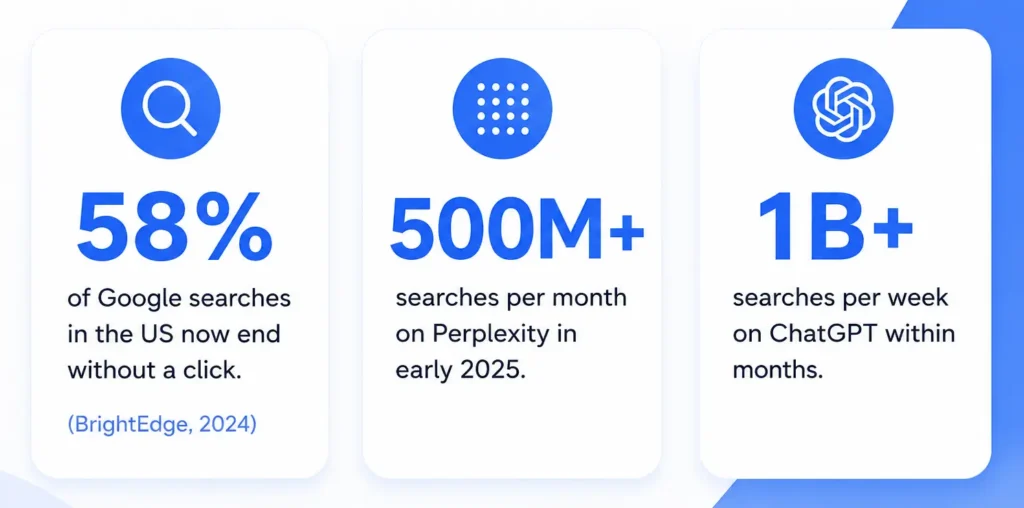
Perplexity reported over 500 million searches per month in early 2025. ChatGPT launched its search feature in late 2024 and reached 1 billion searches per week within months. These aren’t niche tools anymore.
For brands, this means two things. Organic click-through rates from Google are declining even when rankings hold steady. And a new, AI-driven channel for visibility has opened up, one that most competitors haven’t figured out yet.
The Rise of Zero-Click and AI-First Search
Zero-click search happens when a user gets the answer they need directly from the search results page, without clicking through to any website. AI Overviews and AI-generated answers accelerate this trend. Users ask a question, read the AI’s summary, and move on. Brands that don’t appear in those summaries lose visibility with no obvious ranking drop to diagnose.
The brands that do appear in AI-generated answers gain brand awareness, topical authority, and direct referral traffic where the AI cites sources. GEO is how you get into those answers.
How GEO Differs from SEO
SEO and GEO share the same foundation. Both reward well-structured, authoritative, accurate content. Both penalize thin, spammy, or low-trust pages. A site that performs well in organic search today already has most of what it needs to perform well in AI-generated answers.
The difference lies in what the output looks like and who decides it.
Same Foundations, Different Outputs
In traditional SEO, Google’s algorithm ranks pages and presents a list of links. The user chooses where to click. Your job is to earn a high position on that list.
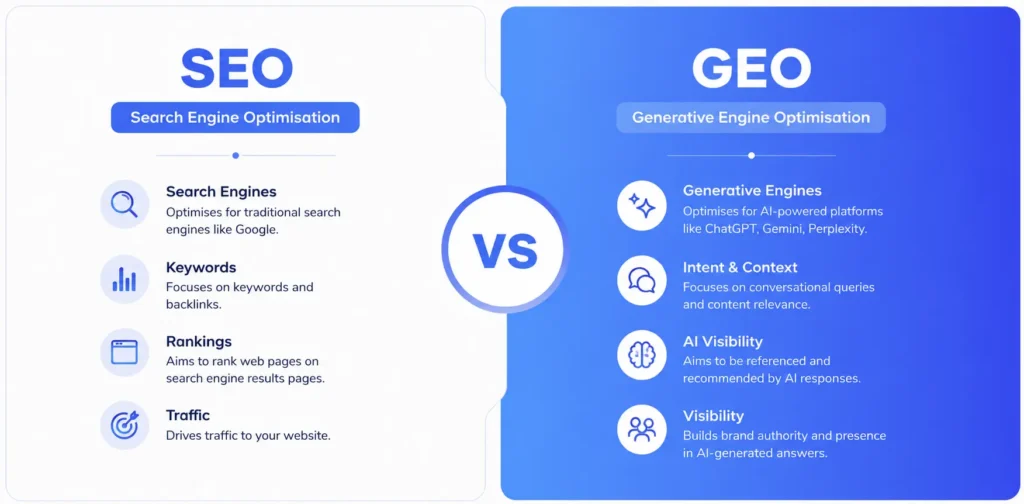
In GEO, an AI engine reads multiple pages, synthesizes the information, and generates a single answer. It may cite one or two sources, or none at all. Your job shifts from earning a ranking to being the source the AI selects to quote.
That shift changes how you write. A page optimized purely for SEO might spread information across many paragraphs to build dwell time. A page optimized for GEO needs clean, directly answerable passages an AI can pull out of context and quote accurately. User intent still drives both; the difference is what happens after the AI reads your page.
GEO vs SEO: A Side-by-Side Comparison
| Factor | SEO | GEO |
|---|---|---|
| Primary goal | Rank on Google’s results page | Get cited in AI-generated answers |
| Success metric | Rankings, organic traffic, CTR | AI mentions, brand citation rate, referral from AI tools |
| Key signals | Backlinks, on-page optimization, Core Web Vitals | Quotable answer blocks, E-E-A-T, inline source attribution, entity clarity |
| Content format | Well-structured pages targeting keyword intent | Direct-answer paragraphs, structured definitions, factual specificity |
| Platforms | Google, Bing | ChatGPT, Perplexity, Google AI Overviews, Gemini, Copilot, Grok |
| Timeline | Weeks to months for ranking movement | Tied to training data cutoffs and live retrieval cycles |
| Does one help the other? | Yes. Strong SEO pages tend to get cited in AI answers | Yes. GEO best practices reinforce on-page SEO quality |
How AI Search Engines Actually Work
Most people treat AI engines as a black box. They don’t need to be. A basic understanding of the mechanics behind AI search makes GEO decisions much easier.
What Is Retrieval-Augmented Generation (RAG)?
Retrieval-Augmented Generation (RAG) is the process AI search engines use to generate answers. The AI pulls relevant content from across the web in real time (the retrieval step), then uses a large language model to synthesize that content into a coherent answer (the generation step). RAG-based systems cite live sources; fully generative systems draw from training data alone.
Think of it in two parts. The retrieval step works like a search engine: the AI identifies pages that match the query. The generation step works like a sharp editor: the AI reads those pages, pulls out the most relevant information, and writes a response designed to answer user queries in a single, readable output.
This matters for GEO because RAG-based systems like Perplexity and ChatGPT with search enabled pull from live web content. Freshly published or updated pages can appear in answers quickly. Purely generative responses draw from training data that may be six months to over a year old.
The practical takeaway: keep content fresh, keep facts current, use structured data markup where relevant, and structure pages so the retrieval step can find exactly what the AI needs.
How Different AI Engines Behave
Each major AI search engine handles content slightly differently. A quick engine-by-engine breakdown helps you prioritize.
Google AI Overviews draws heavily from pages that already rank well in Google Search. Strong E-E-A-T, quality backlinks, and on-page SEO carry directly into AI Overview eligibility. Google’s search and AI systems are deeply connected, so ranking well on Google remains the fastest path to appearing in AI Overviews.
Perplexity favors pages with clear citations, recent publication dates, and direct-answer formatting. It shows sources explicitly alongside answers. Pages with a visible publish or update date perform better here.
ChatGPT Search (powered by Bing) draws from Bing’s index and favors well-known domains with strong authority signals. It also pulls from Reddit, Quora, and community platforms, so brand presence and genuine discussion in online communities directly influences ChatGPT citations.
Google Gemini relies on Google’s quality signals. Pages that perform in traditional Google search tend to appear in Gemini answers. E-E-A-T applies directly.
Microsoft Copilot draws from Bing’s index. Standard Bing SEO practices (clean metadata, fast load times, authoritative backlinks) carry over directly.
Claude (Anthropic) favors pages with clear authorship, factual precision, and well-organized structure. Promotional or hype-heavy copy reduces citability.
Grok (X/Twitter) pulls from X and the broader web. Content that earns discussion and sharing on social platforms surfaces more often in Grok’s responses.
How to Optimize Your Content for Generative AI
GEO doesn’t require a complete rewrite of your existing content strategy. Most of the work comes down to refining how you structure and frame information, not creating entirely new content from scratch.
The single most effective GEO tactic is writing a direct-answer paragraph under each major section heading. Keep it between 40 and 60 words. Write it as a self-contained statement that makes sense without surrounding context. AI engines pull these passages because they answer a question cleanly, the same reason Google pulls them for featured snippets.
Place each quotable block directly under an H2 phrased as a question: “What is GEO?” or “How does GEO differ from SEO?” This mirrors how users prompt AI engines and gives the AI a clean match between the query and the answer.
Every section of a long-form page should contain at least one of these blocks.
Structure Your Pages for AI Parsing
AI engines parse content the same way a fast human reader does. They scan headings, pull out strong paragraphs, and skip anything that looks like filler. Pages with clear structure get cited more often than pages buried in long, dense text.
Practical structure principles for GEO:
- Question-phrased H2s wherever the section answers a question users commonly ask
- Short paragraphs: two to four sentences as a default
- Numbered lists for processes, bullets for multi-part answers
- A clear definition early for any technical term central to the page’s topic
- The most important information first in each section; never bury the answer
- A frequently asked questions section at the end. It captures long-tail queries and gives AI engines clean, structured answers to pull from
Build E-E-A-T Signals That AI Engines Can Read
E-E-A-T stands for Experience, Expertise, Authoritativeness, and Trust. Google introduced these signals as part of its quality evaluation framework. AI engines apply the same logic. They favor content from credible, identifiable sources over anonymous or poorly attributed pages.
E-E-A-T signals that directly improve GEO citability include a named author with verifiable credentials, specific data points with source attribution, a visible publication or last-updated date, and links to or from other authoritative pages on the topic.
In practice, this means:
- Every long-form post needs a named author with a short bio and a link to their LinkedIn or author profile
- Claims need specific numbers, dates, and named sources. “According to BrightEdge’s 2024 research” beats “studies show”
- Pages need a visible publish date, updated every time the content is refreshed
- Internal links to related pages signal topical depth; external links to reputable sources signal credibility
Anonymous content, vague claims, and pages with no date signals sit at a structural disadvantage in both SEO and GEO.
Cover Topics With Depth, Not Just Length
Thin content doesn’t get cited. A 400-word overview of a complex topic gives an AI engine very little to work with. Comprehensive pages that cover a subject from multiple angles (definition, context, comparison, tactical steps, measurement) give AI engines the depth they need to generate a complete, accurate answer.
This isn’t about padding word count. Genuine depth means answering the follow-up questions a reader would ask, covering edge cases, and addressing the points competitors leave out.
The Princeton NLP Group’s 2023 GEO research paper found that adding relevant statistics, citing authoritative sources, and using fluent language improved content visibility in AI-generated answers by up to 40%. Depth and credibility signal quality across both Google and AI platforms.
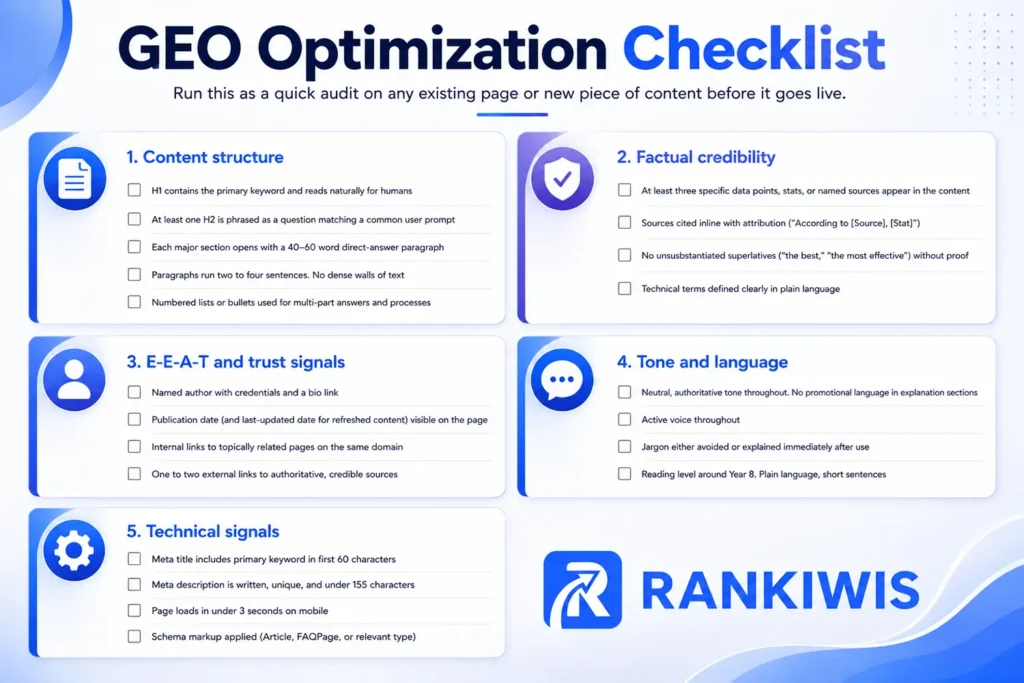
GEO Optimization Checklist
Run this as a quick audit on any existing page or new piece of content before it goes live.
Content structure
- H1 contains the primary keyword and reads naturally for humans
- At least one H2 is phrased as a question matching a common user prompt
- Each major section opens with a 40–60 word direct-answer paragraph
- Paragraphs run two to four sentences. No dense walls of text
- Numbered lists or bullets used for multi-part answers and processes
Factual credibility
- At least three specific data points, stats, or named sources appear in the content
- Sources cited inline with attribution (“According to [Source], [Stat]”)
- No unsubstantiated superlatives (“the best,” “the most effective”) without proof
- Technical terms defined clearly in plain language
E-E-A-T and trust signals
- Named author with credentials and a bio link
- Publication date (and last-updated date for refreshed content) visible on the page
- Internal links to topically related pages on the same domain
- One to two external links to authoritative, credible sources
Tone and language
- Neutral, authoritative tone throughout. No promotional language in explanation sections
- Active voice throughout
- Jargon either avoided or explained immediately after use
- Reading level around Year 8. Plain language, short sentences
Technical signals
- Meta title includes primary keyword in first 60 characters
- Meta description is written, unique, and under 155 characters
- Page loads in under 3 seconds on mobile
- Schema markup applied (Article, FAQPage, or relevant type)
Does SEO Still Work With AI Search?
Yes. Strongly and directly.
The best GEO strategy starts with a strong SEO foundation. Pages that rank well in Google search are far more likely to appear in Google AI Overviews. Pages with strong backlinks and domain authority are more likely to get retrieved by ChatGPT Search and Copilot. Good SEO makes GEO more effective, and GEO best practices reinforce the on-page quality signals Google rewards.
The main shift is this: SEO optimizes for ranking position; GEO optimizes for citability. A page can sit at position four in Google and still appear in an AI Overview if it contains the clearest, most directly quotable answer to the search query.
That’s why content quality and structure matter more now than they ever have. The page that wins the AI citation isn’t always the one in position one. It’s the one that answers the question most cleanly.
The death-of-SEO narrative is wrong. What’s actually happening is that the bar for content quality has risen. Thin, keyword-stuffed pages that once relied on backlinks and domain authority to hold rankings now compete against pages that answer questions directly, cite credible sources, and carry genuine author expertise. Both SEO and GEO reward the same underlying quality.
Do both well. They aren’t competing priorities.
How to Measure GEO Performance
This is the section most GEO guides skip, which is why so many teams struggle to prove the value of GEO work to leadership and clients. Measurement is harder than in traditional SEO. There’s no GEO version of Google Search Console yet. But several practical approaches exist right now.
To measure GEO performance, teams combine AI platform monitoring tools, referral traffic analysis, brand mention tracking, and prompt testing. The goal is to track how often your brand or content appears in AI-generated answers across major platforms and whether that visibility translates into referral traffic, brand searches, or leads.
Tools for Tracking AI Visibility
Profound is one of the most purpose-built tools for tracking AI search visibility. It monitors brand and content mentions across ChatGPT, Perplexity, Claude, and Gemini, showing which queries surface your brand, which competitors appear alongside you, and how your AI visibility trends over time.
Otterly.ai focuses specifically on tracking brand presence in AI-generated answers. It lets you monitor specific prompts and see whether your content gets cited or referenced.
Manual prompt testing is low-tech but a solid starting point. Query the AI tools your audience uses most, using the same questions they’d ask. Note whether your brand appears, which competitors show up instead, and what sources the AI cites. Run the same tests monthly to track shifts.
Dark traffic from AI search refers to sessions in your Google Analytics that arrive with no referral source, showing as direct traffic in GA4. As AI tools send users to websites without a clear UTM or referral tag, some of that previously unexplained direct traffic is actually AI-referred. Watch for unexplained spikes in direct traffic on pages with strong GEO signals, particularly alongside flat or declining organic search numbers.
Brand search volume in Google Search Console is an indirect signal worth watching. When AI tools mention your brand in answers, brand-name search queries often increase even as non-branded traffic shifts. A rising brand search trend alongside flat organic traffic frequently signals growing AI visibility.
Set a baseline now. Track AI mentions monthly across at least three platforms. Even a simple spreadsheet logging which prompts surface your brand and which competitors appear instead gives you actionable data to work from.
FAQs About Generative Engine Optimization
What is generative engine optimization in simple terms?
GEO is the practice of writing and structuring content so AI-powered search engines like ChatGPT, Perplexity, and Google AI Overviews choose to cite it in their generated answers. It works alongside traditional SEO. A strong SEO foundation makes GEO more effective, not less.
What’s the difference between SEO and GEO?
SEO targets rankings on Google’s search results page. GEO targets citation in AI-generated answers. SEO measures success through rankings and organic traffic. GEO measures success through AI brand mentions, citation rate, and referral traffic from AI platforms. The tactics overlap significantly. Both reward clear structure, credible authorship, and high-quality content.
How do I get cited by ChatGPT or Perplexity?
Write content that directly answers the questions your audience asks. Use a named author with verifiable credentials. Cite specific data with source attribution. Structure each major section with a short, self-contained answer paragraph. Keep content fresh and update it regularly. Strong organic search performance in Bing for ChatGPT Search also raises your chances.
Does GEO replace SEO?
No. GEO extends SEO. The same content quality signals that help Google rank a page also help AI engines cite it. Treat GEO as an additional optimization layer on top of a solid SEO strategy, not a replacement for it.
How long does GEO take to work?
For AI engines using live retrieval like Perplexity and ChatGPT Search, well-optimized content can appear in AI answers within days or weeks of publication. For training-data-dependent responses, visibility ties to when AI models next update their training data, which can take six to twelve months. Start building GEO-optimized content now; the compounding effect builds over time.
What tools can I use to measure GEO performance?
Profound and Otterly.ai are the most purpose-built tools for tracking AI search visibility and brand mentions. Manual prompt testing across ChatGPT, Perplexity, and Gemini is a practical low-cost starting point. Brand search volume trends in Google Search Console and unexplained direct traffic spikes in GA4 offer useful indirect signals of growing AI visibility.
Start Optimizing for AI Search
GEO isn’t a future problem. It’s a current one. The brands that build GEO-optimized content now will hold a real advantage as AI search continues to grow.
The good news: if you already invest in quality SEO and content marketing, you’re closer than you think. GEO doesn’t ask you to reinvent your strategy. It asks you to refine how you write, structure, and attribute your content.
Want to know how your content performs in AI-generated answers right now? Book a free GEO audit with Rankiwis Team. We’ll show you exactly where your brand appears (and where it doesn’t) across the major AI platforms, and what to do about it.