You’ve got a budget to spend and two platforms asking for it. Google Ads promises people who are already looking for what you sell. Meta Ads promises people who don’t know they need you yet, but might, if the timing and creative land right. Both pitches are true. Neither tells you which one to fund first.
The Google Ads vs Meta Ads question comes up in almost every early budget conversation we have with clients, and it rarely has a one-size-fits-all answer. This guide skips the vague “it depends” response and gives you the actual numbers: what each platform costs right now, who it works best for, and when running both makes more sense than picking one. A quick word on your other channel options first: if you haven’t settled on paid advertising as your next move at all, weighing your channel options before you spend is worth reading before this guide. Once you land on Google Ads as your platform, our guide on how to set up your first Google Ads campaign walks through that setup step by step. This piece covers the decision that comes before either of those.
What’s the Difference Between Google Ads and Meta Ads?
Google Ads is a search advertising platform. Someone types a query into Google, and your ad competes to appear next to the organic results based on your bid and relevance. Meta Ads runs across Facebook, Instagram, and Messenger, and it targets people based on demographics, interests, and behavior rather than a search query, because there isn’t one to target.
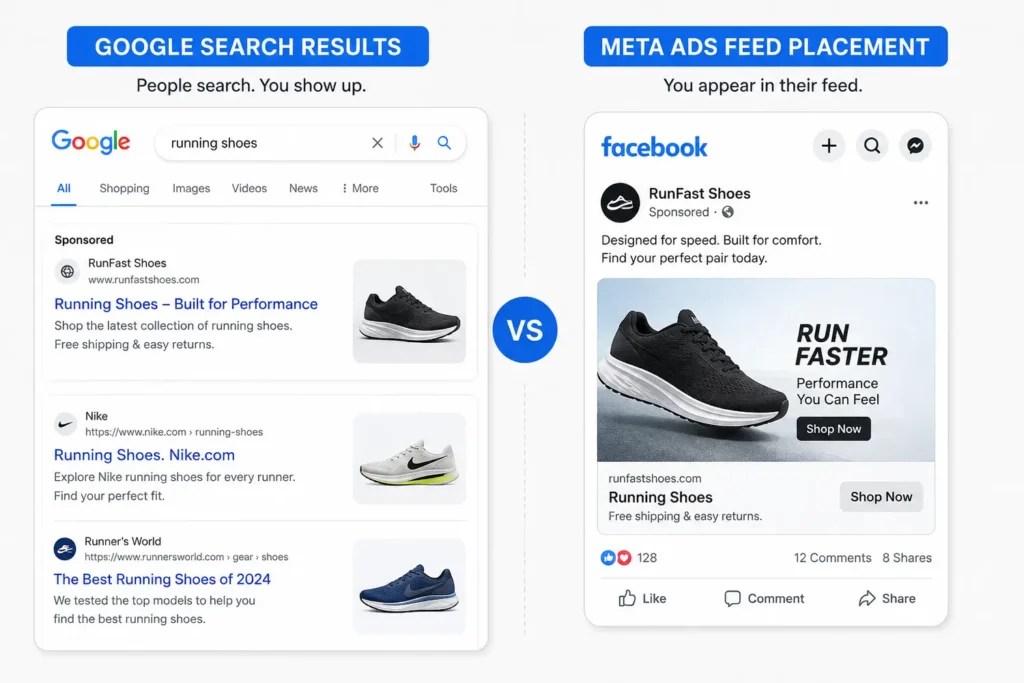
Google Ads matches ads to what people type. Meta Ads matches ads to who people are, based on their profile, interests, and behavior on Facebook and Instagram. One reaches an active search; the other reaches an audience that fits a profile. That split shapes almost every other decision in this comparison, from cost to creative to what a “good result” even looks like on each platform.
The practical difference shows up fastest in format. Google Ads leans on text, structured around headlines and descriptions that answer a specific query. Meta Ads leans on visuals: image, video, carousel, and Stories formats that need to stop a scroll rather than answer a question. Ad copy built for one platform rarely transfers cleanly to the other, and treating them the same is a common way small budgets get wasted early.
Google Ads Captures Demand. Meta Ads Creates It.
Here’s the mental model that actually matters more than any feature comparison: Google Ads captures demand that already exists. Meta Ads creates demand that doesn’t exist yet.
Someone searching “emergency plumber near me” has a problem right now and wants a solution today. Google Ads puts your business in front of that exact moment. Someone scrolling Instagram wasn’t thinking about plumbers at all. Meta Ads has to earn attention first, build interest second, and only then hope for a click or a save for later.
Google Ads captures existing demand: people who already know what they want and are actively searching for it. Meta Ads creates new demand: people who weren’t looking for a solution but discover one through a well-targeted ad in their feed. Neither approach beats the other. They serve different stages of the same buying journey.
This isn’t just a marketing framing exercise. It changes what you should expect from each platform. A Google Ads campaign that doesn’t convert fast is broken. A Meta Ads campaign that doesn’t convert fast might just be doing its job, building awareness that shows up as a search or a direct visit weeks later.
Which Platform Costs Less: Google Ads or Meta Ads?
Cost per click tells a clear story here, and it’s worth looking at real numbers instead of guessing.
According to WordStream’s 2026 search advertising benchmarks, the average cost per click across all industries on Google Ads is $5.42, with an average click-through rate of 6.64%. Meta Ads runs far cheaper on a per-click basis. WordStream’s Facebook ads benchmark report puts the average cost per click for traffic campaigns at $0.70 across all industries, with a 1.71% click-through rate. For lead generation campaigns specifically, Meta’s average cost per click rises to $1.92, with a 2.59% click-through rate and a 7.72% conversion rate.
| Metric | Google Ads (search) | Meta Ads (traffic) | Meta Ads (leads) |
|---|---|---|---|
| Avg. click-through rate | 6.64% | 1.71% | 2.59% |
| Avg. cost per click | $5.42 | $0.70 | $1.92 |
Meta Ads costs less per click than Google Ads in nearly every case, but a cheap click isn’t automatically a cheap customer. Google’s higher cost per click reflects higher buyer intent, so those clicks convert at a better rate on average. Compare cost per lead or cost per acquisition, not cost per click alone, before deciding where your budget goes furthest.
A cheaper click that never converts costs more than an expensive click that does. Budget decisions belong on cost per lead or cost per acquisition, not the click price alone. That said, the gap in raw click cost is wide enough that Meta Ads gives smaller budgets more room to test creative, targeting, and offers before spending real money on a single channel.
Worth noting for context: eMarketer’s April 2026 forecast projects Meta will overtake Google in total worldwide ad revenue for the first time this year, with Meta reaching $243.46 billion against Google’s $239.54 billion. That shift reflects where advertiser budgets are moving industry-wide. It doesn’t tell you where your budget should go. That decision still comes down to your funnel stage and your numbers, not the platform’s market share.
When Google Ads Is the Better Choice
Google Ads earns its cost when the searcher already knows what they want. A few business types where it consistently performs well:
- Service businesses solving an urgent problem. Plumbers, locksmiths, urgent care clinics, and lawyers all benefit from being the answer to a search someone runs the moment they need help.
- High-consideration purchases with clear search terms. Software, B2B services, and anything with an established category name gets found through Google Ads because buyers research before they buy.
- Businesses with a tight, well-defined keyword list. If you can name the exact phrases your buyers type, Google Ads turns that list into traffic fast.
- Anyone who needs measurable, attributable leads quickly. Google’s conversion tracking ties a click to a result cleanly, which matters when a client or a boss wants proof the spend works.
Already running Google Ads? Cleaning up your keyword targeting with negative keywords is one of the fastest ways to bring that average cost per click down without touching your bids.
When Meta Ads Is the Better Choice
Meta Ads earns its cost when the audience exists but the demand needs to be built. It tends to perform best for:
- Visually driven products. Fashion, home décor, food, and anything that photographs or films well benefits from Meta’s carousel, video, and Stories formats.
- New or unfamiliar brands. If nobody is searching for your business by name yet, there’s no search demand to capture. Meta builds the awareness Google Ads depends on later.
- Niche or emerging audiences. Meta’s interest and behavior targeting reaches people a keyword list would miss entirely, especially for products people don’t yet know they want.
- Retargeting warm traffic. Someone who visited your site but didn’t buy is a strong Meta Ads audience, since you’re not creating demand from zero, you’re closing a loop.
Should You Run Google Ads and Meta Ads Together?
For most growing businesses, yes. The two platforms aren’t really in competition with each other; they cover different parts of the same funnel. Meta Ads builds awareness and warms up an audience that hasn’t searched yet. Google Ads then captures that same audience once they start actively looking, along with everyone else who was already searching independently.
A common, effective pattern: run Meta Ads to introduce the brand and drive traffic or engagement, then run Google Ads to capture the resulting search demand, including branded search from people who remember the name after seeing it in their feed. A retargeting layer connects the two platforms further, since Meta ads can go right back to website visitors who clicked a Google ad but didn’t convert on the first visit.
Don’t rush into both at once, though. A small budget split across two unproven platforms usually generates too little data on either one to optimize well. Get one platform to a stable, profitable cost per lead first, with clean conversion tracking in place, then use what you learned about your customer’s language and behavior to launch the second. As a rough floor, plan on at least $1,000 to $1,500 a month per platform before expecting enough volume to judge performance fairly.
One more thing worth knowing before you compare numbers across both dashboards: Google Ads and Meta Ads will never report matching conversion totals, and that’s normal rather than a tracking bug. The two platforms use different attribution windows and count view-through conversions differently, so a buyer who sees a Meta ad and later searches your brand name on Google can get counted as a win by both platforms. Consistent measurement rules and clean first-party tracking matter more than reconciling every conversion between systems.
Budget split depends on where the business sits today. A brand-new business with little search volume for its name should weight spend toward Meta Ads first, since there’s limited existing demand for Google Ads to capture yet. An established business with strong branded search and clear high-intent keywords usually gets more immediate return from Google Ads, with Meta Ads playing a supporting role for retargeting and top-of-funnel reach.
FAQ
Is Google Ads or Meta Ads better for small business?
Neither is universally better. Google Ads works best for small businesses with a specific, searchable service, like local repair or emergency trades. Meta Ads works best for small businesses with a visual product or a new brand that needs awareness before search demand exists.
Which is cheaper, Google Ads or Meta Ads?
Meta Ads has a lower average cost per click, at $0.70 for traffic campaigns compared to $5.42 for Google Ads, according to WordStream’s 2026 and 2025 benchmark reports. Google Ads clicks cost more but come from higher-intent searchers, so cost per lead is a better comparison than cost per click alone.
Can I use Google Ads and Meta Ads at the same time?
Yes, and for most growing businesses it’s the stronger approach. Meta Ads builds awareness and reaches people before they search, while Google Ads captures the demand once it exists, including branded searches that Meta Ads helped create.
Do Google Ads and Meta Ads use the same ad creative?
No. Google Ads relies on text headlines and descriptions built around search queries. Meta Ads relies on images, video, and visual formats built to stop a scroll. Ad copy and creative built for one platform usually needs a rework before it performs on the other.
Why don’t my Google Ads and Meta Ads conversion numbers match?
Because the two platforms count conversions differently, not because your tracking is broken. Google and Meta use different attribution windows and handle view-through conversions differently, so the same buyer can get credited by both platforms if they see a Meta ad and later convert through a Google search. Focus on consistent measurement rules and clean first-party tracking rather than trying to make the two totals line up exactly.