Introduction: Why a Content Audit for SEO Is No Longer Optional
If your website has been publishing content for months or years, chances are you’re sitting on untapped SEO potential. Some pages may be ranking but underperforming, others may be outdated, and a few could even be hurting your overall search visibility. This is where a Content Audit becomes essential.
A Content Audit for SEO is a structured process of analyzing all the content on your website to understand what’s working, what’s not, and what needs improvement. Combined with a thorough SEO Review, it helps businesses align their content with search intent, improve rankings, and maximize ROI.
This supporting post complements a broader content marketing strategy and is designed to help marketers, SEO professionals, and business owners perform a practical, results-driven audit.
What Is a Content Audit in SEO?
A Content Audit is a systematic review of all indexable content on your website. From blog posts and landing pages to guides and resources, every URL is evaluated based on performance, relevance, and optimization.
An SEO-focused audit goes beyond surface-level checks. It looks at:
- Organic traffic performance
- Keyword rankings
- Search intent alignment
- Content quality and freshness
- Technical SEO elements
The goal of an SEO Review is not just cleanup—it’s optimization and growth.
Why Content Audits Are Critical for SEO Success
Search engines reward relevance, quality, and authority. Over time, even high-performing content can decay. Conducting a regular Content Audit helps you:
- Identify outdated or underperforming content
- Improve keyword targeting and internal linking
- Eliminate duplicate or thin pages
- Increase organic traffic and conversions
- Strengthen topical authority
Without a structured audit, SEO decisions become guesswork rather than strategy.
When Should You Conduct a Content Audit?
You should consider a Content Audit if:
- Organic traffic has plateaued or declined
- Rankings fluctuate frequently
- Your site has grown significantly
- You’re planning a website redesign or migration
- You want to scale your content marketing efforts
Most SEO professionals recommend a full audit once or twice per year, with mini-audits quarterly.

Step 1: Define the Goal of Your Content Audit
Before pulling data, define why you’re auditing. Clear objectives shape better outcomes.
Common goals include:
- Improving organic traffic
- Increasing conversions
- Aligning content with search intent
- Supporting a new SEO or content strategy
- Cleaning up technical SEO issues
Your Content Audit and SEO Review should always support broader business goals.
Step 2: Create a Complete Content Inventory
A content inventory is the foundation of your audit.
How to Build a Content Inventory
Use tools like:
- Screaming Frog
- Sitebulb
- Google Search Console
- CMS exports
Capture key details such as:
- URL
- Page title
- Content type
- Word count
- Publication date
This creates a centralized database for analysis.
Step 3: Collect SEO Performance Data
Now it’s time to enrich your inventory with performance metrics.
Key SEO Metrics to Track
- Organic traffic
- Average keyword position
- Click-through rate (CTR)
- Backlinks
- Indexing status
- Conversions or goal completions
These insights form the backbone of your SEO Review.
Step 4: Analyze Content Quality and Relevance
SEO isn’t just about data—it’s about usefulness.
Ask critical questions:
- Does this content satisfy search intent?
- Is it accurate and up to date?
- Does it demonstrate expertise and authority?
- Is it easy to read and well-structured?
Low-quality or outdated pages can dilute your site’s overall SEO strength.
Step 5: Map Keywords and Search Intent
One of the most common SEO problems is keyword misalignment.
During Your Content Audit, Check:
- Are multiple pages targeting the same keyword?
- Does the keyword match user intent (informational, navigational, transactional)?
- Are important keywords missing entirely?
This step often reveals keyword cannibalization, which can silently hurt rankings.
Step 6: Evaluate On-Page SEO Elements
Every page should follow on-page SEO best practices.
Elements to Review
- Title tags and meta descriptions
- H1–H3 heading structure
- Internal links
- Image alt text
- URL structure
Optimizing these elements can deliver quick SEO wins without rewriting entire articles.
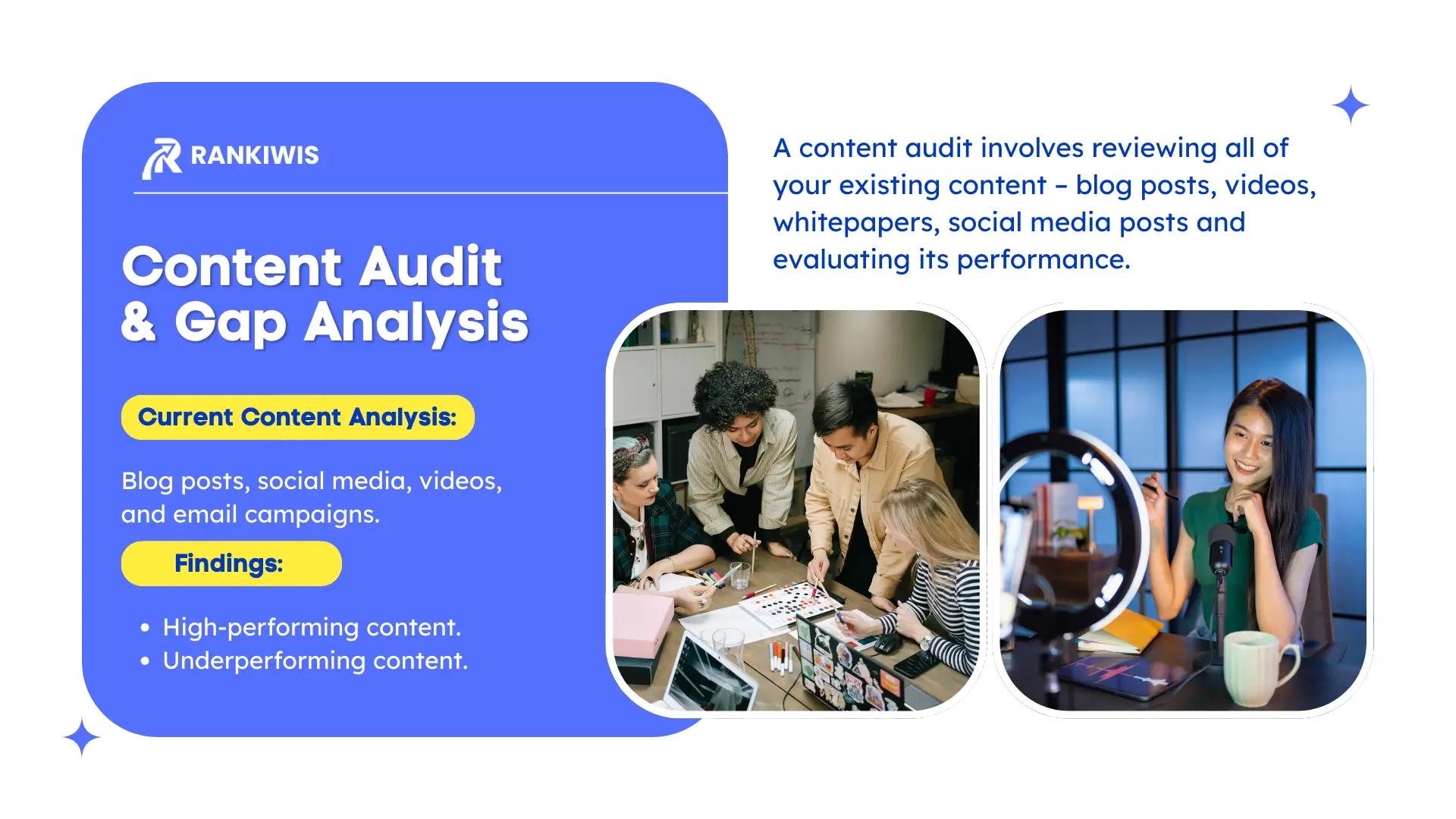
Step 7: Identify Content Gaps and Opportunities
A strong Content Audit doesn’t just fix problems—it uncovers opportunities.
Look for:
- Topics competitors rank for that you don’t
- High-impression pages with low CTR
- Pages ranking on page two of Google
- Emerging keyword trends
These insights directly inform future content creation and optimization.
Step 8: Decide What Action Each Page Needs
Every URL should fall into one of these categories:
| Action | Description |
| Keep | High-performing, evergreen content |
| Update | Content that needs optimization or freshness |
| Merge | Similar or overlapping pages |
| Redirect | Outdated pages with backlinks |
| Remove | Thin or low-value content |
Clear decisions streamline execution and prevent analysis paralysis.
Step 9: Update and Optimize Content for SEO
For pages marked “Update,” focus on:
- Improving depth and clarity
- Refreshing statistics and examples
- Enhancing internal linking
- Adding FAQs or structured data
- Optimizing for featured snippets
This is where your Content Audit turns into measurable SEO growth.
Step 10: Monitor Results and Measure Impact
SEO is iterative. After implementing changes:
- Track ranking improvements
- Monitor organic traffic growth
- Review conversion data
- Compare pre- and post-audit performance
A successful SEO Review should show measurable gains within 4–12 weeks.
Common Content Audit Mistakes to Avoid
- Auditing without clear goals
- Focusing only on traffic metrics
- Ignoring search intent
- Deleting pages without redirects
- Treating audits as one-time tasks
Avoiding these mistakes ensures long-term SEO success.
How Content Audits Support a Broader Content Marketing Strategy
A Content Audit is not a standalone task—it’s a strategic asset. It ensures that every piece of content supports your wider marketing goals.
For a deeper understanding of aligning audits with long-term planning, explore this Content Marketing Strategy guide
FAQs: Content Audit for SEO
1. What is the difference between a Content Audit and an SEO Audit?
A Content Audit focuses on content quality and performance, while an SEO Review also includes technical and off-page factors.
2. How long does a Content Audit take?
Depending on site size, it can take anywhere from a few days to several weeks.
3. Do I need paid tools for a Content Audit?
Paid tools help, but you can perform a basic audit using Google Search Console and Analytics.
4. How often should I run a Content Audit?
At least once per year, with quarterly check-ins for high-traffic sites.
5. Can a Content Audit improve rankings quickly?
Yes, especially when optimizing pages already ranking on page two of search results.
6. Is a Content Audit necessary for small websites?
Absolutely. Even small websites benefit from clarity, focus, and optimization.
Conclusion: Turn Your Content into an SEO Growth Engine
A well-executed Content Audit is one of the most powerful tools in SEO. By combining performance data, qualitative analysis, and strategic decision-making, businesses can transform underperforming content into high-ranking assets. When paired with a consistent SEO Review process, content audits ensure your website stays relevant, competitive, and aligned with search engine expectations—today and in the future.
Start your content audit today and turn your website into a predictable, scalable SEO growth engine that delivers real business results.