Search used to be simple. You typed a question, Google handed you ten links, and you clicked the best one. That loop is breaking down. Today, a growing number of searches end with an answer delivered directly on the results page, no click required. AI tools like ChatGPT, Perplexity, and Google AI Overviews synthesize information and deliver it straight to the user.
That shift is what answer engine optimization is about. Not ranking higher in a list of links, but becoming the source an AI engine trusts enough to cite when someone asks a question you can answer.
This guide covers what AEO is, how it differs from SEO and GEO, what Google’s own guidance says about it, and the specific steps you can take to get your content cited by AI search platforms in 2026.
Table of Contents
What Is Answer Engine Optimization (AEO)?
Answer engine optimization (AEO) is the practice of structuring content so that AI-powered search tools, including ChatGPT, Perplexity, and Google AI Overviews, can extract it and present it as a direct answer. The goal is not just to rank in search results but to become the cited source when an AI engine responds to a user’s question.
Traditional search optimization gets your page into a ranked list. AEO gets your content selected as the answer itself. The distinction matters more every year as AI-generated responses push organic links further down the page.
AEO is built on a simple idea: write content that machines can read, trust, and extract. Clear structure, direct answers, factual accuracy, and credible sourcing are the building blocks. Most of those principles align with good SEO. The difference is the intent behind them: you’re optimizing for citation, not just for clicks.
Why AEO Matters Right Now
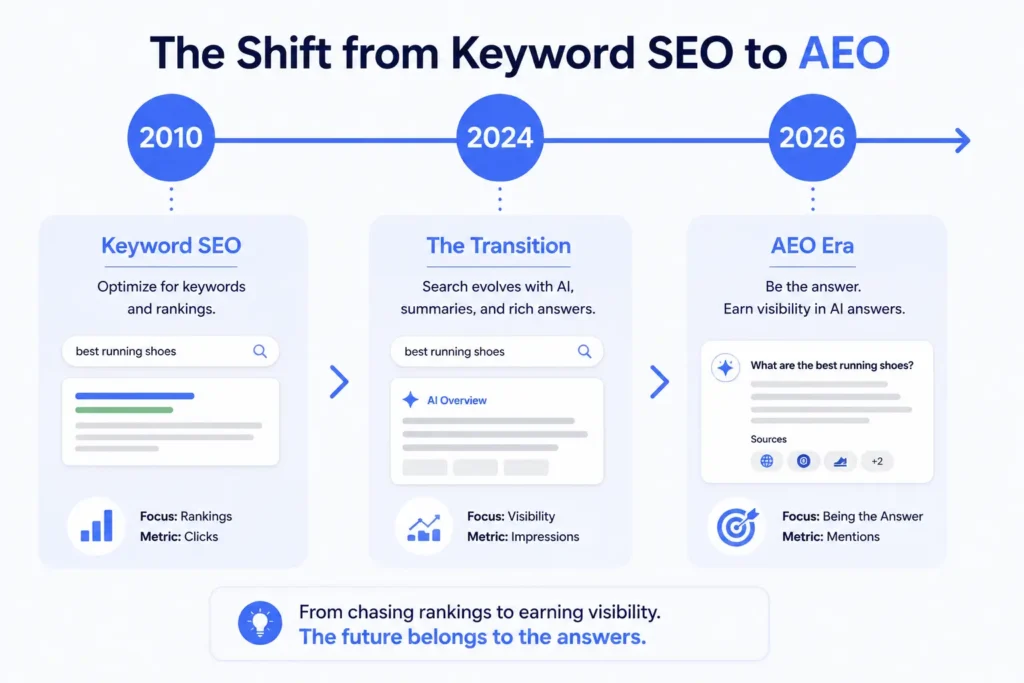
Search is moving away from links
The numbers make the case fast. According to Gartner, traditional search volume will drop 25% by 2026 as AI answer engines grow in adoption. ChatGPT now handles over 2.5 billion queries daily, according to OpenAI. AI-referred sessions to websites grew 527% between January and May 2025, according to Previsible’s analysis of 19 GA4 properties reported by Search Engine Land, but that traffic concentrates in a tiny pool of cited sources. The brands that earn citations capture that audience. The brands that don’t become invisible.
This isn’t a coming trend. It’s happening in the search results right now, every time Google’s AI Overview answers a question before the user sees a single organic link.
Zero-click is the new normal, and that’s not entirely bad news
Nearly 60% of Google searches in 2024 ended without a user clicking through to any website — 58.5% in the US and 59.7% in the EU, according to SparkToro and Datos. That number keeps rising. Voice search, AI chat tools, and featured snippets all serve the answer directly, with no click involved.
For most marketers, that sounds like bad news. For content built purely for clicks, it is. But the business case for AEO goes deeper than traffic. Semrush’s 2025 AI search study found that visitors arriving through AI search convert at 4.4 times the rate of those coming from traditional organic search. The audience is smaller, but the intent is sharper. And a brand cited in an AI response earns authority even when no click happens.
The conversion data makes that case even more clearly. Ahrefs published a study in June 2025 showing that visitors arriving from AI search platforms generated 12.1% of all signups despite representing only 0.5% of traffic — a 23x higher conversion rate than traditional organic visitors. The audience is smaller, but the intent is sharper. These users arrive pre-qualified: by the time an AI engine cites your content and a user clicks through, they have already compared options and evaluated your brand. That’s the AEO payoff.
AEO vs. SEO: What’s the Difference?
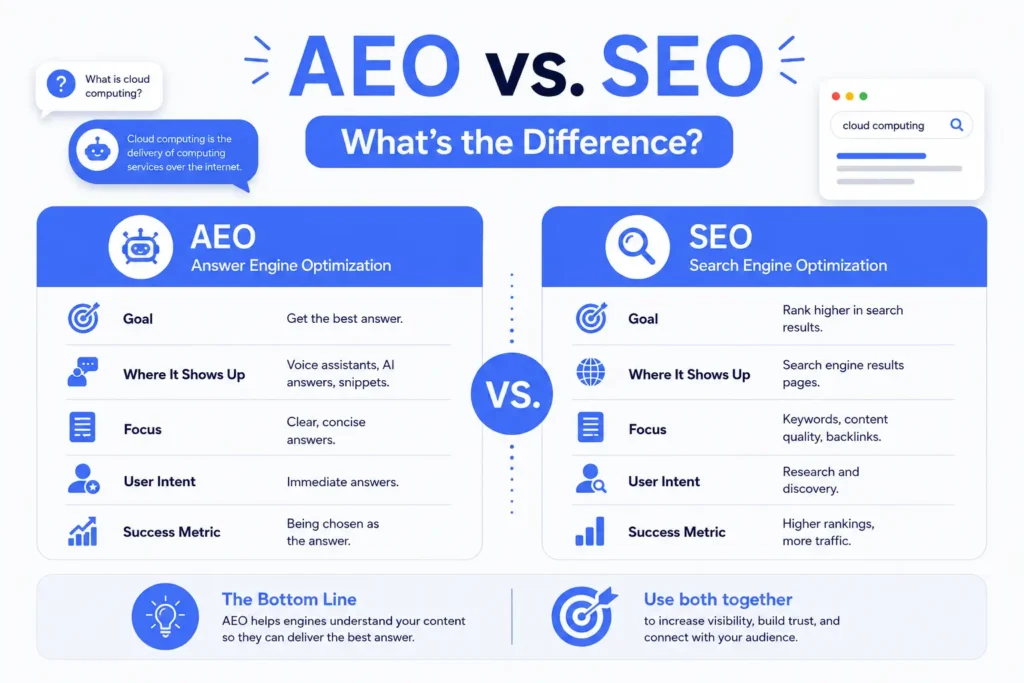
SEO and AEO share a foundation, but they optimize for different outcomes. The table below shows where the two disciplines converge and where they split.
| SEO | AEO | |
|---|---|---|
| Primary goal | Rank pages in search results | Be cited in AI-generated answers |
| Content focus | Comprehensive pages that send ranking signals | Concise, extractable answers AI can summarize |
| Query targeting | High-volume keywords, transactional and local | Question-based, conversational, long-tail |
| Technical priority | Meta tags, headings, site speed, internal links | FAQ schema, structured data, speakable markup |
| Trust signals | Backlinks, domain rating | Citation authority, E-E-A-T, named authorship |
| Measurement | Rankings, clicks, traffic | AI citations, brand mentions, share of voice |
| User journey | Click to site for deeper engagement | Often zero-click — brand visibility without a visit |
| Backlinks | Critical | Still matter, but content quality matters more |
The practical overlap is significant. Research shows 99% of URLs cited in Google’s AI Mode appear in the top 20 organic results, according to Bounteous. A strong SEO foundation correlates directly with AI visibility. But ranking alone doesn’t guarantee citation. AI engines evaluate content through a different lens: how extractable is the answer, how clear is the authority, and how direct is the response to the question.
SEO asks: can Google find and rank this page? AEO asks: can an AI engine extract a usable answer from this page?
Both questions matter. Neither replaces the other. A page that ranks well but answers poorly won’t get cited. A page that answers well but ranks poorly won’t be found. The goal is both.
AEO vs. GEO: Same Thing or Different Discipline?
This is where the terminology gets genuinely confusing, so a straight answer helps.
AEO (answer engine optimization) and GEO (generative engine optimization) describe overlapping practices, and the industry uses the terms interchangeably in most contexts. Wikipedia’s entry on generative engine optimization lists AEO as a related term, along with LLMO (large language model optimization) and AIO (AI optimization). No universal consensus distinguishes them in the academic literature as of early 2026.
Practitioners who draw a distinction usually frame it this way:
AEO focuses on earning the direct answer slot, the specific passage an AI engine extracts and presents as the response to a question. It’s granular, format-driven work. Question-based headings, concise answer paragraphs, FAQPage schema, structured data. These are AEO tactics.
GEO is broader. It’s about how AI engines perceive your brand and content across the entire web, not just one answer on one page. GEO includes entity building, citation management, consistent brand mentions across authoritative sources, and the signals that shape whether an AI model associates your brand with a given topic at all.
Put simply: AEO is about one answer. GEO is about overall presence in AI responses. The tactics required to do each well overlap heavily, which is why most people use the terms as synonyms, and why both sit within Rankiwis’s core content work.
For readers already familiar with what GEO is, AEO is the more specific, content-level discipline within it.
What Google Says About AEO (June 2026 Update)
This is worth knowing before you build an AEO strategy.
In June 2026, Google released new guidance asserting its authority over how AEO and GEO should be practiced, according to Search Engine Journal. The guidance urges caution with third-party SEO services, tools, and data providers making claims about AI visibility optimization. Google’s position, consistent with how it has always framed SEO best practice, is that its own documentation is the ground truth for what works.
The practical implication for content teams: build AEO strategy on Google’s stated quality signals, not on third-party tools claiming to “guarantee” AI citations or AI Overview placement. The same E-E-A-T principles that govern Google Search govern AI Mode and AI Overviews. Demonstrable expertise, clear authorship, factual accuracy, and structured content remain the foundation. No tool shortcuts that.
What this doesn’t change: the core AEO tactics in this guide, including answer-first structure, FAQPage schema, inline citations, and topical authority, align with Google’s own guidance. The risk is in chasing metric dashboards from tools that may not reflect how Google’s systems actually select content.
How Answer Engines Decide What to Cite
AI engines don’t rank pages the way Google does. They look for content that satisfies specific criteria at the moment of query. Understanding those criteria is the core of AEO strategy.
Clarity and extractability. AI engines parse content by section, not by page. Each heading and its following paragraph needs to function as a standalone unit. A vague, context-setting opening to a section gets skipped. A direct answer in the first two sentences gets extracted.
Factual density. Content with specific numbers, named sources, dates, and referenced research is far more citable than content built on general claims. Researchers at Princeton conducted a large-scale study of GEO tactics across 10,000 queries and found that adding expert quotes increased citation probability by 41%, statistics by 30%, and inline citations by 30%. Vague copy with no proof points gets passed over.
Topical authority. AI engines favor sources that demonstrate deep coverage of a subject. A site with fifteen well-linked posts on a topic earns more trust than a site with one long post. Breadth and depth both signal authority.
Structural legibility. Short paragraphs, clear H2s, bullet lists for multi-part answers, and numbered steps for processes all make content easier for AI to parse. Structured content makes extraction easy. Dense walls of text make it hard.
Neutral, authoritative tone. Salesy language actively reduces citability. AI engines favor content that reads like an informed practitioner, not a marketer writing a pitch. Promotional phrasing like excessive enthusiasm, superlatives, or product pushes signals bias, and biased content doesn’t make a reliable cited source.
How to Optimize for Answer Engines
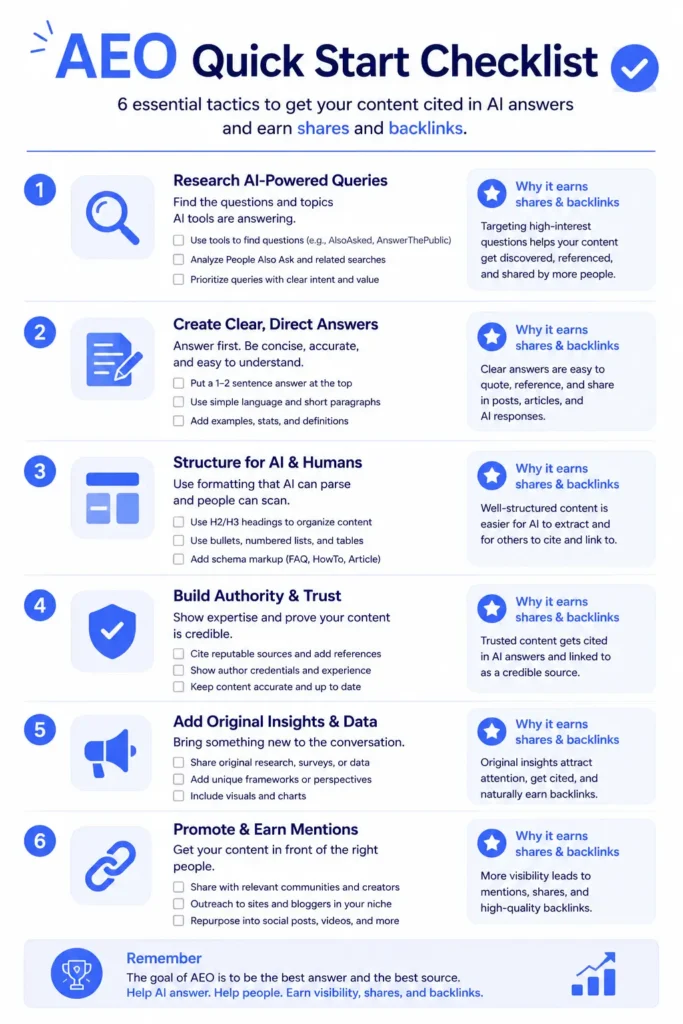
Most AEO tactics are things good content should do anyway. The shift is in execution: write with extraction in mind, not just engagement.
Lead every section with a direct answer
AI engines scan the opening sentences of each section to decide whether the content answers a query. Start each major section with the answer, then support it with context, examples, and evidence. The Frase team frames it clearly: if your opening is vague context-setting, the engine moves on to a competitor whose answer starts immediately.
A direct opening looks like: “FAQPage schema helps AI engines identify question-and-answer pairs within your content and extract them for direct responses.”
A vague opening looks like: “In the modern digital landscape, many marketers are beginning to explore the role of structured data.”
The first one is citable. The second one isn’t.
Use question-based headings
Structure your H2s and H3s as the questions your audience is actually searching. “How do answer engines decide what to cite?” is more extractable than “Answer Engine Selection Criteria.” The heading signals intent to the AI engine before it even reads the paragraph beneath it.
Review your keyword research for the natural questions around your topic. Google’s “People also ask” section surfaces real question phrasing. Each question that appears there is a direct AEO opportunity.
Add FAQ sections with schema markup
A dedicated FAQ section at the bottom of a post does two things at once. It captures long-tail question queries and creates structured, self-contained Q&A pairs that AI engines can lift directly.
Pair your FAQ with FAQPage schema markup, which tells AI engines explicitly: this is a question, and this is the accepted answer. According to AirOps research, structured pages with proper schema earn a 2.8x citation lift compared to unstructured equivalents. For the schema to work properly, the answers in the markup must match what’s visible on the page. Structured data that contradicts visible content creates trust problems rather than clarity.
Build topical authority, not just topic coverage
Covering a topic once in depth is a start. Earning AI citations consistently requires a cluster of related, well-linked content. AI engines favor sources that cover a subject from multiple angles, not just the core definition, but also the adjacent questions, how-tos, comparisons, and edge cases.
The Rankiwis content model for AEO and GEO works exactly this way: a pillar post covers the concept, and supporting posts go deeper on specific tactics. This post connects to guides on how to optimize content for AI search and how to write quotable answer blocks, each building topical authority for the cluster and creating more entry points for AI citation.
Keep your sourcing visible
Name your sources inline rather than burying them in footnotes or leaving claims unsupported. “According to Gartner’s 2025 search forecast” signals credibility to both AI engines and human readers in a way that “studies show” never does. The Princeton GEO study found inline citations improved citation probability by 30%. That’s worth the extra line of copy.
The same principle applies to on-page SEO more broadly: specific, verifiable content builds trust faster than general claims. AEO just makes the stakes explicit: your sourcing directly affects whether AI engines trust your content enough to cite it.
Get mentioned beyond your own site
On-site AEO covers structure and format. But AI engines also weight off-site signals. Getting your content mentioned, cited, or referenced by other authoritative sources increases the probability that AI engines encounter your brand in multiple credible contexts, which reinforces citation likelihood.
Practical off-site AEO moves include: publishing data or original research that other sites naturally cite, contributing quotes to industry publications that AI engines already pull from, and building genuine presence on platforms like Reddit and LinkedIn where AI engines increasingly surface community-generated answers. The fastest shortcut to off-site AEO is to be the source other credible sources point to.
How to Measure AEO Performance
Traditional SEO metrics don’t fully capture AEO performance. You need to track a different set of signals alongside your usual rankings data.
Google Search Console: impressions with low CTR. A page with high impressions but low click-through rates is often appearing in AI Overviews or featured snippets, where users see the answer without clicking through. That’s AEO working. The visibility is real even when the traffic isn’t.
AI mention tracking. Tools like Semrush, Advanced Web Ranking, and specialized platforms like Profound track where your brand appears across AI answer engines. They monitor citations, brand mentions, and share of voice across ChatGPT, Perplexity, Gemini, and others. Run a manual check first: ask ChatGPT and Perplexity the same questions your target audience would ask. Does your content appear? Does a competitor appear instead?
Featured snippet captures. Track how many of your target keywords generate featured snippets and whether you hold them. Featured snippets are the original answer engine format, and winning them correlates with stronger AI citation performance across the board.
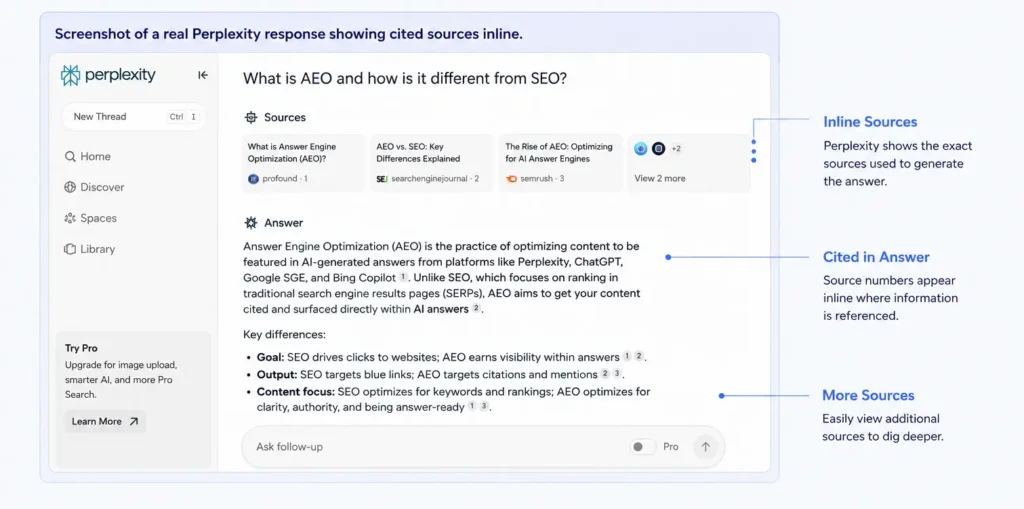
Perplexity as a feedback loop. Perplexity retrieves sources in near real-time and shows citations inline. It’s the fastest platform to test AEO changes on. Optimize a page, then query Perplexity for the same question a few days later. If your page appears where it didn’t before, the change worked. Use it as a quick validation tool before investing time in other platforms.
Revenue and conversion quality alongside traffic. As zero-click grows, traffic volume alone becomes a less accurate measure of AEO success. Track whether AI visibility is contributing to brand searches, direct visits, and conversion rates. Ahrefs’ data showing AI visitors converting at 23x the rate of organic visitors is a useful benchmark: the goal is higher-intent traffic, not necessarily more of it.
Frequently Asked Questions
What is answer engine optimization in simple terms?
Answer engine optimization (AEO) is the practice of writing and structuring content so AI-powered tools like ChatGPT, Perplexity, and Google AI Overviews select it as a direct answer to a user’s question. Instead of optimizing purely for search rankings and clicks, AEO optimizes for AI citations and answer placement.
Is AEO the same as GEO?
The terms overlap significantly and are used interchangeably by most practitioners. AEO typically refers to the content-level tactics that earn direct answer placement: clear formatting, question-based headings, schema markup, and direct answer paragraphs. GEO is broader and includes brand entity building and overall AI visibility across the web. Both describe optimizing for AI search, and the tactics required are nearly identical.
Will AEO replace SEO?
No. AEO builds on SEO rather than replacing it. Research shows 99% of URLs cited in Google’s AI Mode appear in the top 20 organic search results, meaning strong SEO performance directly supports AI visibility. AEO adds an additional layer: formatting content so that AI engines can extract and cite it, writing answer-first sections, and implementing schema markup. SEO gets your content into consideration. AEO gets it selected as the answer.
Do backlinks still matter for AEO?
Yes, but their role shifts. In traditional SEO, backlinks are a primary ranking signal. In AEO, content quality, clarity, and named authorship matter more than raw link volume. That said, backlinks still contribute to domain authority, which AI engines use as a proxy for trustworthiness. Off-site AEO tactics like earning citations in credible publications are the link-building equivalent for AI visibility.
Do I need AEO if I already do SEO?
A strong SEO foundation helps with AEO, because AI engines favor authoritative, well-structured pages that already rank well. But AEO requires additional work: formatting content for extraction, adding schema markup, writing quotable answer blocks, and sourcing claims visibly. SEO gets you into consideration. AEO gets you cited.
How long does AEO take to show results?
Perplexity retrieves sources in near real-time, so changes to well-indexed pages can appear in Perplexity citations within days of publishing. Google AI Overviews and ChatGPT with search take longer, typically weeks to months, depending on how quickly Googlebot and OpenAI’s crawler re-index the updated content. Topical authority signals build over months, not days.
What’s the easiest AEO tactic to start with?
Add a FAQ section to your top-performing informational pages and pair it with FAQPage schema markup. This creates structured, self-contained Q&A pairs that AI engines can extract directly, and it’s one of the highest-impact AEO implementations relative to the effort involved.
The Answer Is the Product Now
For most of search’s history, content competed to be the best option in a list. The reader made the final call. AI search changes that dynamic. The engine makes the call first, selects one or two sources, and presents them as the answer. The reader often goes no further.
That shift makes AEO one of the most practical areas of focus for any content team working in 2026. The tactics aren’t complicated. Lead with answers. Structure content for extraction. Source your claims. Build topical depth. Get mentioned beyond your own site. The brands that do this consistently will show up in AI responses at the moment users are forming opinions and making decisions.
SEO still matters. The ranking signals that earn Google positions also earn AI citations. The optimization layer on top, the formatting, the schema, the answer-first writing, is what separates pages that rank from pages that get cited.
Start with your best-performing informational posts. Add question-based headings, a structured FAQ, and direct answer paragraphs under each section. Then query ChatGPT and Perplexity with the questions those posts answer. See what comes back. That feedback loop will tell you more about your AEO performance than any rank tracker will.