Most content written today is still built for Google’s blue links. Keyword-rich H2s, clean meta tags, internal links, and a solid page structure. All of that still matters. But a growing gap has opened between content that ranks in Google and content that gets cited when someone asks ChatGPT, Perplexity, or Google AI a question your page already answers.
That gap comes down to one thing: quotable answer blocks.
AI engines don’t scroll through your article the way a reader does. They scan for passages they can extract and use – short, self-contained, credible paragraphs that answer a specific question without the engine having to interpret, paraphrase, or stitch together multiple sentences. Content structured that way gets cited. Content that buries the answer three paragraphs deep gets skipped.
This guide covers exactly how to write those blocks – with anatomy breakdowns, real before-and-after rewrites, platform-specific tactics, and a 10-point citability checklist you can run on any page before it goes live.
Table of Contents
What Is a Quotable Answer Block?
A quotable answer block is a self-contained paragraph of 40–60 words that directly answers one specific question. AI engines like ChatGPT, Perplexity, and Google AI Overviews extract these passages to build their responses. Place the answer immediately after a question-based heading, use plain language, and back the claim with a named source or specific data point.
That paragraph above is a quotable answer block. It opens with a direct definition. It answers the question in full. No surrounding context needed. An AI engine can lift it out of the page and use it as-is.
That’s the standard every content block should meet.
The concept sits at the intersection of SEO and GEO – Generative Engine Optimization, the discipline of structuring content so AI answer engines can find, extract, and cite it. Traditional SEO gets your page into the index. GEO gets your words into the answer. Our beginner’s guide to Generative Engine Optimization covers the full strategic framework if you want the bigger picture before getting into the writing mechanics.
Why AI Engines Pick Some Content and Skip Others
AI engines assemble answers by crawling content, breaking it into chunks, and selecting the most extractable, credible, and relevant passages for each query. Pages with buried answers, promotional language, or dense unbroken paragraphs rarely make it into the cited sources – even when those pages rank well in organic search.
According to SparkToro’s 2026 LLM citation analysis, 44.2% of all AI citations come from the first 30% of a piece of content. The middle section accounts for 31.1%, and the conclusion just 24.7%. Front-loading your answers isn’t optional. It’s the most direct lever you have on citation probability.
The Citation Triad: Structure, Authority, and Recency
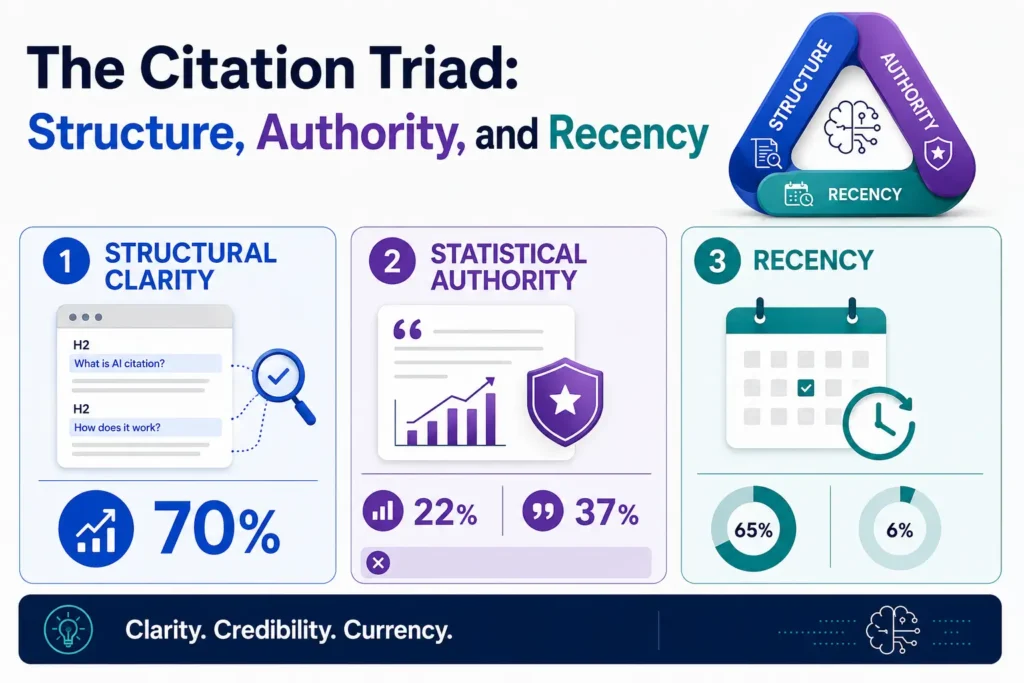
Three factors determine whether an AI engine cites your content.
Structural clarity. The engine needs to find a clean, self-contained answer quickly. Pages with question-based H2s, short paragraphs, and direct opening sentences score higher on extractability. SE Ranking’s 2025 research found that pages with sections of 120–180 words receive 70% more ChatGPT citations than longer, denser sections.
Statistical authority. Named data wins. Princeton GEO Research, cited by Digital Bloom (2025), found that adding statistics to content increases AI visibility by 22%, while verifiable quotations from credible sources boost it by 37%. Vague claims – “many businesses report better results” – get ignored. Specific claims with a named source get cited.
Recency. AI engines filter by freshness. According to Wellows (2025–2026), 65% of AI bot traffic targets content published or updated within the past year, while only 6% cites content older than six years. Freshness is no longer just a Google ranking signal. It’s a citation filter for every major AI platform.
The Anatomy of a Quotable Answer Block
Most content writers think in paragraphs. Writing for AI citation means thinking in extraction units – discrete, standalone chunks of text that function independently of everything around them.
The 40–60 Word Rule
The 40–60 word range matches the extraction length AI engines use for featured snippets and zero-click answers on Google and AI Overviews alike. Blocks shorter than 40 words often lack enough context to stand alone. Blocks longer than 60 words tend to get paraphrased rather than cited directly, which reduces brand attribution.
Every major section needs at least one block that hits this range. Think of it as the citation-ready paragraph – the one that does the heavy lifting so the engine doesn’t have to.
Here’s what the anatomy looks like:
Part 1 – The direct answer. No preamble. No historical context. No “great question.” Just the answer.
Part 2 – One supporting detail or qualifier. A narrow expansion of the answer, or a condition that limits or clarifies it.
Part 3 – Evidence. A stat, a named source, or a specific example. This is what makes the block citable rather than just quotable.
Total: 40–60 words. Self-contained. Plain language. No promotional tone.
Question, Answer, Evidence: The Structure That Works
The most citation-friendly content structure follows a three-part pattern: Question, Answer, Evidence. The H2 or H3 heading poses the question. The first paragraph answers it in one or two sentences. The next sentence (or the same paragraph) provides supporting evidence with a named source.
This structure works because it places a quotable answer immediately after a stable retrieval anchor – the heading. AI engines map headings to the content below them. A question-based H2 followed by a direct answer makes extraction near-mechanical. The engine finds the question, finds the answer, extracts the block.
According to Animalz’s AEO citation research (2025), pages with question-based headings are 2.8x more likely to earn AI citations than pages with descriptive but non-question headings. The difference isn’t a dramatic content overhaul. It’s swapping “Our Approach to GEO” for “How Should You Structure Content for AI Citation?”
Before and After: How to Rewrite Content So AI Engines Actually Cite It
Most content fails the citability test not because it’s bad – but because it delays the answer. Here’s how that rewrite looks in practice.
Topic: What word count should a quotable answer block be?
Before – not citable:
“There are many different schools of thought when it comes to content length and how it affects search engine rankings. Some SEO professionals recommend longer content, while others focus on conciseness. For AI citation purposes, the question of word count becomes even more nuanced because different platforms may have different extraction preferences…”
This is 52 words. It contains no answer, no data, and no extractable claim. An AI engine parsing this passage finds nothing to cite.
After – citation-ready:
“A quotable answer block should be 40–60 words. This matches the extraction length AI engines use for featured snippets and AI Overview citations. Blocks shorter than 40 words often lack enough standalone context. Blocks longer than 60 words get paraphrased rather than cited directly, which reduces brand attribution across platforms like Perplexity and ChatGPT.”
Same approximate length. Now it leads with the answer, backs it with reasoning, and ends with a specific consequence. An AI engine can lift this paragraph without any modification.
The rewrite principle is simple: lead with the answer, not the context. Every section should open with its conclusion and support it afterward. Journalists call this the inverted pyramid. GEO practitioners call it BLUF – Bottom Line Up Front. The terminology differs. The principle is identical. And it’s the single biggest writing shift that improves AI citability without touching your technical SEO.
How Do Different AI Engines Decide What to Cite?
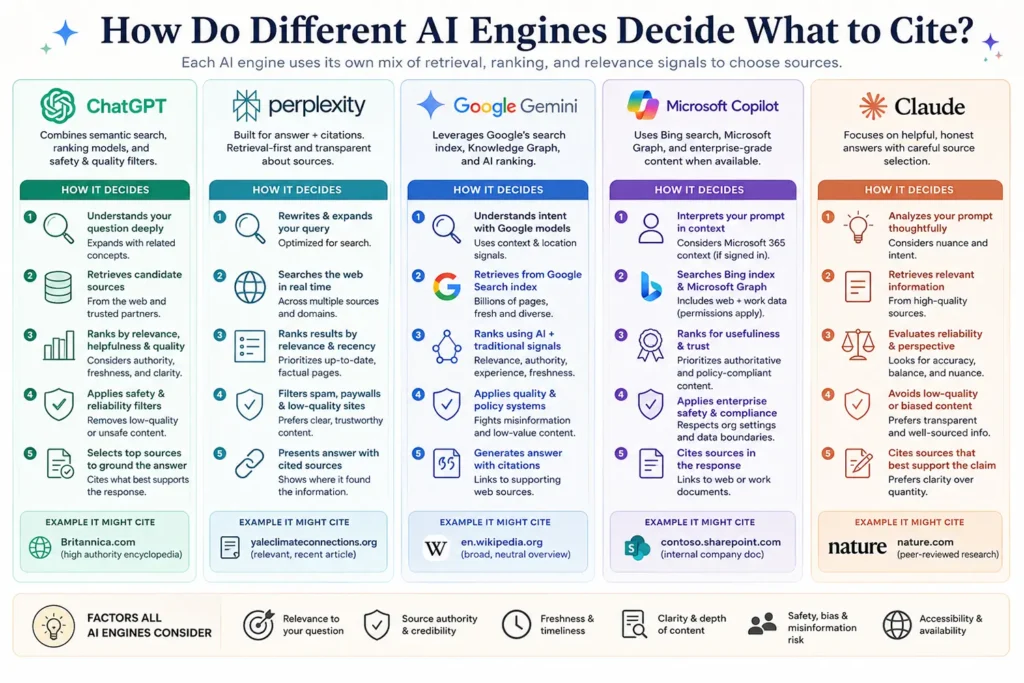
Different platforms extract and cite content in meaningfully different ways. A generic “optimize for AI” approach underperforms compared to platform-aware content. Semrush research (2025) found that citation rates can differ by as much as 615x between platforms like Grok and Claude. That’s not a rounding error – it reflects genuinely different retrieval behavior. Knowing where your audience encounters AI answers changes how you prioritize. Our full guide on how to optimize content for ChatGPT, Perplexity, and Google AI Overviews goes deeper on platform-level tactics beyond the writing mechanics covered here.
ChatGPT (with Search)
ChatGPT favors well-known domains with strong backlink profiles and clean structured content. According to Ahrefs (2025), “Best X” listicles account for 43.8% of all page types cited in ChatGPT responses – a near-majority. Content that answers comparison queries should be structured as numbered or bulleted lists with clear winners and named evidence. ChatGPT also pulls from Reddit and Quora, so encouraging genuine discussion about your brand or content on these platforms expands your citation footprint beyond your own pages.
Perplexity
Perplexity weights pages with visible publication dates, inline source citations, and direct answers placed early in the content. It rewards transparency. Name your sources. Show your date. Write your opening paragraph as if Perplexity’s crawler reads only the first 150 words – because often, it does. According to NAV43’s 2026 AI search content brief analysis, 44.2% of citations come from the first 30% of content, and Perplexity skews even heavier toward introductions than the average.
Google AI Overviews and Gemini
Both platforms tie closely to Google’s own quality signals. Pages that follow E.E.A.T. principles, carry author credentials, and perform well in organic search are the strongest candidates. According to SearchEngineLand’s 2026 analysis, 68% of pages cited in Google AI Overviews use structured data. Article and FAQPage schema are the minimum viable technical requirements for this platform.
Claude
Claude tends to cite pages with clear authorship, factual precision, and well-organized structure. Promotional language and unsupported superlatives reduce citability significantly. Write the key passages of your content as if a sharp-eyed editor will flag every claim that lacks evidence – because the model effectively will.
Microsoft Copilot
Copilot draws from Bing’s index. Standard Bing SEO practices apply: clean metadata, fast load times, and authoritative backlinks. Copilot also pulls from Microsoft 365 contexts, so content published on LinkedIn – particularly long-form articles – has higher surface probability in Copilot responses than on most other platforms. For B2B brands in particular, LinkedIn content is a direct feed into Copilot’s citation pool.
Which Schema Markup Amplifies Your Quotable Blocks?
Well-written quotable blocks get you most of the way. Schema gets you the rest.
Structured data tells AI crawlers exactly where to find your extractable content. It removes the interpretation work the engine would otherwise do to identify which passages are quotable answers versus sidebars, disclaimers, or navigation text.
According to SearchEngineLand’s 2026 analysis, 87.6% of websites still don’t implement structured data correctly. That gap is a direct citation advantage for the sites that do.
FAQPage schema is the most directly useful for citability. It marks up a specific question and its paired answer as a structured unit. AI engines extract these with near-zero ambiguity. Every page with a FAQ section should carry FAQPage schema. Each answer should hit the 40–60 word rule.
Article schema signals that the page is editorial content, not a product listing or advertisement. It also lets you specify the author, publication date, and last-updated date – all of which AI engines use as recency and credibility signals.
Note: Google deprecated the How To schema in January 2026. Remove it from any existing pages where it appears. FAQPage and Article are the schemas that matter most for citation optimization right now.
One additional technical asset worth adding: an llms.txt file at the root of your domain. This machine-readable summary tells AI crawlers what your site covers and how to navigate it. Prometheus Agency reported measurable improvement in AI citations after implementing one. It takes under an hour to set up and signals deliberate AI visibility optimization – which carries increasing weight as competition in this space grows.
Is GEO Separate from SEO?
No. And this is the misconception that costs the most time.
GEO is not a parallel strategy to SEO. It’s an extension of it. The signals Google rewards – clear structure, strong E.E.A.T., specific data, authoritative backlinks, fast load times – are the same signals AI engines use to decide what to cite. The only real additions GEO requires are quotable answer blocks, inline source attribution, and a deliberately neutral tone in key passages.
Fewer than 10% of sources cited in ChatGPT, Gemini, and Copilot rank in the top 10 Google organic results for the same query, according to eMarketer (2025). That statistic often gets misread as proof that SEO and GEO are disconnected. It proves the opposite: ranking well in Google is a necessary but not sufficient condition for AI citation. A page can rank without being cited. A page is very unlikely to get cited without ranking at all. The overlap is imperfect, not nonexistent.
The practical outcome: build your GEO improvements on top of solid SEO foundations. Don’t abandon keyword research, internal linking, or technical optimization. Add quotable answer blocks, update your statistics, and restructure your H2s as questions. Both strategies reinforce each other – and the pages that do both compound their advantage over time. Our guide on why SEO has moved beyond your website covers how these signals work together across the broader search landscape.
A 10-Point Citability Checklist for Every Content Block
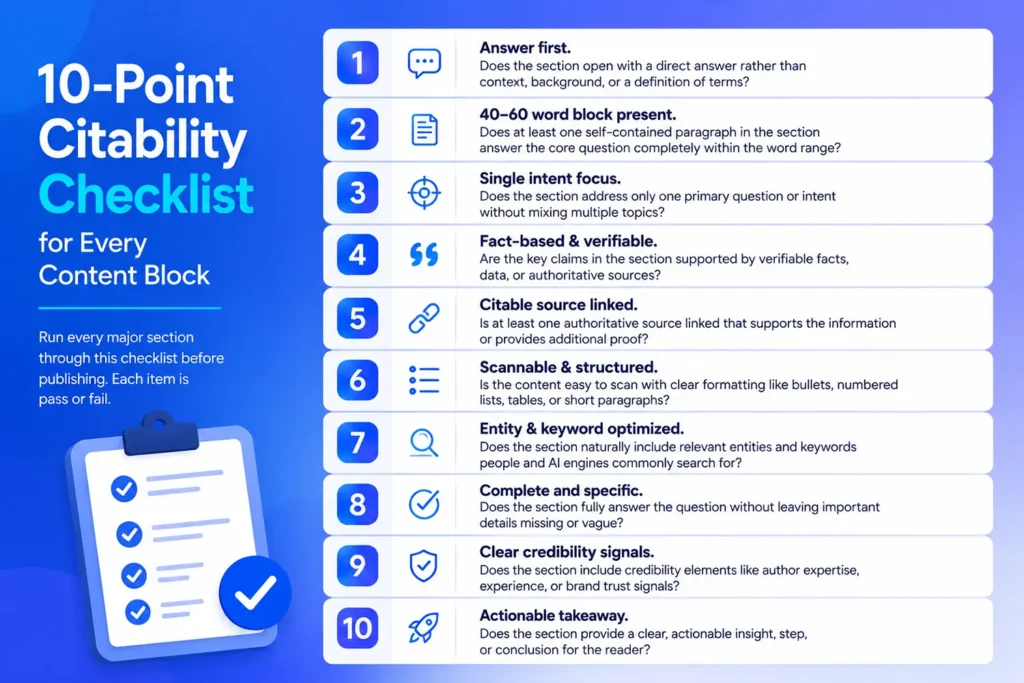
Run every major section through this checklist before publishing. Each item is pass or fail.
1. Answer first. Does the section open with a direct answer rather than context, background, or a definition of terms?
2. 40–60 word block present. Does at least one self-contained paragraph in the section answer the core question completely within the word range?
3. Question-based heading. Is the H2 or H3 phrased as a question that mirrors how a user would query an AI engine?
4. Named source for key claims. Does every significant claim include a named source – not “research shows” but “according to Semrush’s 2025 State of Search report”?
5. Current data. Are all statistics from the past 12–18 months? Stale data reduces citability on recency-weighted platforms like Perplexity.
6. Plain language. Read the section aloud. Does anything sound like a press release, a sales deck, or a compliance notice? Rewrite it.
7. No promotional language. Are there superlatives, buzzwords, or marketing claims in the section? “World-class,” “industry-leading,” and “cutting-edge” reduce AI citability. Replace them with specific evidence.
8. Standalone logic. Can the quotable block be lifted out of the page and understood with zero surrounding context? If not, rewrite it until it can.
9. Author attribution visible. Does the page carry a named author with credentials? Claude and Perplexity both weight authorship as a trust signal.
10. Last-updated date visible. Does the page show a publish or last-updated date? Both Google and AI engines treat undated pages as potentially stale. Make the date visible.
The Compounding Effect of Getting Cited
AI citation is not a one-off win. It builds.
Pages that get cited frequently signal to AI engines that they’re reliable sources on a topic. Engines weight those sources more heavily in future responses, which increases citation frequency, which compounds the authority signal further. The flywheel is real – and it favors the sites that move first.
AI-referred visitors convert at 4.4x the rate of traditional organic traffic, according to Semrush’s June 2025 AI search study. These aren’t casual clicks. They arrive pre-qualified, having already received an AI-curated answer that named your brand as the source. Trust is established before they reach your page.
Start with your highest-traffic pages. Run them through the citability checklist. Add a quotable answer block to every major section. Update any statistics older than 18 months. Add FAQPage schema. Make the author bio visible and specific. A content audit is the fastest way to identify which pages to prioritize. Most pages reach citability standard in a few hours of work.
The marketers who act now build a compounding citation advantage. Everyone else discovers too late that the search landscape already moved.
Frequently Asked Questions
What is the ideal length for a quotable answer block?
A quotable answer block should be 40–60 words. This matches the extraction length AI engines use for featured snippets and AI Overview citations. Blocks shorter than 40 words often lack enough standalone context. Blocks longer than 60 words tend to get paraphrased rather than cited directly, reducing brand attribution.
Do I need separate content strategies for Google SEO and AI citation?
No. The signals Google rewards – clear structure, strong E.E.A.T., specific named data, visible authorship, and fast load times – are the same signals AI engines use to select content for citation. GEO is an extension of solid SEO practice, not a replacement. The main additions are quotable answer blocks, inline source attribution, and a neutral tone in key passages.
Which AI engine is the most important to optimize for?
It depends on your audience. ChatGPT Search drives the highest referral traffic volume. Perplexity dominates research-heavy queries. Google AI Overviews surface in general search. Microsoft Copilot is strongest in B2B and enterprise contexts. A content structure built around the Question, Answer, Evidence pattern performs well across all platforms without platform-specific rewrites.
Does schema markup actually improve AI citation rates?
Yes. According to SearchEngineLand’s 2026 analysis, 68% of pages cited in AI Overviews use structured data. The FAQPage schema and Article schema are the most directly useful for citation optimization. They remove ambiguity for AI crawlers and make it easier to identify which passages are quotable answers rather than navigation or promotional text.
How often should I update content to maintain AI citability?
Aim to review every piece every 6–12 months. Perplexity and other recency-sensitive platforms weight content published or updated within the past year heavily. Update outdated statistics, refresh any deprecated technical recommendations (Google deprecated HowTo schema in January 2026), and keep the last-updated date visible to maintain freshness signals.