Most content that ranks on Google doesn’t get cited by AI. That gap is real, it’s growing, and it matters more than most marketing teams realize. As we covered in SEO has moved beyond your website, AI platforms have become search engines in their own right — and they pull from a completely different pool of sources.
ChatGPT reached 900 million weekly active users as of February 2026, according to OpenAI’s announcement — more than double the 400 million it had in February 2025. Perplexity processed 780 million queries in May 2025 — up 239% from August 2024. Google AI Overviews now appear on approximately 48% of tracked queries as of February 2026, according to BrightEdge. And the overlap between what Google ranks and what AI engines actually cite has dropped from roughly 70% to below 20% in less than two years.
The search game has split. You can keep playing the old one, or you can learn the new one.
This guide covers how each major AI engine selects content, what separates cited pages from invisible ones, and the specific tactics that drive AI citations in 2026.
Table of Contents
What Is Generative Engine Optimization?
Generative Engine Optimization (GEO) is the practice of structuring content so AI engines like ChatGPT, Perplexity, and Google AI Overviews cite it in their answers. It differs from traditional SEO by targeting AI citations rather than ranked link positions. The core tactics are answer-first writing, structured formatting, cited data, and strong E.E.A.T. signals.
The Princeton University and Georgia Tech research team formalized the term at ACM KDD 2024. Their study tested 10,000 queries across 10 search engines and found the top-performing optimization tactics: adding named statistics, citing sources inline, and including direct expert quotations. Traditional keyword stuffing actually underperformed baseline content by 10% in generative contexts.
SEO gets you clicked. GEO gets you quoted. Both matter, and they need different tactics. Not sure where your SEO foundations stand? Start with what is SEO and how it works before layering GEO on top.
Why AI Search Needs Its Own Strategy
Here’s the number that changes how you should think about this: only 11% of domains cited by ChatGPT are also cited by Perplexity for the same query. Google AI Overviews and Google AI Mode cite the same URLs only 13.7% of the time.
Each AI engine has its own source preferences, citation logic, and retrieval method. Optimizing for one platform doesn’t carry over to the others automatically.
There’s also a strong conversion case. AI referral traffic converts at 15.9% from ChatGPT and 10.5% from Perplexity, according to Seer Interactive’s case study covering October 2024 to April 2025 — compared to a 1.76% organic search baseline. Ahrefs found that AI search visitors generated 12.1% of signups despite accounting for only 0.5% of total traffic. Users who click through from an AI answer arrive pre-researched and ready to act.
At the same time, zero-click searches on Google climbed to approximately 69% by 2025, according to Similarweb. Organic CTR on AI Overview queries dropped 61% — from 1.76% to 0.61% — between June 2024 and September 2025, per Seer Interactive’s September 2025 study covering 3,119 queries across 42 organizations. Traditional click traffic is shrinking. AI-referred traffic converts better. The direction is clear.
How Each AI Engine Actually Selects Content
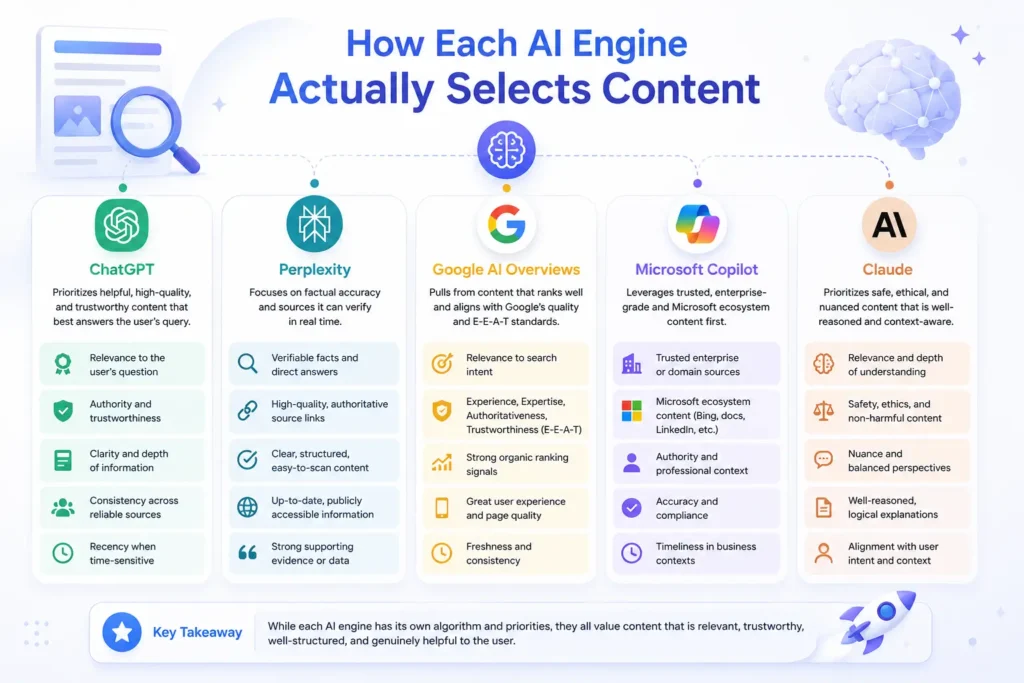
Each platform retrieves content differently. A single strategy won’t work across all three.
ChatGPT: Authority and Entity Signals
ChatGPT uses a hybrid model. For training-based knowledge, it draws on content embedded during model training — meaning domain authority, brand mentions, and cross-platform presence all feed into it. For live search via SearchGPT, it retrieves real-time content and attributes citations.
ChatGPT skews toward authority at scale. Sites present on four or more platforms are 2.8 times more likely to appear in ChatGPT recommendations. YouTube mentions correlate with ChatGPT AI visibility at 0.737 — roughly three times more predictive than traditional backlink authority scores at 0.266, according to Ahrefs’ December 2025 study of 75,000 brands.
One structural detail worth knowing: 44.2% of all large language model citations come from the first 30% of a page’s text, per Growth Memo’s 2026 analysis. Pages with strong, claim-rich introductions get cited 2.1 times more often than pages that bury key points mid-article.
For ChatGPT, prioritize: answer-first introductions, strong entity presence across third-party directories and LinkedIn, brand mentions in YouTube transcripts and news coverage, and allowing OAI-SearchBot in your robots.txt.
Perplexity: Freshness and Citation Density
Perplexity performs real-time web searches for every query and provides mandatory inline citations. Every claim in a Perplexity response links directly to a source. Your content competes on freshness, structure, and citation density — not historical authority.
Content updated within 30 days receives 3.2 times more AI citations than stale content on the same topic, according to Seer Interactive’s analysis of 5,000+ URLs. Perplexity is also the platform where keyword stuffing most visibly hurts. Tests showed over-optimized content underperformed baseline content with no optimization at all.
Perplexity cites brands in approximately 13.05% of responses, compared to ChatGPT’s 0.59%, according to the 5W AI Platform Citation Source Index 2026. Perplexity is the most achievable citation target right now.
For Perplexity, prioritize: visible “last updated” dates, short self-contained paragraphs, specific data points with named sources, FAQ schema markup, and a refresh cycle of at least every 90 days.
Google AI Overviews: Extraction on Top of Rankings
Google AI Overviews layer an AI extraction system on top of Google’s existing ranking signals. Pages that already rank well in organic search have a real foundation here — AI Overviews cite the top 10 organic results 85.79% of the time. If you want a full picture of how AI Overviews fit alongside other SERP features, the 21 types of search results on SERPs guide covers every placement type in detail.
But ranking alone isn’t enough. The page also needs to contain clean, self-contained answer blocks that Google can extract directly without rewriting. Content published within the last two years accounts for 85% of AI Overview citations. Content from 2025 alone accounts for 44%, per Seer Interactive’s freshness study.
For Google AI Overviews, prioritize: strong traditional organic rankings, direct 40-to-60 word answer blocks under question-phrased H2s, FAQPage and HowTo schema, and visible publish or update dates.
7 GEO Tactics That Actually Drive Citations
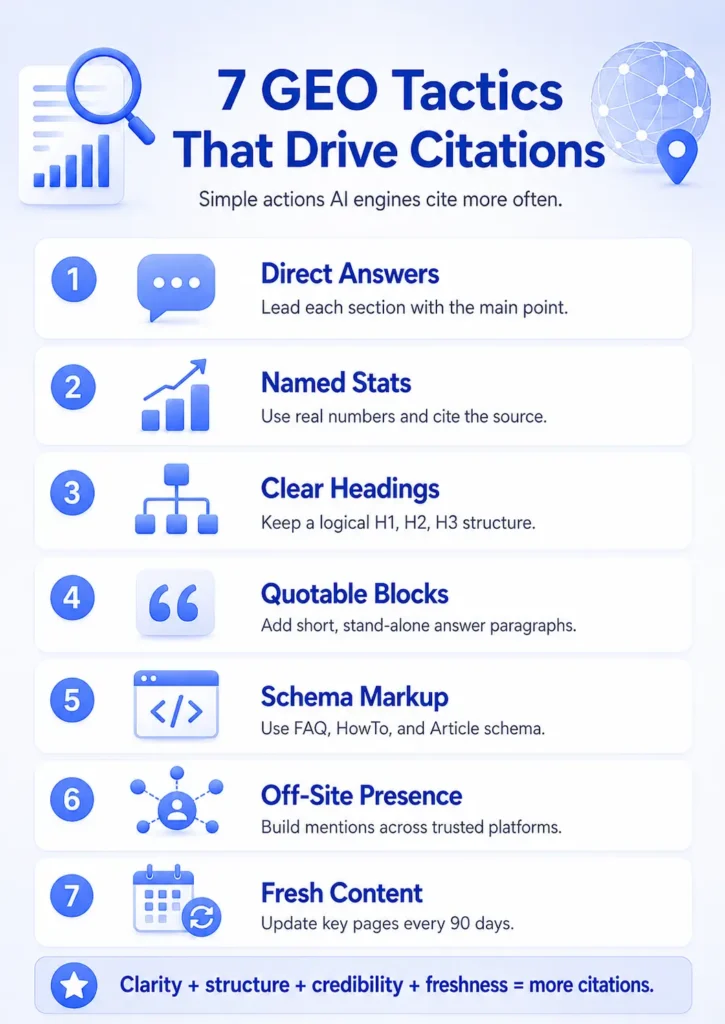
These come from the Princeton/KDD 2024 research, ConvertMate’s 2026 Benchmark Study across 12,500+ queries and 8,000 domains, and Seer Interactive’s real citation pattern analysis.
1. Lead Every Section with a Direct Answer
Put the core point in the first sentence of every major section. Expand with detail after that. The inverted pyramid structure works here — give the AI the answer it needs up front, then support it with context and data.
Pages that front-load key claims get cited 2.1 times more often than pages that build toward a conclusion. This same structure also targets Google featured snippets, which correlate strongly with AI Overview inclusion.
2. Add Named Statistics with Source Attribution
The Princeton GEO research found that adding statistics boosted AI visibility by up to 40%. The critical detail: the statistics need attribution. “Studies show…” doesn’t count. “According to Seer Interactive’s 2025 analysis of 5,000+ URLs…” does.
Aim for at least one cited data point every 150 to 200 words. Use real numbers from real sources — industry reports, academic research, platform announcements, or your own client data. Named sources signal credibility to both AI engines and human readers.
3. Use Clean Heading Hierarchies
Foundation Marketing’s March 2026 analysis found that 68.7% of ChatGPT citations follow logical heading hierarchies — H1 to H2 to H3. Pages with well-structured headings are significantly more parseable by large language models.
Use question-phrased H2s where the content answers a specific query. Keep section headings descriptive and specific. Never skip heading levels. This improves featured snippet targeting and reader navigation at the same time.
4. Write a Quotable Answer Block for Each H2
A quotable answer block is a self-contained paragraph of 40 to 60 words that answers the section’s core question without needing surrounding context. AI engines pull these directly because they’re clean, complete, and extractable.
Write it in a neutral, authoritative tone. No promotional language. No vague claims. The more precisely it answers a specific question, the more likely an AI engine lifts it into a response. This is one of the highest-leverage moves on any existing piece of content.
5. Add FAQPage and HowTo Schema
61% of AI-cited pages use structured data markup, according to Foundation Marketing’s 2026 research. The FAQ schema directly improves Google AI Overview visibility and helps Perplexity extract clean, attributable answers.
Add the FAQPage schema to any section with question-and-answer pairs. Use the HowTo schema for step-by-step processes. Add Article schema with Author entity markup on every blog post. Schema markup improves LLM discoverability by 67%, but it works best combined with strong content quality signals — not as a standalone fix.
6. Build Entity Presence Off-Site
ChatGPT’s pre-training bias means off-site mentions matter as much as on-site optimization for that platform. Brands are 6.5 times more likely to get cited through third-party sources than through their own domains, according to Airops data cited in Growth Memo 2026.
Build your brand’s entity footprint consistently: same name and description across LinkedIn, Google Business Profile, Crunchbase, G2, and relevant industry directories. Earn mentions in YouTube video transcripts, podcast show notes, and news coverage. Every platform where your brand appears teaches AI systems the same description of who you are and what you do. The tactics that build this off-site authority are covered in depth in the off-page SEO best practices guide.
7. Refresh Content Every 90 Days
AI systems that use real-time retrieval weight recency directly. Content updated within 30 days receives 3.2 times more AI citations than stale content, per Seer Interactive. For Perplexity, a recent update date is a direct ranking signal.
Display a visible “last updated” date on all content. Add a “What’s changed in 2026” section to high-value evergreen articles. Replace outdated statistics, update tool references, and revise any claims with a natural expiry date. For competitive informational topics, 90 days is the practical refresh floor. A content audit for SEO is the cleanest way to identify which pages need a refresh first.
What GEO Won’t Do
GEO doesn’t replace traditional SEO. Google AI Overviews still pull from pages that rank well in organic search 85.79% of the time. A technically sound site with strong backlinks, fast load times, and clean on-page signals remains the foundation everything else builds on. The technical SEO best practices guide covers the structural work your site needs before GEO optimization makes sense. And if you want a reminder of what core SEO principles still hold in 2026, the 7 truths about SEO every marketer needs to know is worth revisiting.
The divergence is real, though. A page that ranks #1 on Google has a 33.07% probability of appearing in a ChatGPT citation. But 28.3% of the most-cited ChatGPT pages rank nowhere on Google at all, according to ConvertMate’s 2026 analysis. The signals that drive AI citation and the signals that drive organic ranking are pulling apart — and they’ll keep doing so.
Run both strategies in parallel. Build the SEO foundation. Layer GEO signals on top. Measure them separately.
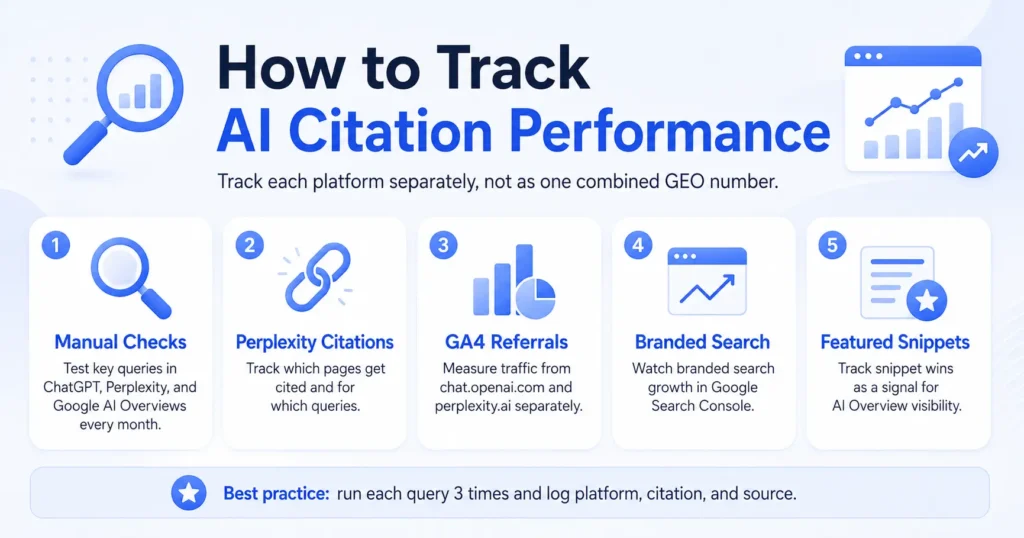
How to Track AI Citation Performance
Most teams still track GEO as one combined number. That’s a mistake, given the 11% overlap between ChatGPT and Perplexity citations for the same query.
Track platform by platform.
Manual citation checks. Run your 20 to 30 most important queries in ChatGPT, Perplexity, and Google AI Overviews. Log which platform cites you, what it says, and which source it attributes. Repeat monthly. Run each query at least three times — AI responses are non-deterministic and vary between sessions.
Perplexity source tracking. Perplexity displays its citations explicitly, making it the most transparent platform to audit. Track which pages get cited and for which queries. This gives you a clear feedback loop for freshness and structure improvements.
GA4 referral traffic. Filter sessions referred from chat.openai.com and perplexity.ai. Track conversion rates from this traffic separately from organic. AI referral sessions typically convert at significantly higher rates — monitor this independently so you can see the true business value.
Branded search in Google Search Console. AI citations often drive branded search rather than direct referral clicks. Growing branded search volume is a downstream indicator of stronger AI visibility, especially from ChatGPT, where many users search the brand name rather than click a citation link.
Featured snippet tracking. Snippet-winning pages frequently appear in Google AI Overviews. Track snippet wins in GSC as a proxy signal for AI Overview inclusion.
Platform-Specific Checklist
Use this before publishing any piece of content.
All platforms
- Direct answer in the first sentence of every major section
- At least one cited statistic every 150–200 words, with a named source
- Clean H1 → H2 → H3 heading hierarchy, no skipped levels
- 40-to-60 word quotable answer block under each H2
- Named author, credentials, and bio on every page
- Visible publish date and “last updated” date in the CMS
- AI crawlers allowed in robots.txt: OAI-SearchBot, PerplexityBot, Google-Extended
- Neutral, authoritative tone in key answer sections — no promotional language
ChatGPT
- Brand entity consistent across LinkedIn, Crunchbase, G2, and Wikipedia where applicable
- Third-party mentions on high-authority sites, YouTube transcripts, and podcast notes
- Clear encyclopedic-style definitions for core concepts
- Content that addresses logical follow-up questions, not just the primary query
Perplexity
- “Last updated” date visible and within 90 days for competitive topics
- Short, self-contained paragraphs — three sentences maximum
- Every factual claim attributed to a named source inline
- FAQPage schema implemented for all question-and-answer sections
- No keyword stuffing — Perplexity penalizes over-optimized copy
Google AI Overviews
- Strong organic rankings in place — AI Overviews pull from the top 10
- FAQPage schema for question-based content
- HowTo schema for step-by-step sections
- Featured snippet targeting: direct answer paragraph under a question-phrased H2
- BreadcrumbList schema where site structure supports it
Frequently Asked Questions
What is generative engine optimization?
Generative Engine Optimization (GEO) is the practice of structuring and writing content so AI platforms like ChatGPT, Perplexity, and Google AI Overviews cite it when answering user queries. Where traditional SEO targets ranked link positions, GEO targets inclusion in AI-generated answers. The term was formalized at KDD 2024 by researchers from Princeton University and Georgia Tech.
Does GEO replace SEO?
No. Google AI Overviews still pull from pages that rank well in organic search 85.79% of the time, so strong traditional SEO remains the foundation. GEO adds answer-first structure, quotable blocks, cited data, and schema markup to make well-ranked content extractable by AI engines. The two strategies work in parallel.
How long does GEO take to show results?
Most sites see initial GEO traction within 8 to 12 weeks of consistent optimization, with measurable citation growth after 4 to 6 months. Perplexity responds fastest to freshness signals. ChatGPT’s pre-training bias means it takes longer to influence through content changes alone — off-site entity building accelerates results on that platform.
Does ChatGPT cite the same content as Perplexity?
Rarely. Only 11% of domains cited by ChatGPT are also cited by Perplexity for the same query. Google AI Overviews and Google AI Mode cite the same URLs only 13.7% of the time. Each platform has different citation logic and source preferences, so platform-specific optimization matters.
What is the best GEO tactic to start with?
Start with FAQ optimization. Identify the 10 to 15 most common questions in your industry, write direct 40-to-60 word answers with FAQPage schema, and cite at least one named data source per answer. This single tactic improves Google AI Overview inclusion, Perplexity citation frequency, and featured snippet wins at the same time.
The Bottom Line on GEO in 2026
Search hasn’t disappeared. It has split. Google still handles the bulk of queries, but AI platforms now shape what people read, trust, and act on before they ever click a link.
The brands getting cited in ChatGPT, Perplexity, and Google AI Overviews right now aren’t necessarily the biggest or the best-funded. Most of them simply structured their content to answer questions directly, cited their sources, kept their pages fresh, and built a consistent entity presence across the web. That’s the entire playbook.
The window is still open. According to the GEO Benchmark Study 2026, 92% of marketers plan to optimize for AI search — but only 40.6% are actually doing it. Citation authority, like domain authority before it, compounds over time. The brands that start now will be harder to displace in 12 months.
Pick one section of your most important page. Rewrite the opening paragraph as a direct 50-word answer. Add a named statistic with a source. Check that the heading is phrased as a question your audience actually types. That’s your first GEO win. Build from there.
The future of SEO for small businesses and the digital marketing roadmap are worth reading alongside this guide if you want the broader strategic picture for 2026.