Guest posting has a reputation problem. Mass-produced articles, paid “write for us” pages and keyword-stuffed bio links gave the whole tactic a bad name, and Google wrote rules specifically about it.
Done properly, guest posting for SEO still works. A good guest post puts your expertise in front of a new audience on a site they already trust, and earns a link that makes sense. This guide covers where Google draws the line, then walks through doing it right, step by step.
Is Guest Posting Still Good for SEO?
Yes, when it’s editorial. Guest posting works when you write useful, original content for a relevant site and its readers. Google treats guest posts with keyword-optimized anchor links, or posts placed in exchange for payment without a sponsored or nofollow tag, as link spam.
The value isn’t only the backlink. A strong guest post brings referral visitors, builds your name in your industry, and adds to the evidence of expertise that feeds E-E-A-T. Treat the link as a bonus on top of those, not the whole point. Guest posting is one part of a wider off-page SEO plan, alongside reviews, mentions and digital PR.
What Do Google’s Spam Policies Say About Guest Posting?
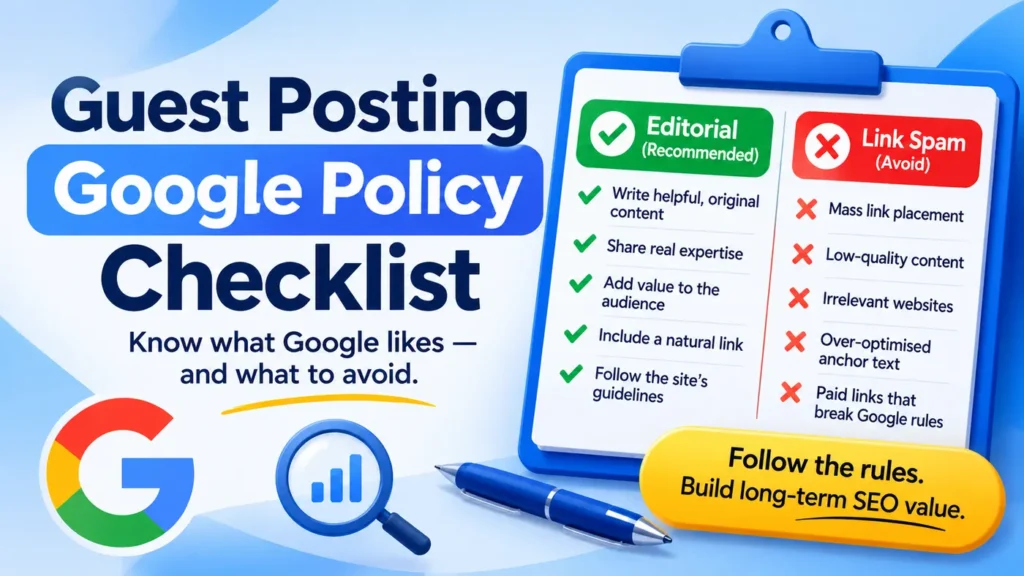
Google’s spam policies don’t ban guest posting. They list “links with optimized anchor text in articles, guest posts, or press releases distributed on other sites” as link spam, along with paying for posts that contain links passing ranking credit. A useful article written for the host’s readers, with a natural or branded link, stays on the right side.
The link spam list in Google’s spam policies also names:
- Money, goods or services traded for links, or for posts that contain links.
- Excessive link exchanges, the “link to me and I’ll link to you” kind.
- Low-value content made mainly to manipulate links and rankings.
Money or free products changing hands for a post with a link? Google’s link best practices say to qualify that link with rel="sponsored" or rel="nofollow". The host site adds the tag. Your job is never to ask them to skip it. Our guide to dofollow vs nofollow links explains what each attribute does.
Can Guest Posts Hurt the Site That Publishes Them?
Yes. Google’s site reputation policy targets third-party content published on a host site mainly to borrow that site’s ranking signals. Editorial guest content is fine: Google lists “columns, opinion pieces, articles, and other work of an editorial nature” as consistent with the policy. Original, well-presented work under a clear byline keeps both sites safe.
That’s why good sites have become choosier. The policy applies where third-party content appears on a host site “mainly because of that host’s already-established ranking signals.” In plain terms: content placed on a strong site just to borrow its rankings.
When Google reviews a site, it looks at factors such as:
- Whether the content’s design and formatting match the rest of the host site.
- Whether the quality drops below the host site’s usual standard.
- Whether authorship is clear.
- Whether the same content appears on multiple other sites in identical or near-identical form.
For you as a guest author, that translates into four rules. Write original content, write it for that site, put your name on it, and never publish the same article in several places.
How Do You Do Guest Posting the Right Way?
Do guest posting the right way in six steps. Choose topics where you have real experience, find relevant sites your customers read, pitch each editor individually, write for that site’s audience, place one or two natural links, then track referral visits and links. Relevance and usefulness matter more than any authority score.
Step 1: Know what you can offer
Pick two or three topics where you have real experience: jobs you’ve done, mistakes you’ve fixed, data you hold. Hosts accept posts that teach their readers something they can’t get elsewhere.
Step 2: Find relevant sites
Relevance beats authority scores. A smaller site your customers read is worth more than a big one they never visit. Ways to find them:
- Search Google for
your topic + "write for us"oryour topic + "guest post". - Look at where people in your industry already contribute.
- Check industry associations, local business publications and supplier blogs.
Then vet each site. Does it have real readers, real authors, and content you’d be proud to sit beside? A site that publishes anything on any topic, or sells links openly, is the kind Google’s policies warn about.
Step 3: Pitch individually
Read the site first. Then send a short, personal email with two or three specific post ideas that fit their audience, a line on why you’re qualified, and a link to something you’ve written. Templates sent to hundreds of sites get ignored, and the sites that accept them are usually the ones you don’t want.
Here’s an example template. Swap in your own details:
Subject: Post idea for your readers: fixing slow WordPress checkouts
Hi [Name],
Your recent post on [topic] got me thinking. I’ve [your relevant experience, with a real number], and the same [problems or lessons] come up every time.
A few ideas for your readers:
- Three checkout speed fixes that don’t need a developer
- What a slow checkout costs a small store, with real examples
- A one-page checkout audit checklist
Here’s a recent piece I wrote: [link]. Happy to follow your contributor guidelines.
Thanks,
[Your name]
Step 4: Write for their readers
Match the host’s style, length and formatting, and follow their guidelines. Make the post useful even if a reader never clicks your link. Our guide to how to write SEO-friendly blog posts covers the structure.
Want help finding sites worth writing for? The Rankiwis team runs editorial outreach for small businesses. Contact Rankiwis team for a quick chat.
Step 5: Place your link naturally
One or two links are plenty, and only where they help the reader. Practical guidelines:
| Do | Avoid |
|---|---|
| Link where a reader would want more detail | Links dropped in purely for SEO |
| Use your brand name, the page title, or a natural phrase | Exact-match keyword anchors like “best plumber Chicago” |
| Link to a useful page, such as a guide | Linking only to sales pages |
Accept nofollow or sponsored when the host requires it | Asking hosts to remove required tags |
Google names keyword-optimized anchors in guest posts as link spam, so the anchor choice matters more than the number of links.
Step 6: Track results and repeat
Note each post’s URL and publish date. Check referral visits in GA4, and confirm the link appears over time in the Links report in Google Search Console. Sites that send real visitors deserve a second pitch.
Should You Pay for Guest Posts?
Only if you treat the spend as advertising. Google’s link spam policy covers exchanging money, goods or services for posts that contain links passing ranking credit. A paid placement, whether in cash, free products or services, should carry a rel="sponsored" or rel="nofollow" tag on the link.
Sponsored placements can still be worth it for visibility and referral traffic. Just budget for them as advertising, not link building.
Do Nofollow Guest Post Links Still Help?
Yes, in the ways that matter most for a small business. Visitors still click nofollow links, readers still see your name, and the article still shows your expertise to a new audience. A guest post on a site your customers trust can bring more business through referrals than a followed link on a site nobody reads.
Guest posting also works best alongside links you control. Strong internal linking passes the attention your guest posts earn on to the rest of your site.
What Guest Posting Mistakes Should You Avoid?
The biggest guest posting mistakes are paying for followed links, using exact-match keyword anchors, publishing the same article on several sites, and chasing authority scores instead of relevant readers. Each one either breaks Google’s spam policies or wastes the effort on an audience that will never become a customer.
- Paid followed links. It’s exactly what Google’s link spam policy describes.
- Keyword-stuffed bio links. Use your name or brand instead.
- Spun or reused articles. Identical content across sites is a site reputation red flag.
- Mass pitches to every “write for us” page. Sites that accept anything are the ones Google’s policies warn about.
- No follow-up on results. A post that sends no visitors in three months tells you where not to pitch next.
Frequently Asked Questions
Is guest posting against Google’s guidelines?
No. Google’s spam policies target guest posts with keyword-optimized anchor links and posts placed in exchange for payment with followed links. Original, editorial articles written for a relevant site’s readers, with natural or branded links, are consistent with Google’s guidance and still a sound tactic.
Should I pay for guest posts?
Only if you treat it as advertising. Google’s link spam policy covers exchanging money, goods or services for posts that contain links passing ranking credit. Paid placements should carry a sponsored or nofollow tag. Budget for them as visibility and referral traffic, not as link building.
What anchor text should I use in a guest post?
Use your brand name, the title of the page you’re linking to, or a natural phrase that fits the sentence. Avoid exact-match keyword anchors. Google’s spam policies specifically name links with optimized anchor text in guest posts as an example of link spam.
How many links can I include in a guest post?
One or two is the practical norm, placed where they actually help the reader. Google doesn’t set a number, but a post crammed with links to your own site reads like an advertisement. Many publishers also limit author links in their contributor guidelines.
How do I find guest posting opportunities?
Search your topic plus phrases like “write for us” or “guest post”, look at where people in your industry already contribute, and check associations, local publications and supplier blogs. Prioritize sites your customers actually read over sites with high authority scores alone.
Do nofollow guest post links still help?
Yes. Nofollow links still send visitors, build recognition and show expertise in front of a new audience. For many small businesses, a guest post on a trusted industry site brings more inquiries through referral traffic than a followed link on an unrelated site ever would.
Want links you’d be proud to show Google? Rankiwis helps small businesses earn editorial links and mentions that hold up. Contact Rankiwis team to plan your outreach.