Your Google Business Profile is verified. Your website is live and optimized. Reviews are coming in. Yet local search rankings still aren’t where they should be.
One common and overlooked cause: NAP citations are inconsistent, outdated, or missing from the directories and platforms that search engines actually check.
NAP citations are one of the most foundational elements of local SEO and one of the easiest to let slip. Consistent citations reinforce every other local ranking signal you’re building. Inconsistent ones quietly erode trust with Google, AI engines, and the customers trying to find you.
Here’s what they are, what’s changed in 2026, and exactly what to do about them.
Table of Contents
What Are NAP Citations?
NAP stands for name, address, and phone number. A NAP citation is any online mention of these three pieces of business information, whether in a formal business directory, a local blog post, a news article, or a social media profile.
NAP citations are online mentions of a business’s name, address, and phone number across directories, websites, and other platforms. Search engines use this data to verify that a business is real and located where it claims to be. Inconsistent NAP information sends conflicting signals that erode trust and suppress local search rankings.
In 2026, most local SEO practitioners now refer to NAPW: name, address, phone number, and website URL. The website is considered the fourth essential element of a complete citation because it allows search engines to connect a directory listing directly to your owned domain, strengthening entity verification. A citation that includes your website URL is more complete and more valuable than one that only carries the basic three.
Why Google Uses NAP Data as a Trust Signal
Google’s local algorithm determines rankings through three factors: relevance, distance, and prominence. NAP citations contribute directly to prominence, which reflects how well-known and verified a business is across the web.
When Google encounters a business in local search, it cross-references that business’s information across its own index. The more consistently a business’s name, address, and phone number appear in the same format across credible sources, the higher Google’s confidence that the business is legitimate and accurately located. That confidence translates directly into better local rankings.
According to BrightLocal’s Local Search Ranking Factors research, citations are the sixth most significant ranking factor for Local Pack visibility (the map results block at the top of local searches) and tied as the fourth most important signal for local organic results. Their Business Listings Visibility Study found that business directories account for 31% of local-intent organic search results. Nearly a third of what users see in local searches comes directly from the directories where your citations live.
Every consistent citation is a small verification that your business is what it says it is, where it says it is, and reachable at the number provided. Multiply that across 50 or 100 sources and you have a trust foundation that strengthens everything else in your local SEO strategy.
Structured vs. Unstructured Citations
Not all citations are the same type. Understanding the two main categories matters for building an effective citation profile in 2026.
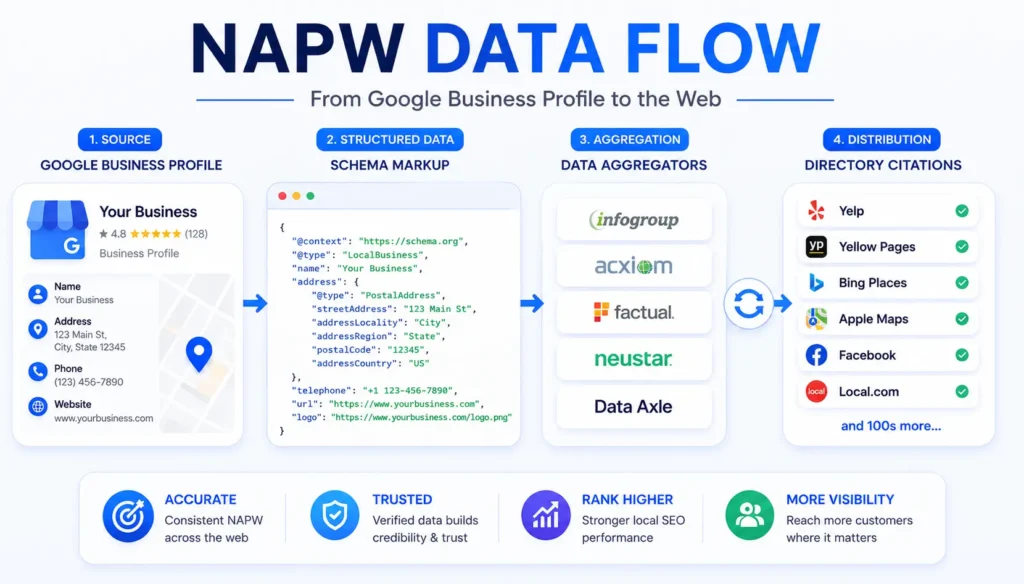
Structured Citations
A structured citation appears in a formal business directory: a platform with dedicated database fields for your business name, address, phone number, website, hours, and category. These are the listings most people picture when they think of local citations.
Core structured citation sources include Google Business Profile, Yelp, Bing Places for Business, Apple Maps, Facebook Business, and Yellow Pages. Industry-specific directories such as Healthgrades for healthcare, Avvo for legal, and OpenTable for restaurants also count as structured citations within their verticals.
Structured citations are machine-readable and propagate widely through data aggregators to partner sites. They form the baseline foundation that every local business needs to cover.
Unstructured Citations
An unstructured citation is an organic mention of your business details in content that doesn’t follow a directory format. A local journalist includes your phone number in an article. A “best plumbers in [city]” roundup blog post lists your address. A community forum recommends your business by name.
These mentions still signal to search engines that your business exists and operates where it claims to. An unstructured citation from a well-read regional news site or a high-authority local publication often carries more weight than a structured listing on a low-quality directory no one visits.
Here’s the 2026 nuance most pages miss: structured citations are now table stakes. Every serious local business already has them. What differentiates citation profiles in competitive markets today is unstructured citations: organic editorial mentions from credible, locally relevant sources. Building those takes genuine community presence, press coverage, and content worth referencing. It can’t be automated.
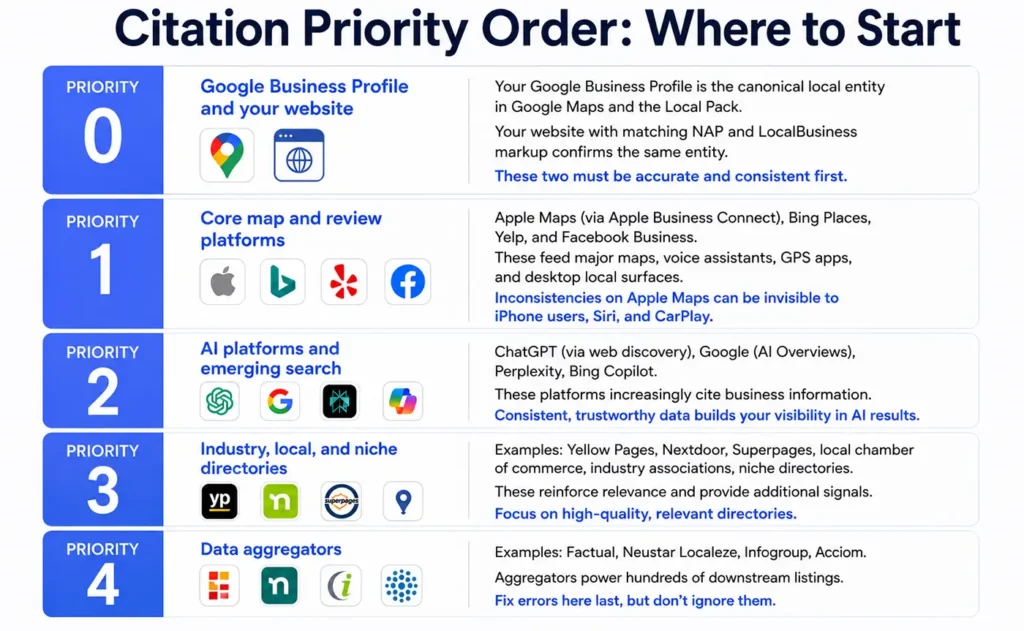
Citation Priority Order: Where to Start
Not all citation sources carry equal weight. Working through them in the right order prevents wasted effort and fixes the highest-impact problems first.
Priority 0: Google Business Profile and your website. Your Google Business Profile is the canonical local entity in Google Maps and the Local Pack. Your website contact page, with matching NAP data and LocalBusiness structured data markup (covered in the next section), confirms the same entity on your owned domain. These two must be accurate and consistent before anything else.
Priority 1: Core map and review platforms. Apple Maps (via Apple Business Connect), Bing Places, Yelp, and Facebook Business. These feed major maps, voice assistants, GPS navigation apps, and desktop local surfaces. A business listed inconsistently on Apple Maps appears incorrectly when someone asks Siri for directions. Fix these early.
Priority 2: Data aggregators. In the US, the main aggregators are Data Axle, Foursquare, and Localeze. These platforms don’t just list your business; they distribute your NAP data to hundreds of downstream directories. Correcting your information at the aggregator level propagates accurate data across a large portion of the web automatically. One fix, many directories updated.
Priority 3: Industry and local directories. Niche directories relevant to your business type (Healthgrades, Zocdoc, TripAdvisor, Avvo, Justia) and local sources (Chamber of Commerce, city business portals, local news listings). These add topical and geographic relevance signals that generic national directories cannot.
Priority 4: General web directories. Lower-authority general directories carry limited differentiation value. Use them sparingly and only when the directory has real user traffic and editorial standards. Skip directories that exist purely to host outbound links.
The Role of Your Google Business Profile
Your Google Business Profile is the most important single citation in your local SEO strategy. It feeds directly into Local Pack results, Google Maps rankings, and Google AI Overviews for local queries.
Your Google Business Profile is the benchmark against which Google compares every other citation it finds. The exact business name, address format, and phone number you use there becomes your canonical NAP. Every other citation must match it precisely.
Lock this down first. Confirm your Google Business Profile is verified, fully completed, and reflects the exact NAP format you want to use everywhere else. Then use it as the reference record for every citation you audit, fix, or build going forward.
NAP data also needs to appear as visible text on your website’s contact page. Search engines read that page. It should show the same name, address, phone number, and website URL that appears on your Google Business Profile.
LocalBusiness Schema: Your NAP’s On-Site Anchor
LocalBusiness schema is structured data markup that you add to your website’s code. It translates your business information into a machine-readable format that search engines and AI engines can parse without ambiguity.
LocalBusiness schema markup on your website closes the loop between your on-site NAP, your Google Business Profile, and your directory citations. When all three sources describe the same business in the same format, search engines gain higher confidence in the entity they’re indexing.
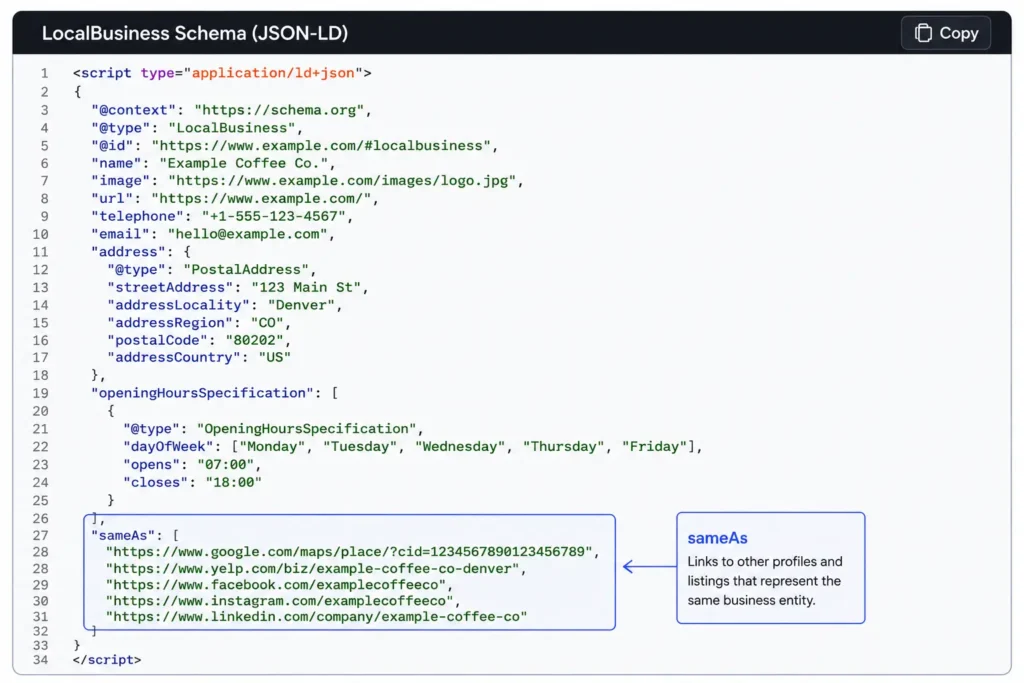
A complete LocalBusiness schema block should include your business name, full address (using the PostalAddress format), phone number, website URL, and business hours. Including a sameAs An attribute that links to your Google Business Profile, Yelp page, and Facebook Business page strengthens entity disambiguation, explicitly telling search engines and AI engines that all of these profiles refer to the same real-world business.
This is an area where almost every competitor page falls short. Schema is part of the citation ecosystem, not separate from it. NAP data in your schema, on your contact page, on your Google Business Profile, and across your top directories must all tell the same story. Any mismatch introduces the same ambiguity as inconsistent directory listings.
How NAP Inconsistency Hurts Your Local Rankings
NAP consistency means your business name, address, and phone number appear in exactly the same format across every citation source. In practice, this breaks down quickly.
A business might be listed as “Joe’s Plumbing” on Google Business Profile, “Joe’s Plumbing LLC” on Yelp, and “Joe Brennan Plumbing” on a local directory. The address might read “45 Oak Ave” in one place and “45 Oak Avenue” in another. The phone number might include the area code in one format and drop it elsewhere.
Each variation creates ambiguity. Google has to decide which version of your information is correct. That ambiguity reduces ranking confidence and can suppress your Local Pack and Google Maps positions. BrightLocal’s Local Search Ranking Factors research confirms that citation signals directly affect competitive positioning in the Local Pack — and every inconsistency actively works against that.
The real-world consequences extend beyond rankings. Customers follow the wrong directions and give up. Calls reach numbers that no longer connect to your business. Someone searches, finds an old address, drives across town, and finds an empty building. Bad citations don’t just cost ranking positions. They cost customers who were already ready to buy.
This is why local SEO strategy always starts with citation accuracy before building new links or content. Rankings built on a clean citation foundation hold up far better than those built on a messy one.
How to Run a Citation Audit (Step by Step)
A citation audit identifies every place your business appears online, verifies the accuracy of that information, and flags inconsistencies that need fixing. For any business operating for more than a year, this is the highest-ROI local SEO task available.
Step 1: Define your canonical NAP. Write down the exact format for your business name, address, phone number, and website URL. This is your reference record. Every citation must match it precisely, including abbreviations (“St” vs “Street”), suite numbers, and area code formatting.
Step 2: Scan for existing citations. Tools like BrightLocal, Moz Local, and Semrush’s Listing Management crawl the web and surface mentions of your business. Run at least one tool-based scan, then spot-check the Priority 0 and Priority 1 sources manually regardless of what the tool reports.
Step 3: Sort findings into three buckets. Correct (exact match to canonical NAP), incorrect (wrong name, address, or phone in any field), and duplicate (the same directory has your business listed more than once with conflicting data).
Step 4: Fix incorrect citations. Claim the listings you don’t control and update them. Some directories process changes within days. Others require a verification process that takes weeks. Work through Priority 0 and Priority 1 sources first before moving to smaller directories.
Step 5: Remove or merge duplicates. Duplicate listings split trust signals and confuse both users and search engines. Contact the directory to request removal of the duplicate entry. If removal isn’t available, mark the duplicate as permanently closed.
Step 6: Document everything. Keep a spreadsheet of every citation source, its status, the login credentials used to manage it, and the date you last checked it. Citation management without records becomes unmanageable within months.
Where to Build New Citations
Once existing citations are clean and consistent, building new ones expands your local authority footprint.
Start at Priority 2: the data aggregators. In the US, Data Axle, Foursquare, and Localeze are the main ones. These aren’t just directories. They’re distribution networks. When your NAP is accurate at the aggregator level, that data flows downstream to hundreds of partner directories automatically. This makes aggregators the most efficient first step in any citation-building campaign.
From there, work through Priority 3: the niche and local sources that carry topical and geographic relevance. A dental practice benefits from Healthgrades and Zocdoc. A restaurant gains from TripAdvisor and OpenTable. A law firm should appear on Avvo and Justia. Your local Chamber of Commerce, city business portal, and community directories add geographic authority that generic national listings cannot provide.
Fifty accurate, well-chosen citations on credible platforms consistently outperform two hundred listings on low-quality directories. Volume without accuracy is counterproductive.
Citation Monitoring: An Ongoing Discipline
A clean citation profile is not a one-time project. Directories update business information without notice. Businesses change addresses or phone numbers and miss listings in the rush. Duplicate entries reappear after being removed.
Citation monitoring means reviewing your listings on a regular cycle to confirm accuracy is maintained. Most citation management tools include monitoring dashboards that flag discrepancies as they appear. A quarterly review of Priority 0 through Priority 2 sources is the baseline for any active local business. Multi-location businesses need monthly monitoring.
This is part of a broader off-page SEO discipline: managing the signals about your business that live outside your own website but directly shape how search engines and AI engines understand and rank you. The same principle applies here as everywhere in local SEO: accurate, consistent, and maintained.
NAP Citations, Entity Verification, and AI Search
NAP citations now serve a second role alongside traditional local rankings: they help AI engines verify your business as a real-world entity.
AI engines like Google AI Overviews, ChatGPT with search, and Perplexity don’t rank pages the way traditional search does. They verify entities. When an AI engine encounters a local business query – it cross-references business information across multiple sources: the Google Business Profile, the website contact page, directory listings, schema markup, and unstructured mentions across the web. Consistent NAP data across these sources increases what researchers call entity confidence: the degree to which an AI engine trusts that the information it holds about a business is accurate and current.
An inconsistent citation profile introduces ambiguity. AI engines, like Google’s local algorithm, default to the most corroborated version of business information when sources conflict. That version may not be yours.
According to an Ahrefs analysis of 863,000 keywords published in March 2026, only 38% of Google AI Overview citations come from pages in the top 10 organic results, down from 76% in a comparable study the previous year. This means content quality and structural clarity now matter more than ranking position for AI citation. A well-structured page with attributed data, clear definitions, and neutral authority can be cited in AI Overviews even without a top-10 ranking.
According to BrightLocal’s 2025 Local Search Ranking Factors research, structured and unstructured citations have a significant impact on AI search visibility for local businesses, and that influence is growing as AI search handles a larger share of local queries.
The practical implication: businesses treating citation management as a legacy tactic are losing visibility in a search landscape that has added new surfaces where accurate, corroborated business data determines whether a business gets recommended.
The Bottom Line
NAP citations tell search engines, AI engines, and the people trying to find you that your business is real, reachable, and operating where it claims to be. Consistency across those citations, in directories, on your website, and in your LocalBusiness schema, turns scattered listings into a single coherent trust signal.
The work is practical: define your canonical NAPW, audit and fix what exists, build citations in priority order, align your schema, and monitor regularly. None of it is glamorous. All of it makes every other local SEO investment more effective.
Frequently Asked Questions
What does NAP stand for in local SEO?
NAP stands for name, address, and phone number. These three pieces of business information form the core of any local citation. In 2026, most local SEO practitioners refer to NAPW, adding the website URL as a fourth essential element. Search engines use NAP data to verify that a business is real, legitimately located at its listed address, and reachable at the number provided.
How many NAP citations does a local business need?
There is no fixed number. For most local businesses, 50 to 100 accurate, consistent citations on credible and relevant platforms is a strong foundation. Quality and accuracy matter more than volume. A smaller number of correct citations on authoritative sources outperforms hundreds of inconsistent listings on low-quality directories that neither users nor search engines trust.
What happens if my NAP information is inconsistent?
Inconsistent NAP data sends conflicting signals to search engines, reducing their confidence in which version of your business information is correct. This can suppress your Local Pack and Google Maps rankings. It also creates practical problems: customers follow wrong directions, calls reach disconnected numbers, and trust is lost before anyone reaches you.
What is the difference between structured and unstructured citations?
A structured citation appears in a formal business directory with dedicated database fields for your business details, such as Yelp or Google Business Profile. An unstructured citation is an organic editorial mention in a news article, blog post, or community forum that includes your business name, address, or phone number. Structured citations form the foundation. Unstructured citations from credible, locally relevant sources are increasingly the differentiator in competitive local markets.
Do NAP citations still matter in 2026?
Yes, and their role has expanded. Citations remain a key factor for traditional local search rankings. They also now function as entity verification data for AI engines. According to BrightLocal’s 2025 Local Search Ranking Factors research, structured and unstructured citations have a significant impact on AI search visibility for local businesses across platforms including Google AI Overviews, ChatGPT, and Perplexity.
What is LocalBusiness schema and how does it relate to NAP citations?
LocalBusiness schema is structured data markup added to your website that translates your business information into machine-readable format. It should include the same name, address, phone number, and website URL as your Google Business Profile and directory listings.
A sameAs attribute linking to your GBP, Yelp, and Facebook pages helps AI engines identify all your profiles as a single entity. When schema, website, and citations all match, you reduce ambiguity and strengthen the entity signals search engines rely on for local rankings.